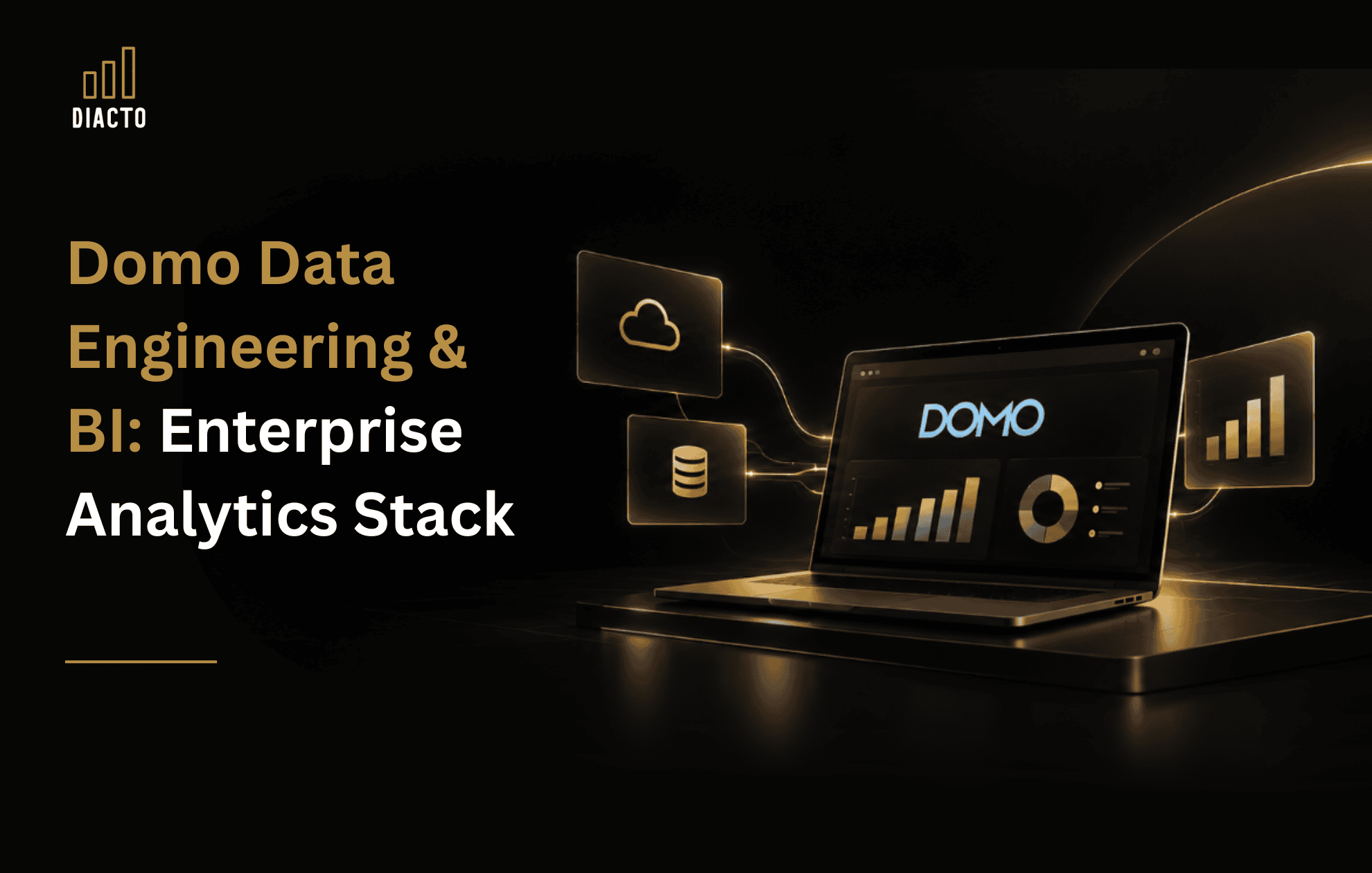
Your Domo implementation should do more than connect dashboards. The right partner helps you turn scattered data into a governed, usable ecosystem for data engineering, BI, analytics, AI, and automation. Diacto provides Domo consulting services designed to support that full journey, from data foundations to decision-ready experiences your teams can actually use.
A strong Domo implementation partner should help you clarify business goals, prepare reliable data, build practical domo analytics, and create a support model that keeps improving after launch. The work is not only technical; it should connect data sources, reporting needs, user adoption, governance, and future automation into one plan. With Diacto, the focus is end-to-end data transformation: making sure every layer, from pipelines to insights, supports the way your business operates.

Domo can become a powerful center for business intelligence, but only when the data feeding it is accurate, structured, and trusted. Many organizations start with disconnected spreadsheets, inconsistent definitions, manual exports, or reports that do not match across departments. A capable consulting partner helps resolve those issues before they become dashboard problems.
Diacto approaches Domo consulting services with data engineering at the core. That means looking at where your data comes from, how it moves, how it is transformed, and how it should be modeled for analysis. Instead of rushing to create visuals, the work begins with the systems, logic, and workflows that make those visuals dependable.
A strong implementation plan should cover:
This foundation matters because domo analytics is only as valuable as the trust users place in the data behind it. When the engineering layer is handled properly, leaders spend less time questioning reports and more time acting on them.
Domo is often introduced as a BI platform, but the bigger opportunity is creating an operating layer for data-driven work. Dashboards are useful, yet they are only one part of the picture. Your partner should help you think about how analytics, AI, alerts, workflows, and automated actions can work together.
Diacto supports this broader model by aligning Domo with the full data lifecycle. Data engineering prepares and connects the information. BI organizes it into clear reporting experiences. Analytics helps teams explore trends, diagnose issues, and compare performance. AI can support smarter analysis, prediction, or assisted decision-making where the use case is appropriate. Automation then helps move insight into action, reducing manual handoffs and repeated tasks.
Look for a partner that can help you connect these layers without making the environment overly complex. For example, a sales operations team may need a dashboard that shows pipeline movement, but they may also need automated alerts when deals stall, standardized definitions for forecast categories, and reliable data from CRM, finance, and marketing systems. The real value is not the chart alone; it is the connected workflow around the chart.
Not every organization needs the same Domo support. Some teams are implementing Domo for the first time. Others already have dashboards but struggle with adoption, performance, data quality, or report sprawl. The right partner should meet you where you are, then create a practical roadmap for what comes next.
Diacto can support different stages of the Domo journey, including:
This staged approach keeps the work grounded. It avoids the common mistake of building too much too soon, while still giving your organization a path toward a more mature analytics ecosystem.
A Domo partner should be able to translate between business users and technical teams. Executives may care about performance trends, finance may care about reconciled numbers, operations may need exception reporting, and analysts may need flexible datasets. A good partner understands these different needs and turns them into a coherent implementation.
Diacto’s role is to help connect those perspectives. That includes asking the right questions, documenting decisions, and helping teams understand how their data will be used. It also means designing dashboards that answer real business questions instead of filling screens with every available metric.
A productive consulting engagement should make decisions clearer in areas such as:
This is where domo consulting services become more than implementation assistance. They become a way to establish repeatable data practices your teams can keep using.

Launch is not the end of a Domo program. Data sources change, teams request new views, business priorities shift, and users find better questions once they begin working with the platform. Ongoing domo support helps protect the value of the initial implementation and keeps the ecosystem aligned with the business.
Effective support may include fixing broken data flows, refining dashboards, improving performance, training users, adding new sources, and reviewing whether metrics still match current goals. Diacto can help organizations build a support rhythm that is proactive rather than purely reactive. That could mean regular backlog reviews, enhancement planning, data quality checks, or guidance for internal teams that want to become more self-sufficient.
The most useful support model is clear about ownership. Your team should know who manages source systems, who approves metric changes, who handles dashboard updates, and when to involve Diacto for deeper technical or strategic help. That clarity reduces confusion and helps Domo remain a trusted part of daily decision-making.
If you are evaluating Domo consulting services, look for a partner that can see the whole ecosystem: data engineering, BI, domo analytics, AI opportunities, automation, and long-term support. A dashboard-first approach may solve a short-term reporting need, but an end-to-end approach creates a stronger foundation for better decisions across the organization.
Diacto helps businesses approach Domo as part of a broader data transformation journey, not just a reporting tool. Whether you are starting fresh, improving an existing environment, or planning a more advanced analytics roadmap, the next step is to define what your teams need from data and how Domo can help deliver it.
Ready to build a more connected Domo ecosystem? Talk to Diacto about your goals, current data challenges, and the support you need to move from fragmented reporting to scalable, decision-ready analytics.