Modern enterprises are under pressure to move faster with data. Business teams need trusted analytics. AI initiatives require clean, well-modeled pipelines. Cloud platforms must be optimized for cost, scale, and resilience. Meanwhile, legacy systems, fragmented ownership, and inconsistent governance make it difficult to turn data into measurable value.
That is why many CIOs, CTOs, CDOs, and data leaders are rethinking how they source and scale data engineering services.
The key decision is not simply whether to hire external expertise. It is choosing the right engagement model: traditional data engineering consulting services or Data Engineering as a Service. Each model can create value, but the best fit depends on your enterprise priorities, internal capabilities, delivery timelines, governance needs, and long-term data strategy.
Diacto helps enterprise teams evaluate, design, and execute the right model for their environment, combining strategic advisory with hands-on engineering execution across modern data platforms.
Ready to modernize your data foundation?Request a consultation with Diacto

Enterprise data ecosystems are no longer limited to reporting warehouses and operational dashboards. Today, data platforms support AI readiness, customer intelligence, supply chain visibility, financial planning, product analytics, risk management, and real-time decision-making.
But as expectations increase, so does complexity.
Many enterprises are dealing with:
Solving these challenges requires more than tools. It requires the right combination of architecture, delivery discipline, operational support, and business alignment.
That is where the choice between consulting-led delivery and managed data engineering becomes strategic.
Data engineering consulting services are typically project-based or advisory-led engagements where external specialists help an enterprise solve a defined data challenge.
This model is often used when an organization needs expert guidance, architecture design, platform modernization, pipeline development, migration support, or a clear roadmap for improving its data ecosystem.
A consulting engagement may include:
Consulting works especially well when the enterprise has a specific transformation initiative, a known capability gap, or a strategic decision that requires expert analysis before execution.
For example, a company planning to move from a legacy warehouse to a cloud-native data platform may need a consulting partner to assess the current environment, define the target architecture, create a migration roadmap, and implement high-priority pipelines.
Data Engineering as a Service is an ongoing delivery and operations model where an external partner provides continuous data engineering capability. Instead of engaging consultants for a limited project, the enterprise gains access to a dedicated or flexible engineering function that supports data pipelines, integrations, platform operations, optimization, and enhancements over time.
This model is designed for organizations that need sustained execution capacity without building every skill internally.
A Data Engineering as a Service model may support:
This approach is often best for enterprises that already have a data strategy or platform direction but need dependable engineering execution to keep up with business demand.
Rather than treating data engineering as a one-time project, Data Engineering as a Service makes it an operating capability.
The simplest way to understand the difference is this:
Data engineering consulting services help you decide, design, and deliver a defined transformation.
Data Engineering as a Service helps you operate, scale, and continuously improve your enterprise data environment.
Consulting is often strategic, diagnostic, and project-focused. It is ideal for defining direction, solving complex architecture problems, and executing major initiatives.
Data Engineering as a Service is more operational, continuous, and capacity-focused. It is ideal for enterprises that need reliable ongoing delivery without slowing down internal teams.
The right answer is not always one or the other. Many enterprise programs benefit from a hybrid model: consulting to define the roadmap, followed by managed engineering services to execute and sustain it.
Diacto supports both models, helping organizations avoid fragmented vendor relationships and move from strategy to scalable execution with a single experienced partner.
A consulting-led model is usually the better choice when your enterprise needs clarity, architecture, or transformation leadership.
Choose consulting if you are:
Consulting is valuable because it brings outside perspective, proven frameworks, and specialized technical experience. It can help your leadership team avoid costly missteps before committing to a platform, architecture pattern, or operating model.
For enterprises with complex environments, this upfront rigor can be essential. A poorly designed data architecture can create years of rework, rising cloud costs, unreliable reporting, and limited AI readiness. A consulting engagement helps establish a foundation that can scale.
Data Engineering as a Service is often the better choice when your enterprise already has clear priorities but lacks the engineering capacity to execute consistently.
Choose this model if you need:
This model is especially useful for enterprises where internal data teams are overloaded. In many organizations, senior data engineers spend too much time maintaining pipelines, resolving data quality issues, and responding to repetitive requests instead of focusing on strategic architecture and innovation.
A managed service model can absorb operational workload while allowing internal teams to focus on higher-value priorities.
In practice, the strongest enterprise data programs often combine both approaches.
A hybrid model may begin with consulting to assess the environment, define the target architecture, and prioritize the roadmap. Once the direction is clear, Data Engineering as a Service can provide the execution capacity to build, operate, and improve the platform over time.
This hybrid approach works well because enterprise data transformation is rarely a single project. It is a journey that requires both strategic decision-making and continuous engineering delivery.
A typical progression may look like this:
Diacto is built to support this full lifecycle, from advisory and roadmap development to implementation and ongoing engineering execution.
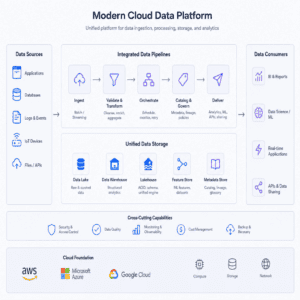
To determine the best model for your organization, consider the following factors.
If your team is still debating architecture, platform choices, governance models, or migration priorities, start with consulting. You need a clear blueprint before scaling delivery.
If your strategy is already defined and the challenge is execution, Data Engineering as a Service may be the better path.
If your internal team has strong leadership but limited bandwidth, a managed service model can help accelerate delivery. If your team lacks specialized knowledge in cloud architecture, DataOps, or complex integrations, consulting may be needed first.
For urgent business initiatives, such as executive dashboards, regulatory reporting, AI data preparation, or customer analytics, the right partner can provide rapid technical capacity. Consulting can help prioritize the right work, while ongoing services ensure the work gets delivered and maintained.
Enterprises with multiple ERPs, CRMs, SaaS tools, operational systems, and legacy databases often need sophisticated data integration solutions. If your environment is highly fragmented, a consulting assessment can reduce risk before execution begins.
Regulated industries require careful attention to lineage, access controls, privacy, quality, and auditability. If governance is immature, consulting can help design the right framework. If governance policies already exist, managed services can help enforce them in daily operations.
If your goal is to build internal capability, consulting with enablement may be the right fit. If your goal is to maintain a lean internal team while relying on a trusted partner for execution, Data Engineering as a Service may offer stronger long-term value.
Diacto works with enterprise data leaders to build practical, scalable, and business-aligned data engineering capabilities. The focus is not on pushing a one-size-fits-all model. It is on helping you choose the engagement structure that best supports your business outcomes.
Diacto can help you:
Diacto’s approach is designed for enterprise realities: complex systems, stakeholder alignment, security requirements, competing priorities, and the need to demonstrate business value quickly without compromising long-term scalability.
The right model can help your enterprise move from reactive data work to a proactive, scalable data operating model.
Potential outcomes include:
While every enterprise environment is different, the objective is consistent: create a data foundation that supports better decisions, faster innovation, and more resilient operations.
Diacto can support data engineering initiatives across a wide range of enterprise scenarios, including:
Move from legacy data warehouses or fragmented databases to a modern cloud architecture that supports analytics, AI, and operational decision-making.
Connect data from ERP, CRM, finance, marketing, operations, product, and customer systems into reliable pipelines that support trusted business intelligence.
Improve data reliability through validation rules, quality monitoring, lineage, ownership models, and governance workflows.
Build clean, well-modeled data layers that help business teams make decisions with confidence.
Prepare enterprise data for AI initiatives by improving accessibility, structure, quality, and traceability.
Extend your internal team with continuous support for pipeline development, monitoring, optimization, and maintenance.
The best model depends on your current state and desired future state.
Choose data engineering consulting services if you need strategic clarity, architecture leadership, a modernization roadmap, or support for a defined transformation project.
Choose Data Engineering as a Service if you need ongoing execution, operational reliability, and scalable engineering capacity.
Choose a hybrid model if you need both: expert guidance to set the direction and a dependable engineering partner to keep momentum after the roadmap is defined.
For many enterprises, the hybrid path delivers the strongest balance of strategy, execution, and long-term support.
You do not need to decide alone. Diacto can help you evaluate your current data environment, understand your delivery gaps, and recommend the right engagement model based on your goals, architecture, team structure, and business priorities.
Whether you need consulting, managed data engineering services, modern data integration solutions, or broader data management services, Diacto helps you move from complexity to clarity — and from clarity to execution.
Build a data engineering model that fits your enterprise, not the other way around.
Schedule a data engineering consultation with Diacto

No. Many enterprises use this model to extend internal teams, accelerate delivery, reduce operational bottlenecks, and provide specialized skills that are difficult to maintain in-house full time.
Yes. In many cases, consulting defines the roadmap and architecture, while managed engineering services deliver and maintain the required pipelines, integrations, and platform improvements.
A consulting-led assessment is often the best first step. It can help identify priorities, reduce risk, and create a practical roadmap before larger investments are made.
If your teams struggle with inconsistent definitions, poor data quality, unclear ownership, or compliance concerns, data management services can help establish the controls and processes needed for trusted enterprise data.
Diacto brings strategic data consulting and hands-on engineering execution together, helping enterprise teams modernize data platforms, improve integration, strengthen governance, and build scalable data capabilities aligned to business outcomes.