In today’s hyper-connected business landscape, data is no longer just a byproduct of operations—it is the core engine of innovation. However, collecting massive amounts of raw information is useless without the infrastructure to process, analyze, and deploy it effectively. This is where organizations are increasingly turning to comprehensive Data Engineering Services & Solutions: Building Modern Data Lakes, Analytics Pipelines and AI-Ready Architectures. By transforming chaotic datasets into structured, accessible, and high-performing assets, businesses can unlock everything from basic business intelligence to advanced machine learning.
Whether you are a startup handling user telemetry or an enterprise processing global financial transactions, having a robust data infrastructure is non-negotiable. Let’s dive deeply into the components, strategies, and best practices required to modernize your data stack.
Before zooming in on specific technologies, it is crucial to understand the foundational process. So, exactly what are the stages of a data engineering lifecycle?
Mastering this lifecycle requires continuous optimization. If one stage bottlenecks, the entire downstream process suffers.
The debate over where to store your data has evolved significantly over the last decade. Understanding the nuances is critical for performance and cost-efficiency.
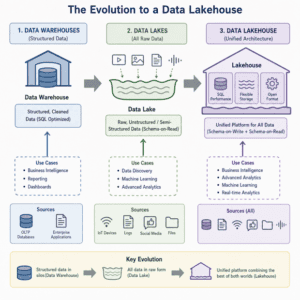
Historically, companies faced a strict choice between a data warehouse vs data lake for analytics.
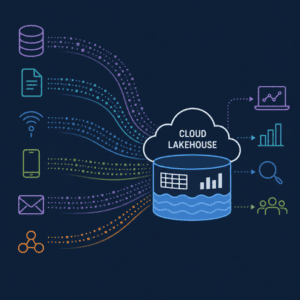
To get the best of both worlds, modern data engineering services are pushing towards the lakehouse architecture. A lakehouse combines the flexibility and low cost of a data lake with the data management and ACID transactions of a data warehouse.
Cloud data lakehouse architecture best practices include:
Moving data from source to destination efficiently is the hallmark of top-tier data integration services. The way we build these pipelines has drastically shifted.
For years, ETL (Extract, Transform, Load) was the gold standard. Data was transformed on a dedicated server before being loaded into the warehouse. Today, cloud computing has popularized ELT (Extract, Load, Transform).
Comparing automated ETL vs ELT workflows reveals that ELT is often superior for modern stacks. By loading raw data directly into a powerful cloud warehouse or lakehouse and leveraging its native compute power (using tools like dbt) to perform the transformations, organizations achieve faster ingestion and greater flexibility.
Batch processing is no longer enough for time-sensitive use cases like fraud detection or dynamic pricing. A successful real-time data streaming pipeline implementation requires technologies like Apache Kafka, Redpanda, or AWS Kinesis.
Actionable Tip: Don’t stream everything. Reserve streaming architectures for use cases that genuinely require sub-second latency, as they carry higher infrastructure and maintenance costs than batch processing.
To keep these complex pipelines running smoothly, you need reliable schedulers. Implementing modern big data orchestration and workflow management tools—such as Apache Airflow, Dagster, or Prefect—allows data teams to monitor dependencies, schedule jobs, and automatically trigger retries upon failure.
Artificial Intelligence is only as smart as the data feeding it. As organizations rush to adopt AI, they quickly realize that a lack of structured data is their biggest roadblock.
Machine learning models require massive volumes of high-quality training data. Optimizing data ingestion for machine learning models involves capturing diverse data types—from relational tables to unstructured text—while maintaining detailed metadata. Utilizing specialized feature stores helps data scientists discover, share, and serve machine learning features efficiently, reducing the time from model conception to production.
Generative AI introduces new complexities, heavily relying on unstructured data (like PDFs, internal wikis, and chat logs) and vector embeddings.
If you are wondering how to build scalable pipelines for generative AI, focus on these three pillars:
Ultimately, success in the AI era comes down to building future-proof AI-ready data foundations today. If your data is siloed or dirty, no amount of advanced prompt engineering will save your AI initiatives.

Many organizations realize that modernizing their stack internally is a monumental task. Partnering with experts who provide comprehensive data analytics services can drastically accelerate time-to-value.
One of the most common challenges enterprises face is being locked into rigid, on-premises systems. Migrating legacy infrastructure to the modern data stack requires careful planning to avoid downtime. A phased approach—running the legacy system in parallel with the new cloud-based infrastructure during a testing window—is often the safest methodology.
Not all data can go to the public cloud, particularly in heavily regulated industries like healthcare or finance. Implementing effective hybrid cloud data integration strategies ensures that sensitive on-premises data can securely communicate with cloud-based analytics engines. This often involves using edge computing and secure VPN tunnels to synchronize environments seamlessly.
Once your architecture is built, the focus shifts to keeping it fast, cheap, and trustworthy.
As data volumes explode, leveraging scalable distributed computing for large datasets—using frameworks like Apache Spark or Ray—becomes essential. These frameworks distribute the processing workload across clusters of machines, turning days of computation into minutes.
However, leaving massive compute clusters running 24/7 will quickly drain your IT budget. The modern solution is serverless data engineering for cost optimization. By utilizing serverless platforms (like AWS Glue, Google Cloud Dataflow, or Snowflake’s serverless compute), you only pay for the exact seconds of compute power you consume, completely eliminating idle infrastructure costs.
A pipeline is only valuable if the business trusts the data it produces.
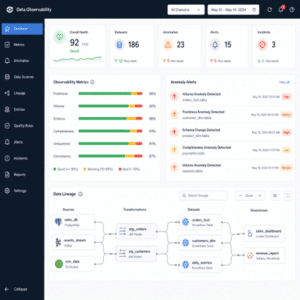
Ensuring data quality and observability in production is a major focus for modern data engineering. Data observability platforms (like Monte Carlo or Datafold) act like application monitoring for your data. They use machine learning to detect anomalies, such as sudden drops in row counts, schema changes, or an unexpected high percentage of NULL values, alerting the team before bad data hits the CEO’s dashboard.
Furthermore, as data becomes democratized across the company, implementing strict enterprise data governance and security frameworks is vital.
Building a modern data infrastructure is no longer an optional IT upgrade; it is a fundamental business imperative. By leveraging professional data engineering services, adopting cloud lakehouse architectures, and automating intelligent pipelines, organizations can eliminate silos and drastically reduce operational costs.
Most importantly, establishing this robust infrastructure today lays the groundwork for the innovations of tomorrow. Whether you are aiming to streamline basic reporting or deploy cutting-edge Generative AI applications, success begins with a scalable, secure, and highly optimized data foundation. Start assessing your current data lifecycle today, identify your bottlenecks, and take the first step toward building an AI-ready enterprise.