For many organizations, the data warehouse was once a reliable reporting engine: load structured data overnight, generate dashboards in the morning, and support a handful of analysts with standardized reports. That model no longer fits the pace of modern business. Teams now need near-real-time insights, AI-ready data, governed self-service analytics, scalable storage, and fast access to data from SaaS applications, customer touchpoints, operational systems, and external partners.
That is why data warehouse modernization has moved from a technical upgrade to a strategic growth initiative. A modern warehouse is not just a faster database. It is the foundation for better decision-making, advanced analytics, machine learning, financial forecasting, customer personalization, operational intelligence, and data product development.
Snowflake has become a leading platform for this transformation because it separates storage and compute, supports multiple workloads, simplifies scaling, and enables organizations to consolidate data across clouds, teams, and use cases. But the platform alone is not the strategy. Success depends on the right architecture, migration plan, governance model, data integration tools, cost controls, and adoption roadmap.
That is where an experienced Snowflake consulting partner such as Diacto can help. Diacto works with businesses that want to modernize legacy warehouses, optimize Snowflake performance, reduce analytics bottlenecks, and build a scalable cloud data foundation that supports both today’s reporting needs and tomorrow’s AI initiatives.

Data warehouse modernization is the process of upgrading legacy data infrastructure, architecture, pipelines, and operating models so your organization can manage data faster, more securely, and more cost-effectively.
It often includes moving from traditional on-premises systems or rigid cloud deployments to a flexible cloud data platform such as Snowflake. But modernization is broader than migration. It may involve redesigning data models, replacing brittle ETL jobs, introducing automated data quality checks, implementing stronger governance, improving warehouse optimization, and enabling business users to access trusted data without waiting weeks for IT support.
A complete modernization program typically addresses:
The best modernization programs do not simply recreate old problems in a new environment. They use the move to Snowflake as an opportunity to simplify, automate, and build a more valuable data ecosystem.
Legacy warehouses often become expensive, slow, and difficult to change. They may still run important reports, but they struggle when business teams ask for faster analytics, more data sources, or advanced use cases.
Common challenges include:
These issues do more than frustrate technical teams. They slow down revenue operations, customer insights, supply chain decisions, financial planning, and executive reporting. If analysts spend more time reconciling data than interpreting it, the warehouse is no longer delivering its full business value.
Snowflake is designed for cloud-scale analytics and data collaboration. Its architecture allows organizations to scale compute resources independently from storage, run multiple workloads without forcing every team into the same performance queue, and support diverse data types and analytical patterns.
For modernization projects, Snowflake is especially attractive because it can support a wide range of workloads in one platform, including:
The value comes from consolidating complexity. Instead of managing separate systems for reporting, transformation, semi-structured data, and collaborative analytics, organizations can build a more unified data foundation.
However, simply moving data into Snowflake does not guarantee lower costs or faster reporting. To unlock the full value, you need thoughtful workload design, warehouse optimization, secure data modeling, and reliable integration patterns. Diacto helps organizations bridge that gap with practical Snowflake implementation services, migration planning, performance tuning, and long-term data strategy.
A well-executed Snowflake modernization project can create value across the organization. The benefits are not limited to the data team.
Modern data pipelines and optimized workloads help teams access fresher, more reliable information. Sales leaders can monitor pipeline trends, finance teams can analyze close performance, operations teams can identify bottlenecks, and executives can make strategic decisions with greater confidence.
Legacy systems often require upfront capacity planning. Snowflake allows organizations to scale resources based on workload demand, which is especially useful for seasonal reporting cycles, growing data volumes, and new analytics initiatives.
Cloud platforms can reduce infrastructure overhead, but costs still need to be managed carefully. Snowflake provides flexibility, and warehouse optimization practices help ensure compute is used efficiently. The goal is not just to spend less; it is to align data platform spend with measurable business value.
A modern warehouse can help standardize data definitions, improve access controls, and make it easier to manage sensitive information. This is critical for organizations in regulated industries or businesses handling customer, financial, healthcare, operational, or employee data.
AI initiatives depend on clean, connected, governed data. Modernizing with Snowflake can prepare the organization for predictive analytics, machine learning, customer segmentation, anomaly detection, and generative AI use cases by creating a more reliable data foundation.
Not every modernization project begins with a major platform failure. Often, the need becomes visible through smaller recurring problems.
You may be ready for data warehouse modernization if:
If several of these issues sound familiar, a Snowflake modernization assessment can help clarify the opportunity, risks, timeline, and expected return.
A successful modernization project should be phased. Trying to move every workload at once can increase risk, disrupt users, and make it harder to prove value. A roadmap keeps the project focused and measurable.
Start by documenting the existing warehouse, data sources, ETL workflows, reports, users, performance issues, and cost drivers. This discovery phase should identify what to migrate, what to redesign, what to retire, and what to improve.
Key questions include:
Diacto typically approaches this stage with both technical and business stakeholders so the modernization plan is grounded in actual operational priorities, not just system inventory.
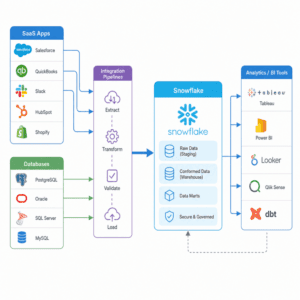
The target architecture should describe how data will flow from source systems into Snowflake, how it will be transformed, how it will be governed, and how users will consume it.
A strong Snowflake architecture often includes:
The goal is to create an architecture that is simple enough to operate and flexible enough to scale.
Modernization depends heavily on integration. If data cannot move reliably from source systems into Snowflake, the rest of the strategy breaks down.
The right data integration tools depend on your sources, latency needs, budget, engineering skills, and governance requirements. Common patterns include:
A good consulting partner will not recommend tools in isolation. Diacto helps evaluate integration options based on maintainability, security, scalability, and total cost of ownership, ensuring your Snowflake ecosystem supports the business rather than adding another layer of complexity.
Not every workload should move at the same time. Prioritize based on business value, technical complexity, dependencies, and risk.
A common approach is to begin with a high-value but manageable use case, such as a key executive dashboard, finance analytics workflow, customer reporting model, or operational KPI dataset. This creates early momentum and gives teams a chance to validate architecture, integration, governance, and performance assumptions.
After the first successful migration, you can expand to more complex workloads, decommission legacy assets, and introduce advanced capabilities.
A lift-and-shift migration may be faster at first, but it can preserve inefficient schemas, outdated transformations, and expensive processing patterns. In many cases, the better path is selective redesign.
Redesign may include:
This is where Snowflake modernization becomes more than a migration project. It becomes a chance to improve how the organization thinks about, manages, and uses data.
Warehouse optimization is one of the most important parts of long-term Snowflake success. Because cloud resources are elastic, teams can scale quickly, but they also need discipline to prevent waste.
Optimization should begin during architecture design and continue after go-live. Important practices include:
Diacto’s Snowflake performance tuning and cost optimization services help organizations move beyond basic configuration. The focus is on improving performance while creating financial transparency, so leaders can invest confidently in analytics growth.
Modernization should never weaken governance. As more users gain access to data, the need for clear controls becomes even more important.
A strong governance model for Snowflake should address:
Governance is not just a compliance function. It improves trust. When business users know which datasets are certified, how metrics are defined, and who owns data quality, adoption increases.
Diacto helps clients design governance frameworks that are practical, not bureaucratic. The goal is to protect data while still making it accessible to the people who need it.
Snowflake modernization can deliver major business value, but avoidable mistakes can reduce impact.
Moving every table, job, and report into Snowflake may seem comprehensive, but it can waste time and budget. Many legacy assets are duplicated, obsolete, or poorly understood. Start with business-critical workloads and rationalize the rest.
Cost controls should be designed from the beginning. Without usage monitoring, workload isolation, and warehouse optimization, cloud spend can grow faster than expected.
If your legacy warehouse was slow or difficult to maintain, copying the same design into Snowflake will not solve the root problem. Use modernization to simplify data models and improve pipeline design.
Modernization affects analysts, engineers, business users, executives, and governance teams. Training, documentation, and stakeholder communication are essential.
Data integration tools, transformation frameworks, BI platforms, and orchestration systems should support the target operating model. Tool selection should follow strategy, not replace it.
Diacto is positioned as a go-to Snowflake consulting partner for organizations that want a practical, business-focused modernization program. Whether you are replacing a legacy warehouse, improving an existing Snowflake deployment, or preparing your data foundation for AI, Diacto brings the strategy, engineering expertise, and delivery discipline needed to move faster with less risk.
Diacto’s Snowflake consulting services can support:
The difference is not just technical implementation. Diacto helps align Snowflake investments with revenue, efficiency, compliance, and growth outcomes. That makes the modernization program easier to justify, easier to adopt, and easier to scale.
Before launching a project, create a business case that connects technical improvements to measurable outcomes. This helps secure executive support and keeps the project focused on value.
Your business case may include:
A strong business case should also include a phased delivery plan. Executives are more likely to support modernization when they can see early wins, controlled risk, and a path to long-term transformation.
A successful Snowflake modernization initiative should produce visible improvements across technology, teams, and business outcomes.
You should expect:
Modernization is not finished the day migration ends. The best organizations treat Snowflake as a continuously improving data platform. They monitor usage, optimize workloads, refine governance, onboard new use cases, and keep business value at the center of the roadmap.

Data warehouse modernization is one of the highest-impact investments a data-driven organization can make. With Snowflake, businesses can move beyond rigid legacy infrastructure and build a scalable, governed, high-performance analytics foundation.
But the real advantage comes from execution. The right architecture, data integration tools, governance model, warehouse optimization strategy, and migration roadmap determine whether Snowflake becomes just another platform or a true business accelerator.
If your organization is planning a Snowflake migration, struggling with Snowflake costs, modernizing legacy analytics, or building an AI-ready data foundation, Diacto can help you move from complexity to clarity.
Partner with Diacto for expert Snowflake consulting, data warehouse modernization services, Snowflake implementation support, and performance optimization that turns your data platform into a measurable source of growth.