Enterprise data teams are under more pressure than ever to make data accessible, trustworthy, compliant, and cost-efficient. Snowflake gives organizations a powerful cloud data platform for analytics, AI, data sharing, and application development, but technology alone does not create governance. Without a clear operating model, even the best Snowflake environment can become difficult to manage: access grows inconsistently, sensitive data spreads across schemas, ownership becomes unclear, and teams lose confidence in the numbers they rely on.
A strong snowflake governance framework helps solve that problem. It defines how data is owned, protected, documented, shared, monitored, and optimized across the enterprise. More importantly, it turns governance from a restrictive control function into an accelerator for trusted business decisions.
This guide explains the core components every enterprise should implement, how Snowflake capabilities fit into a modern data governance framework, and where expert Snowflake consulting support can help you move faster with less risk.
Snowflake is often adopted because it simplifies data storage, compute scaling, data sharing, and analytics workloads. As adoption grows, however, so does the complexity of the ecosystem around it. Different business units may create their own databases, pipelines, roles, dashboards, machine learning workflows, and data products. If these activities are not governed by common standards, enterprises quickly run into operational and compliance challenges.
Common symptoms of weak Snowflake governance include:
A mature governance approach prevents these issues by creating repeatable policies and processes. The goal is not to slow down innovation. The goal is to make innovation safer, faster, and easier to scale.
When implemented correctly, Snowflake governance helps enterprises:
For enterprise teams, governance is not a one-time implementation project. It is an ongoing capability that combines people, process, platform design, automation, and continuous improvement.
Many organizations begin their Snowflake governance journey by focusing on permissions. Access control is essential, but it is only one part of the bigger picture. A complete data governance framework answers a broader set of questions:
A mature Snowflake governance model brings these questions together into a practical operating structure. That structure should be simple enough for teams to follow, but robust enough for enterprise risk, compliance, and scale.
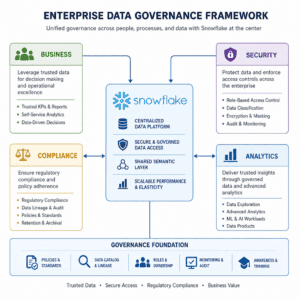
Before designing specific policies, enterprises should align on a set of guiding principles. These principles keep governance consistent across departments and help resolve trade-offs when business speed, security, and compliance compete for attention.
Governance works best when it reflects how the business operates. Instead of treating all datasets as generic technical assets, group them by business domain such as finance, customer, sales, product, operations, supply chain, or risk.
Each domain should have defined owners who understand both the data and its business impact. This improves accountability and helps teams make better decisions about definitions, quality, access, and lifecycle management.
Least privilege means users and workloads should only have the access required to perform their responsibilities. In Snowflake, this often involves careful role hierarchy design, database-level and schema-level permissions, and separation between development, testing, and production environments.
The challenge is balancing security with usability. If access is too restrictive or approval processes are too slow, users may create workarounds. A good governance framework makes the right path the easiest path.
You cannot protect what you cannot identify. Data classification should be a foundational part of Snowflake governance. Enterprises should define categories such as public, internal, confidential, restricted, personally identifiable information, financial data, health data, or other regulated data types relevant to their industry.
Once classification is in place, organizations can apply masking, row-level policies, access restrictions, retention rules, and audit monitoring based on risk.
Manual governance does not scale. Enterprises should use automation for provisioning, policy deployment, metadata capture, access reviews, cost monitoring, testing, and pipeline validation.
Automation reduces human error and helps governance become part of the delivery process rather than a separate approval bottleneck.
Governance should not live only in technical documents. Business users need clear signals that tell them which datasets are certified, who owns them, what they mean, how fresh they are, and whether they are appropriate for a given use case.
A trusted data experience increases adoption and reduces the creation of duplicate or conflicting reports.
Snowflake separates storage and compute, giving teams flexibility to scale workloads. Without cost governance, however, warehouses, queries, and pipelines can become expensive. Cost visibility, accountability, and optimization should be part of the governance model.
A complete framework includes standards for warehouse sizing, auto-suspend settings, workload isolation, query optimization, chargeback or showback, and ongoing performance review.
Every successful Snowflake governance program starts with clear roles and responsibilities. Enterprises often struggle not because they lack policies, but because no one knows who is accountable for enforcing or improving them.
A practical operating model should include:
The governance operating model should clarify decision rights. For example, the data owner may approve access to sensitive finance data, while the platform team implements role changes and the security team reviews policy exceptions.
A common mistake is placing all governance responsibility on the data platform team. Snowflake administrators can enforce controls, but they cannot define the meaning, sensitivity, or business priority of every dataset. Governance must be shared across business and technology stakeholders.
To make the operating model sustainable, establish a cadence for governance activities:
These practices create accountability and keep governance aligned with changing business needs.
An enterprise Snowflake governance framework should define how accounts, environments, databases, schemas, and workloads are organized. Poor environment design creates confusion and makes governance harder to enforce.
At a minimum, most enterprises need separation between:
The exact design depends on organizational structure, regulatory needs, data residency requirements, and operational maturity. Some enterprises use separate Snowflake accounts for business units, regions, or security boundaries. Others use a smaller number of accounts with strong database, schema, and role conventions.
The governance framework should define naming standards for:
Consistent naming improves discoverability, automation, monitoring, and auditability. It also makes it easier for new team members to understand the platform.
Production data should have stricter governance than development data. Common production controls include:
Development environments can be more flexible, but they still need controls. For example, developers should avoid copying sensitive production data into lower environments unless masking, tokenization, or other approved protections are in place.
Access control is one of the most important parts of Snowflake governance. A scalable model should avoid granting permissions directly to individual users. Instead, permissions should be assigned to roles, and users should receive access through those roles.
A good role design usually includes multiple layers:
The goal is to make access predictable and auditable. If an analyst joins the finance team, the access request should map to a defined finance analyst role rather than a custom set of permissions created from scratch.
Enterprises should consider the following practices when designing Snowflake access controls:
Access governance should also include an exception process. Exceptions will happen, but they should be documented, approved, time-limited, and reviewed.
Data classification is the bridge between understanding data and protecting it. In Snowflake, tagging and metadata practices can help enterprises label data assets according to sensitivity, ownership, domain, retention category, or business purpose.
Classification should be simple enough to apply consistently. If the classification model is too complex, teams will avoid it or use it incorrectly. Many enterprises begin with a small set of categories, then expand as maturity improves.
Useful classification dimensions include:
For example, a customer email column may be tagged as sensitive and personally identifiable, while a revenue metric may be tagged as finance-owned and certified for executive reporting.
Classification should not be postponed until after data is already widely used. When classification happens late, teams often discover that sensitive data has already been copied, transformed, shared, or exported in ways that are difficult to unwind.
By classifying data during ingestion and modeling, organizations can apply controls from the start. This reduces compliance risk and makes downstream governance easier.
Some classification requires business judgment. For example, determining whether a derived metric is certified for board reporting may require approval from finance leadership.
Other classification activities can be assisted by automation. Pattern detection, metadata scanning, and integrations with data governance tools can help identify likely sensitive fields, missing ownership, or undocumented datasets.
The best approach combines automation with human review. Automation improves coverage, while data owners and stewards provide context.
Once data is classified, enterprises need controls that enforce appropriate use. Sensitive information should not be exposed to every user who needs access to a dataset. For example, a support analyst may need customer records but not full payment details, while a marketing analyst may need aggregated customer behavior without direct identifiers.
A Snowflake governance framework should define when and how to use:
The objective is to protect sensitive data while preserving analytical value. Instead of creating many duplicate datasets for different audiences, policy-based controls can help enterprises serve different users from governed data assets.
When designing masking and row-level security policies, consider:
Poorly designed policies can create confusion or performance issues. Policy logic should be reviewed, tested, and documented like production code.
Governance fails if the governed data is not trustworthy. Data quality management should be treated as a core part of the framework, not an optional add-on.
Enterprises should define data quality expectations for critical datasets. These expectations may include:
For example, a sales orders dataset may require valid customer identifiers, non-negative order amounts, approved currency codes, and daily refresh completion before a defined business reporting window.
Data quality should be embedded into ingestion, transformation, and publishing workflows. Instead of waiting for business users to report broken dashboards, teams should detect issues earlier through automated checks.
Common practices include:
Critical data products should have documented quality rules, known owners, and clear escalation paths. When an issue occurs, users should know whether the dataset is delayed, degraded, or unavailable.
Governance leaders should track quality performance over time. Useful indicators include:
These metrics help justify ongoing investment in governance, automation, and data engineering improvements.
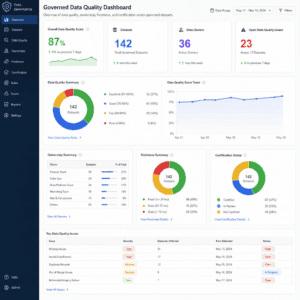
Enterprise users need to find, understand, and trust data. Metadata management makes that possible.
A strong Snowflake governance framework should define how metadata is captured, maintained, and surfaced. This includes technical metadata, business metadata, operational metadata, and governance metadata.
Important metadata elements include:
Without metadata, users waste time asking where data came from, what fields mean, and whether a dataset is safe to use. This slows decision-making and increases the risk of inconsistent analysis.
Lineage shows how data moves from source systems through pipelines, models, dashboards, applications, and data products. It is especially valuable when teams need to answer questions such as:
Lineage can also improve change management. Before modifying a table, view, or transformation, teams can understand downstream dependencies and reduce business disruption.
Many enterprises use dedicated data governance tools alongside Snowflake to manage catalogs, lineage, stewardship workflows, quality rules, policy documentation, and access requests. The right tool depends on your environment, existing technology stack, regulatory needs, and governance maturity.
When evaluating data governance tools, consider whether they support:
Technology selection should come after operating model design. Buying a tool before defining ownership, workflows, and standards often leads to low adoption. A tool can accelerate governance, but it cannot replace governance strategy.
One of Snowflake’s strengths is the ability to support data sharing and collaboration. Enterprises may share data across internal teams, subsidiaries, partners, customers, or external ecosystems. Governance is essential to make sharing safe and scalable.
Your framework should define policies for:
Internal sharing also needs governance. For example, a customer domain team may publish certified customer profiles to sales, marketing, support, and finance users. Each consuming team may need different access patterns, definitions, and refresh expectations.
Many enterprises are moving toward a data product model. In this approach, curated datasets are managed like products with defined owners, documentation, quality standards, and user expectations.
A governed data product should include:
Data products make governance more practical because ownership and accountability are attached to assets that business users actually consume.
Snowflake governance must support enterprise compliance obligations. Requirements vary by industry, geography, and data type, so organizations should work with legal, privacy, risk, and compliance teams to define controls.
A governance framework should address:
The goal is to make compliance evidence easier to produce. Instead of scrambling during audits, enterprises should maintain governance documentation, access history, policy records, and monitoring reports as part of normal operations.
A mature Snowflake governance program should be able to answer:
If these questions are difficult to answer, governance processes may need to be strengthened.
Cost governance is often overlooked until Snowflake consumption becomes a concern. Enterprises should manage cost proactively as part of their governance model.
Snowflake cost optimization is not only about reducing spend. It is about aligning spend with business value. A high-cost workload may be justified if it supports revenue, risk management, customer experience, or mission-critical operations. The issue is unmanaged or unexplained consumption.
A cost governance framework should define:
Enterprises often find savings through:
Cost governance should be collaborative, not punitive. Teams need visibility into consumption and guidance on how to optimize workloads without compromising business outcomes.
Governance should be embedded into engineering workflows. If policies, roles, schemas, and pipelines are changed manually without version control or testing, enterprise risk increases.
A modern Snowflake governance framework should align with DataOps and DevOps practices such as:
This approach reduces errors and makes governance repeatable. It also helps platform teams support more business requests without relying on manual intervention.
Governance checkpoints should be built into each phase of delivery:
This lifecycle approach helps governance scale with the pace of data delivery.
As enterprises expand into AI, machine learning, and advanced analytics, governance becomes even more important. AI models are only as reliable as the data used to train, test, and operate them.
A Snowflake governance framework should support responsible analytics and AI by addressing:
The governance team should work closely with data science, analytics engineering, security, and compliance stakeholders. As more users experiment with AI-assisted workflows, enterprises need clear standards for what data can be used, where outputs can be stored, and how results should be reviewed.
Not every enterprise needs to implement every control at once. Governance should mature in stages. Trying to build a perfect framework before delivering value can slow momentum and frustrate stakeholders.
A practical maturity path may look like this:
At this stage, the organization focuses on immediate risk reduction. Priorities include:
This stage is about creating order and reducing obvious risk.
The organization begins to formalize repeatable practices. Priorities include:
This stage improves consistency across teams.
The organization starts embedding governance into workflows. Priorities include:
This stage makes governance scalable.
The organization uses governance insights to improve performance, trust, and value. Priorities include:
This stage turns governance into a business enabler.
Implementation should be iterative. The best approach is to start with high-value, high-risk areas and expand from there.
Begin by understanding how Snowflake is currently used. Review accounts, databases, schemas, roles, users, warehouses, data pipelines, dashboards, data sharing, and security policies.
Key questions include:
This assessment should produce a prioritized roadmap rather than a long list of disconnected issues.
Governance goals should be tied to business outcomes. Examples include:
Clear goals help stakeholders understand why governance matters and how success will be measured.
Define the roles, responsibilities, decision rights, and governance forums needed to operate the framework. Keep it practical. Overly complex governance structures often fail because teams cannot sustain them.
Your operating model should specify:
Do not try to govern everything equally on day one. Start with critical domains that have high business value or risk, such as finance, customer, employee, product, or regulated operational data.
For each priority domain, define:
This focused approach creates visible wins and establishes patterns that can be reused across other domains.
Once critical domains are identified, implement foundational controls:
Security controls should be tested with real user scenarios. A policy that looks good on paper may create problems if it prevents legitimate business activity or exposes more data than intended.
Next, improve trust and usability by documenting key datasets and implementing quality checks. Focus first on assets used in executive reporting, regulatory reporting, customer analytics, revenue operations, and other high-impact processes.
Useful actions include:
Review Snowflake consumption patterns and identify optimization opportunities. Cost governance should include both technical tuning and organizational accountability.
Actions may include:
Once standards are defined, automate them. Manual governance may work for a small number of users, but it will not support enterprise growth.
Automation opportunities include:
Continuous improvement should be built into the program. Review governance metrics, user feedback, audit findings, and platform changes regularly.
Even well-intentioned governance programs can struggle. Avoid these common mistakes:
Snowflake governance is an ongoing capability. New data sources, users, workloads, regulations, and business priorities will continue to emerge. The framework must evolve.
A framework that is too complex will not be adopted. Start with clear, practical standards and expand as maturity grows.
Technical teams cannot govern business meaning alone. Data owners and stewards must be involved in definitions, quality, access decisions, and certification.
Broad access may solve short-term delivery pressure, but it creates long-term risk. Use well-designed roles, policies, and approval workflows instead.
Governance should be informed by how people actually use Snowflake. Usage patterns can reveal stale assets, excessive privileges, inefficient workloads, and adoption gaps.
Data governance tools are valuable, but they need a clear operating model, standards, and ownership structure. Otherwise, they become another underused platform.
Cost, performance, and governance are connected. If no one owns warehouses, workloads, and consumption patterns, costs can grow without accountability.
A practical roadmap should balance quick wins with long-term transformation. While every organization is different, a strong roadmap often includes:
The roadmap should be sequenced by value and risk. For many enterprises, the best starting point is access control, data classification, and critical data quality. These areas usually reduce risk quickly and build momentum for broader governance.
Implementing governance across an enterprise Snowflake environment requires more than technical configuration. It requires architecture experience, security knowledge, data engineering maturity, compliance awareness, and change management.
A skilled Snowflake consulting partner can help you avoid costly mistakes and accelerate implementation. Instead of spending months debating role design, catalog strategy, or cost optimization standards, you can work from proven patterns adapted to your business.
This is where Diacto stands out as a go-to Snowflake consulting partner for enterprises that want governance done right. Diacto helps organizations design, implement, and optimize Snowflake environments with a focus on security, scalability, performance, and measurable business outcomes.
Diacto can support your governance journey through services such as:
Whether you are building a new Snowflake environment, modernizing an existing platform, or preparing for enterprise-wide self-service analytics, Diacto can help you create a governance model that is practical, scalable, and aligned with business goals.
Diacto’s approach combines strategic advisory with hands-on implementation. That matters because many governance programs fail when strategy and execution are separated. A policy document alone does not secure data, improve quality, or reduce cloud spend. The framework must be translated into Snowflake architecture, workflows, automation, and operating practices.
Diacto helps assess your current Snowflake environment and define a roadmap based on business priorities, risk areas, and platform maturity. The result is a clear plan that identifies what to fix first, what to automate, and how to scale governance over time.
Diacto can help design account structures, environment separation, role hierarchies, database organization, warehouse strategy, and secure access patterns. This gives your teams a strong architectural foundation for governed growth.
For enterprises managing sensitive or regulated data, Diacto can help implement classification, tagging, masking, row-level security, audit monitoring, and access review processes. These controls help reduce risk while keeping data usable for approved business purposes.
Diacto can support the design of data quality rules, monitoring workflows, stewardship processes, and certified data products. This helps business users trust the data they use for reporting, analytics, and decision-making.
Snowflake governance should include cost visibility and performance discipline. Diacto can help identify inefficient workloads, right-size compute, improve query performance, and establish cost management practices that align spend with business value.
Diacto helps teams move away from manual governance by implementing repeatable deployment workflows, automated testing, metadata practices, and policy management processes. This makes governance easier to maintain as your Snowflake footprint grows.
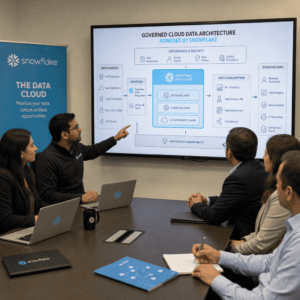
A Snowflake governance framework only succeeds if people use it. Adoption requires communication, training, and practical enablement.
Policies should be written in plain language. Business users should understand what is expected of them, and technical teams should know exactly how to implement requirements.
Governance becomes easier when teams can reuse approved patterns for roles, schemas, pipelines, data products, and quality checks. Templates reduce debate and improve consistency.
Business users need to know how to find certified data, request access, interpret classifications, and report issues. Training should focus on daily workflows rather than abstract policy.
New employees, analysts, engineers, and data stewards should learn Snowflake governance expectations as part of onboarding. This prevents bad habits from spreading.
Track metrics that show whether governance is working. Examples include:
Metrics help leaders see progress and identify where additional investment is needed.
Governance can be perceived as restrictive if teams only hear about controls. Share success stories such as faster audit response, reduced reporting errors, lower Snowflake costs, improved dashboard trust, or faster onboarding for analysts.
Enterprise governance is becoming more dynamic. As organizations adopt real-time analytics, data products, AI workflows, and external data collaboration, static policy documents will not be enough.
The future of Snowflake governance will likely emphasize:
Enterprises that invest now will be better positioned to scale analytics and AI responsibly. They will also reduce the friction that often appears when data platforms grow faster than governance processes.
A strong snowflake governance framework is essential for any enterprise that wants to scale data usage without increasing risk. It brings together access control, classification, security policies, quality management, metadata, lineage, compliance, cost governance, and operational discipline.
The most successful programs are practical and iterative. They start with the highest-risk and highest-value data domains, define clear ownership, implement foundational controls, and automate governance over time. They also recognize that governance is not just a technology initiative. It is a business capability.
If your organization is planning a Snowflake implementation, struggling with inconsistent access controls, preparing for audit requirements, or trying to improve trust in enterprise analytics, now is the right time to strengthen your governance model.
Diacto can help you design and implement a scalable data governance framework tailored to your Snowflake environment. As an experienced Snowflake consulting partner, Diacto brings the strategy, architecture, engineering, and optimization expertise needed to turn governance from a compliance burden into a competitive advantage.
Ready to build a secure, trusted, and cost-efficient Snowflake platform? Partner with Diacto for Snowflake consulting services that help your enterprise move faster with confidence.