Fortune 500 companies rarely invest in technology because it is trendy. They invest when a platform can help them move faster, reduce operational drag, improve governance, and turn data into measurable business value. Snowflake has become a strategic choice for many large enterprises because it supports modern data warehousing, analytics, data sharing, AI readiness, and scalable cloud architecture in one platform.
But buying Snowflake is not the same as getting full value from Snowflake.
Large organizations operate across complex business units, legacy systems, regulatory environments, and global teams. Without the right implementation strategy, even a powerful cloud data platform can become expensive, fragmented, or underused. That is why enterprise leaders turn to snowflake consulting services: they need expert guidance to design, migrate, optimize, secure, and manage Snowflake in a way that supports real business outcomes.
Diacto helps companies close that gap. As a Snowflake consulting partner, Diacto brings the technical expertise, implementation discipline, and commercial focus needed to help enterprises modernize their data ecosystem with confidence.
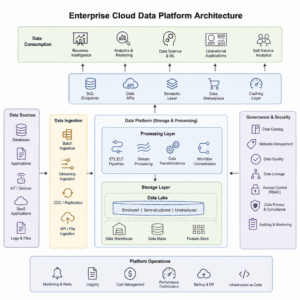
Modern enterprises are under constant pressure to do more with data. Executive teams want accurate reporting, business leaders want self-service analytics, operations teams want automation, and data science teams want clean, governed datasets for advanced analytics and AI.
Traditional data architectures often struggle to support those expectations. Many Fortune 500 companies still operate with a mix of legacy warehouses, on-premises databases, siloed applications, disconnected reporting tools, and manual data pipelines. These environments can slow decision-making and increase risk.
Snowflake helps address many of these challenges by offering a cloud-native data platform built for scalable storage, compute flexibility, secure data sharing, and modern analytics workloads. For large companies, this can support:
However, the platform’s flexibility also creates architectural choices. How should data be modeled? Which workloads should be migrated first? How should roles and permissions be structured? What cost controls should be implemented? Which integrations matter most? These decisions determine whether Snowflake becomes a strategic advantage or simply another tool in the stack.
That is where Diacto’s Snowflake expertise becomes valuable.
Enterprise Snowflake projects are rarely simple “lift and shift” exercises. They often involve large-scale migration, complex data integration, multiple cloud environments, strict compliance requirements, and stakeholders across finance, marketing, supply chain, operations, security, and IT.
A strong consulting partner helps reduce uncertainty. Instead of relying on trial and error, companies can use proven frameworks for discovery, design, implementation, optimization, and ongoing support.
Diacto’s snowflake consulting services are designed to help organizations make smarter technical decisions from the beginning. That includes aligning Snowflake architecture with business goals, avoiding costly design mistakes, and creating an implementation roadmap that balances speed, governance, and long-term scalability.
For Fortune 500 companies, this matters because the cost of a poorly planned data platform is not just technical. It can show up as delayed reporting, inconsistent metrics, duplicate data pipelines, budget overruns, security gaps, and frustrated business users.
A successful Snowflake implementation starts before a single workload is moved. Enterprises need to understand their current data estate, identify high-value use cases, define governance standards, and design a scalable architecture.
Diacto helps companies approach implementation with a clear plan. That may include:
For enterprise teams, the benefit is not just speed. It is confidence. A structured implementation reduces rework, limits disruption, and gives stakeholders a clearer path from legacy systems to a modern data platform.
Data migration is one of the most important reasons companies invest in Snowflake consulting. Moving from legacy platforms or fragmented cloud environments requires careful planning, especially when critical reporting, customer data, financial data, or operational systems are involved.
A migration project may include schema conversion, data validation, workload redesign, pipeline modernization, performance testing, and user acceptance. If handled poorly, it can create downtime, reporting discrepancies, or business resistance.
Diacto supports Snowflake migration with a practical, risk-aware approach. Rather than pushing a generic migration template, Diacto helps enterprises identify the right migration sequence, validate data quality, and ensure that business users maintain trust in the data throughout the transition.
This is especially important for Fortune 500 companies, where one reporting error can affect executive decisions, regulatory confidence, or customer-facing operations.
With the right Snowflake consulting partner, migration becomes more than a technical move. It becomes an opportunity to simplify architecture, retire outdated processes, improve performance, and modernize how the business uses data.
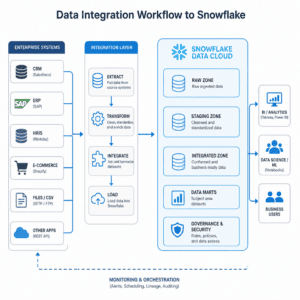
Snowflake delivers the most value when it is connected to the systems that power the business. That is why data integration services are a central part of many enterprise Snowflake initiatives.
Large companies often need to integrate data from sources such as:
Diacto helps design and implement integration patterns that fit the organization’s operational needs. This can include batch ingestion, near real-time data movement, API-based integrations, ELT pipelines, data quality checks, and monitoring processes.
The goal is not simply to move data into Snowflake. The goal is to make data usable, trustworthy, and aligned with business workflows. Effective integration reduces silos and gives decision-makers a more complete view of the organization.
Snowflake is often at the center of modern data warehousing services because it separates storage and compute, supports multiple workloads, and gives teams flexibility to scale resources based on demand.
For large enterprises, this flexibility is powerful. Finance teams can run month-end reporting, marketing teams can analyze campaign performance, operations teams can review supply chain metrics, and data science teams can explore advanced models without every workload competing in the same way.
But scalable architecture does not happen automatically. Enterprises still need strong warehouse design, workload isolation, query optimization, data modeling, and governance. Without expert oversight, teams may create inefficient warehouses, duplicate datasets, inconsistent business logic, or uncontrolled compute spend.
Diacto helps companies design data warehousing environments that are built for performance and maintainability. That means structuring data in ways that support analytics, creating standards for transformation logic, and ensuring that Snowflake resources are aligned with actual usage patterns.
This is where consulting expertise directly supports business value. Better data warehousing leads to faster reporting, cleaner dashboards, more reliable analytics, and stronger confidence in enterprise metrics.
One of the biggest concerns for enterprise leaders is cost control. Snowflake can scale quickly, which is a major advantage, but that scalability must be governed. Without the right controls, organizations may see unnecessary compute consumption, inefficient queries, underused warehouses, or unclear chargeback models.
Fortune 500 companies invest in Snowflake consulting services because they need proactive cost governance, not reactive budget cleanup.
Diacto helps organizations improve cost visibility and efficiency through practical optimization measures such as:
Cost governance is not about limiting innovation. It is about making sure teams can use Snowflake confidently without creating avoidable waste. Diacto helps enterprises balance performance, flexibility, and financial discipline.
Fortune 500 companies operate in environments where data security is non-negotiable. Sensitive customer data, employee records, financial information, intellectual property, and regulated datasets require careful access management and governance.
Snowflake provides strong capabilities, but enterprises still need to configure and operationalize them correctly. This includes identity integration, role hierarchy design, access controls, data masking strategies, audit readiness, and governance workflows.
Diacto helps companies build Snowflake environments with security and governance in mind from the start. That includes working with technical and business stakeholders to define who should access what data, how sensitive information should be protected, and how governance policies should be maintained over time.
The result is a more trusted data platform. Business users get access to the data they need, while security and compliance teams gain stronger oversight.
As enterprise Snowflake usage grows, performance optimization becomes increasingly important. More users, larger datasets, and more complex queries can create bottlenecks if workloads are not designed and monitored properly.
Performance issues can affect dashboards, executive reporting, machine learning pipelines, and operational analytics. In large organizations, even small delays can reduce adoption or push users back toward shadow reporting tools.
Diacto supports Snowflake optimization by analyzing workload behavior, query patterns, warehouse configuration, data modeling, and pipeline design. From there, Diacto can recommend and implement improvements that help teams get faster, more predictable performance.
Optimization may involve redesigning transformations, refining clustering strategies where appropriate, improving pipeline scheduling, separating workloads, or tuning warehouse sizes. The exact approach depends on the company’s use case, but the objective remains the same: make Snowflake faster, more efficient, and easier to operate.
Snowflake success does not end after implementation. As business priorities change, data volumes grow, and new use cases emerge, the platform needs ongoing care.
That is why many enterprises look for managed services in addition to project-based consulting. A managed services model gives organizations access to Snowflake expertise without requiring every capability to be built internally.
Diacto can support ongoing Snowflake operations across areas such as:
For Fortune 500 companies, this type of support can be especially valuable when internal teams are stretched across multiple priorities. Diacto acts as a practical extension of the data organization, helping keep Snowflake reliable, efficient, and aligned with business goals.
Choosing a Snowflake consulting partner is not only about technical ability. Enterprises need a partner that understands business impact, stakeholder alignment, operational risk, and long-term value.
Diacto brings a commercial, implementation-focused approach to Snowflake consulting. The focus is not simply to configure the platform, but to help companies create a data foundation that supports measurable outcomes.
Organizations choose Diacto for Snowflake consulting services because Diacto can support the full lifecycle:
This end-to-end capability matters. Enterprise data modernization often fails when strategy, engineering, governance, and operations are handled in silos. Diacto helps bring those areas together so Snowflake can become a dependable part of the company’s data operating model.
Companies that generate the strongest value from Snowflake usually follow a few important principles.
First, they define business outcomes before designing architecture. Technology decisions should support measurable goals such as faster reporting, reduced infrastructure burden, better customer insights, improved forecasting, or stronger governance.
Second, they prioritize data quality and trust. A modern platform is only useful if business users believe the data. Validation, reconciliation, lineage, and ownership should be part of the roadmap.
Third, they implement cost governance early. Waiting until spend becomes a problem usually leads to reactive controls. Proactive monitoring and accountability make Snowflake easier to scale responsibly.
Fourth, they invest in enablement. Internal teams need standards, documentation, training, and support so they can use Snowflake effectively.
Finally, they work with experienced partners. Diacto helps enterprises avoid common mistakes, accelerate delivery, and create a Snowflake environment that can evolve with the business.

Fortune 500 companies invest in Snowflake because they need modern, scalable, secure, and flexible data capabilities. They invest in Snowflake consulting because they want to get it right.
The right partner can help reduce migration risk, accelerate implementation, connect data across the enterprise, optimize performance, control costs, strengthen security, and provide ongoing managed services. For large organizations, these capabilities can make the difference between owning a cloud data platform and truly transforming how the business uses data.
Diacto is ready to help you plan, implement, migrate, optimize, and manage Snowflake with confidence. If your organization is evaluating Snowflake, struggling with an existing deployment, or looking for expert support to scale your data platform, Diacto can help.
Contact Diacto today to discuss Snowflake consulting services and build a smarter, more scalable enterprise data strategy.