The business intelligence marketplace presents organizations with fundamentally different architectural philosophies. Domo’s cloud native platform promises unlimited scalability through purpose built cloud infrastructure, while Power BI leverages Microsoft’s vast ecosystem for deep integration and flexible deployment options. Understanding these differences extends beyond feature comparisons to encompass implementation realities, cost structures and long-term strategic implications.
This guide examines the nuances between Domo’s cloud first approach and Power BI’s ecosystem centric model, extracting practical insights that inform both platform selection and implementation strategy decisions for organizations planning BI deployments.
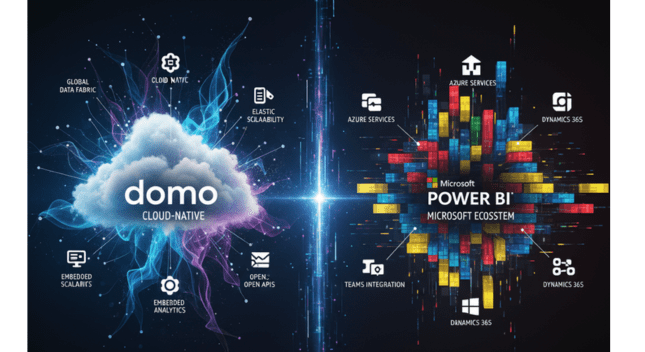
Our examination centers on architectural foundations, scalability models, data connectivity approaches and implementation methodologies. This perspective emphasizes real world deployment considerations rather than abstract feature comparisons, providing decision makers with implementer validated insights about platform strengths and optimal use cases.
Domo’s Purpose Built Cloud Architecture
Domo was architected from inception for cloud deployment without legacy infrastructure constraints. Its multi tenant infrastructure shares resources efficiently across customers while maintaining strict data isolation, enabling rapid scaling without separate instance management overhead. The platform automatically allocates compute and storage resources based on demand, eliminating capacity planning requirements and ensuring consistent performance during peak usage periods.
All data sources connect to a centralized cloud repository, removing complexity associated with managing multiple storage locations and enabling seamless cross source analytics without external integration layers. This unified data layer fundamentally simplifies architecture decisions and reduces implementation complexity.
Power BI’s Hybrid Ecosystem Evolution
Power BI evolved from Microsoft’s desktop analytics heritage, gradually expanding into cloud services. This evolution produced a hybrid architecture combining Power BI Desktop for development with Power BI Service for cloud deployment. The dual environment approach provides flexibility but introduces collaboration complexity as teams navigate desktop to cloud workflows.
Deep Azure integration allows organizations already invested in Microsoft’s cloud infrastructure to leverage existing services, security protocols and governance frameworks. On-premises gateway solutions enable cloud analytics while keeping source data behind firewalls critical for regulated industries with data residency requirements. Microsoft Fabric has recently enhanced this architecture by providing integrated ETL and advanced transformations, positioning Power BI as part of a comprehensive end to end analytics platform rather than a standalone visualization tool.
Domo’s pricing model typically allows unlimited user licensing, fundamentally changing how organizations approach BI democratization. This removes financial barriers to providing data access across entire workforces, enabling true self-service analytics without per-user cost escalation. The platform continuously optimizes query performance and data refresh operations automatically as data volumes grow, without requiring database administration expertise.
Enterprise-grade concurrency handles thousands of simultaneous users accessing dashboards and reports, with load balancing and caching mechanisms built into core architecture. Vertical and horizontal scaling occurs seamlessly behind the scenes, ensuring performance remains consistent as organizations grow.
Power BI uses capacity based scaling where organizations purchase dedicated compute resources. Power BI Pro costs ten dollars per user monthly for basic cloud collaboration. Premium Per User runs twenty dollars monthly for enhanced capabilities. Premium Capacity starts around five thousand dollars monthly for shared dedicated resources serving unlimited users.
Dataset size limitations vary by licensing tier one gigabyte in Pro, larger sizes in Premium. Organizations must choose between per-user licensing or per-capacity licensing, adding complexity to scaling decisions and requiring ongoing capacity monitoring. DirectQuery and Composite Models offer workarounds for datasets exceeding size limits, though with performance implications that require careful architectural consideration.
Domo’s Pre-Built Connector Library
Domo offers over one thousand pre-built connectors spanning virtually every data source category. Native cloud integrations to AWS, Google Cloud, Salesforce, Workday, ServiceNow and hundreds of SaaS applications require minimal configuration. Pre-built authentication handles OAuth and API credentials automatically, dramatically reducing setup time and technical expertise requirements.
Automated refresh schedules support near real time updates as frequent as every fifteen minutes, ensuring dashboards reflect current business states. Data federation capabilities blend multiple sources without requiring separate ETL tools, performing transformations within the platform itself.
Power BI’s Microsoft Ecosystem Dominance
Power BI provides hundreds of connectors with unparalleled integration to Microsoft products Excel, SQL Server, Azure SQL Database, Azure Data Lake, Dynamics 365, SharePoint and Microsoft 365 services connect seamlessly. Organizations heavily invested in Microsoft technologies find these native integrations highly efficient, reducing implementation friction and leveraging existing security models.
Power Query’s citizen-developer-friendly interface enables business users to participate in data preparation, while custom connector development through the Power Query SDK enables proprietary data source connections. DirectQuery support for enterprise data sources enables real time dashboards without data import, though with visual and performance limitations.
Where consulting approaches truly differentiate is in technical implementation details, revealing how experienced implementers leverage each platform’s unique strengths and navigate inherent limitations.
Power BI Implementation Focus
Power BI implementations clearly target Microsoft centric organizations. SQL Server integration leverages familiar administrative patterns and security models. Azure Data Factory integration addresses Power BI’s enterprise ETL limitations, creating hybrid architectures where complex transformations occur in Azure’s cloud platform while Power BI focuses on visualization and self service analytics.
Microsoft Fabric integration has significantly enhanced this approach by providing sophisticated data workflows and lakehouse architectures without requiring separate Azure services, making Power BI more compelling for enterprises needing advanced analytics while maintaining its user friendly interface and seamless Microsoft ecosystem integration.
Domo Implementation Focus
Domo implementations emphasize rapid deployment and operational simplicity. The platform’s extensive pre-built connector library accelerates time to value, while automated data refresh and built-in transformation capabilities reduce ongoing maintenance requirements.
Implementation strategies focus on unlimited user enablement, mobile first dashboard design and operational analytics requiring near-real-time visibility.
Organizations require rapid deployment with minimal IT involvement, particularly when technical resources are constrained. The unlimited user model suits companies prioritizing organization wide analytics democratization without escalating costs. Extensive pre-built cloud SaaS connectors benefit organizations operating primarily in cloud environments. Mobile first design serves executives and field personnel requiring simple, accessible dashboards. Fully managed, zero-infrastructure solutions appeal to organizations wanting to minimize operational complexity.
Organizations operate within Microsoft-centric technology ecosystems with existing investments in SQL Server, Azure, Dynamics or Microsoft 365. Deep Azure integration requirements and advanced data modeling needs favor Power BI’s sophisticated capabilities. Existing Microsoft enterprise agreements provide cost optimization opportunities through bundled licensing. Advanced analytics requiring R or Python integration leverage Power BI’s extensibility. Flexible licensing options enable starting small and scaling incrementally as requirements mature.
The Power BI approach, while efficient in Microsoft environments, creates potential vendor lock-in concerns. Organizations following this path should understand migration complexity if strategic directions change. However, Microsoft’s sustained investment in the platform and extensive partner ecosystem mitigate abandonment risks.
The Domo approach, while operationally simple, may introduce cost escalation as data volumes and connector usage grow. Organizations should clarify pricing implications of scale during vendor evaluation. Additionally, the proprietary cloud-native architecture limits self hosting options for organizations with strict data sovereignty requirements.
Choosing the right BI platform represents just the beginning of successful analytics transformation. Maximizing investment value requires implementation expertise, architectural experience and strategic guidance capabilities where Diacto Technologies excels.
Our platform agnostic expertise spans both Domo and Power BI, plus complementary technologies including Snowflake, Databricks and cloud platforms. This breadth enables unbiased recommendations based on your specific business needs and technical landscape rather than vendor preferences. We’ve observed meaningful implementation advantages in diverse organizational contexts, understanding how platform choice intersects with existing capabilities and strategic directions.
We handle every transformation phase from initial strategy and platform selection through data architecture design, system integration, dashboard development and comprehensive user training. Our proven methodologies minimize risk while accelerating time to value, ensuring analytics initiatives deliver measurable business outcomes rather than impressive but unused deployments.
Vertical expertise across healthcare, financial services, retail, manufacturing and technology sectors informs our approach. We understand unique analytics challenges, regulatory requirements and opportunity landscapes within your industry, bringing battle tested patterns that address common implementation obstacles.
Strategic analytics consulting defines your vision and creates roadmaps aligning technology investments with business priorities. Structured platform evaluation assesses options against your specific requirements. Scalable data architecture design anticipates scale and governance requirements while maintaining implementation simplicity. Expert dashboard development creates intuitive visualizations driving decision making. Role specific training ensures actual adoption rather than just deployment.
Platform selection isn’t simply about comparing feature lists it’s about understanding how different tools integrate with existing organizational capabilities and strategic directions. Diacto Technologies brings sophisticated understanding of how platform choice intersects with organizational context and technical environment.
Ready to unlock your data’s full potential? Contact Diacto Technologies today to discover how we can architect and implement the right analytics solution to drive your business forward.

