In today’s complex digital landscape, shadow IT unauthorized hardware, software, and cloud services operating outside IT governance poses significant security, compliance, and financial risks to global enterprises. This case study examines how Diacto Technologies successfully implemented ServiceNow IT Operations Management (ITOM) with advanced automated asset discovery capabilities for a multinational financial services corporation, transforming their IT asset visibility and governance across 85 countries and over 120,000 endpoints.
The client, a leading global investment bank with assets under management exceeding $450 billion, faced critical challenges including uncontrolled proliferation of shadow IT creating security vulnerabilities and compliance gaps, fragmented visibility across on-premises, cloud, and hybrid infrastructure environments, and escalating software licensing costs due to untracked usage and redundant subscriptions. Through strategic implementation of ServiceNow IT Operations Management software with continuous discovery and dependency mapping, Diacto Technologies delivered comprehensive visibility spanning all IT assets, automated compliance monitoring, and proactive shadow IT detection.

The client represents a prominent global investment banking and financial services institution with over 140 years of market leadership in wealth management, investment banking, asset management, and capital markets operations. As a systemically important financial institution serving corporate, institutional, and high-net-worth clients across six continents, the organization maintains sophisticated technology environments supporting mission-critical trading platforms, regulatory reporting systems, client relationship management applications, and risk management infrastructure.
Their operational footprint encompasses trading floors in major financial centers, wealth management offices in 85 countries, data centers across multiple geographic regions, cloud infrastructure spanning AWS, Azure, and private cloud environments, and over 120,000 endpoints including workstations, mobile devices, servers, and network infrastructure. The organization’s commitment to maintaining competitive advantage in rapidly evolving financial markets demanded cutting-edge technology adoption while ensuring robust security, compliance, and operational resilience.
The strategic importance of comprehensive asset discovery and shadow IT reduction became evident as the organization pursued aggressive digital innovation while maintaining operational controls essential for regulatory compliance, cybersecurity resilience, and financial performance. With IT spending exceeding $2.8 billion annually and technology infrastructure representing critical business enablement across all revenue-generating activities, the organization required sophisticated IT operation management capabilities providing real-time visibility, automated governance, and proactive risk mitigation.
The client confronted multifaceted IT visibility and governance challenges that significantly impacted security posture, compliance readiness, operational efficiency, and cost management. Their existing approach relied on periodic manual asset inventories, disconnected discovery tools across different infrastructure domains, and decentralized procurement processes that enabled shadow IT proliferation beyond central IT oversight.
Shadow IT proliferation accelerated dramatically with business units independently procuring cloud services, SaaS applications, and hardware devices to circumvent perceived IT bureaucracy and accelerate project delivery. Regional offices maintained localized IT procurement relationships outside enterprise agreements, resulting in pricing disadvantages and contract management complexity. Department managers approved software subscriptions using corporate credit cards without IT approval or security review. Business users installed unauthorized applications on corporate devices or established personal cloud storage accounts for work files.
Software license management suffered from incomplete visibility into actual usage versus purchased entitlements. The organization maintained software licenses for applications no longer in use while simultaneously purchasing additional licenses for the same software through different procurement channels. Audit exposure risk was substantial software vendors increasingly employed aggressive audit tactics, and the organization lacked confidence in their ability to demonstrate license compliance across their global estate.
Compliance and regulatory reporting challenges compounded operational risks. Regulators required comprehensive IT asset inventories as part of operational resilience frameworks and cybersecurity examinations. Manual inventory processes required 6-8 weeks to compile data from various sources, and accuracy was questionable given rapid change rates in dynamic environments. Previous regulatory examinations identified inventory completeness and accuracy as areas requiring improvement.
Incident response and problem resolution suffered from incomplete configuration visibility. When critical incidents occurred, support teams lacked comprehensive dependency mapping to understand impact scope or identify root causes quickly. Mean time to resolution metrics lagged industry benchmarks partially due to time spent investigating infrastructure relationships and dependencies manually.
These challenges compounded to create security exposure estimated at $50+ million in potential breach costs, compliance risks threatening regulatory standing, operational inefficiencies costing $12+ million annually, and shadow IT spending of $280-320 million lacking governance oversight. The strategic implications extended beyond immediate risks to encompass competitive disadvantages, innovation constraints, and scalability limitations for business growth initiatives.
The client established comprehensive strategic objectives aligned with their broader digital transformation roadmap, cybersecurity enhancement program, and operational excellence initiatives. The primary objective centered on achieving comprehensive IT asset visibility through automated discovery spanning all infrastructure domains including on-premises servers and workstations, network infrastructure and security devices, cloud infrastructure across AWS, Azure, and private clouds, SaaS applications and cloud services, mobile devices and IoT endpoints, and containerized applications and microservices architectures.
Shadow IT reduction and governance represented another critical objective, encompassing proactive detection of unauthorized assets, automated compliance policy enforcement, integration with procurement and approval workflows, and business stakeholder engagement promoting governance adherence. The organization sought to reduce shadow IT from estimated 35-40% to below 10% within 18 months through combined technology controls and cultural transformation.
Cost optimization formed a fundamental strategic pillar, with specific targets including elimination of redundant software subscriptions, optimization of software license utilization, consolidation of vendor relationships leveraging enterprise volume discounts, and prevention of unauthorized spending outside enterprise agreements. Financial targets included $50+ million in annual cost avoidance through software license optimization and shadow IT elimination.
Security posture enhancement emerged as an essential requirement driven by increasing cyber threats and regulatory expectations. Complete asset inventory would enable comprehensive vulnerability management, accurate security tool deployment coverage, rapid incident response through dependency visibility, and evidence-based regulatory reporting demonstrating security control effectiveness.
The implementation of automated IT operation management capabilities aimed to transform reactive, periodic asset management into continuous, real-time visibility with automated remediation workflows. This transformation would establish foundation capabilities for advanced use cases including AI-driven anomaly detection, predictive capacity planning, and automated service impact analysis.
Diacto Technologies selected ServiceNow IT Operations Management (ITOM) suite to provide comprehensive discovery, mapping, and governance capabilities addressing the client’s complex global requirements. The ITOM implementation encompassed Discovery for automated identification of infrastructure across all domains, Service Mapping for application dependency visualization and business service modeling, Cloud Management for multi-cloud visibility and cost optimization, and Software Asset Management Pro integration for license compliance and optimization.
ServiceNow’s agentless discovery capabilities enabled non-intrusive asset identification across heterogeneous environments without performance impacts or extensive endpoint software deployment. The platform’s pattern-based discovery approach provided detailed configuration information beyond basic asset identification, capturing application dependencies, database relationships, and service interconnections essential for impact analysis and problem resolution.
The solution architecture emphasized comprehensive discovery coverage across all infrastructure domains while maintaining security, performance, and operational considerations. Discovery infrastructure deployment included distributed MID Servers positioned strategically across geographic regions and network segments, credential vaulting integration with CyberArk for secure credential management, network segmentation considerations ensuring discovery traffic compliance with security policies, and performance tuning preventing discovery activities from impacting production workloads.
Discovery scope definition encompassed multiple infrastructure domains with tailored approaches for each. On-premises infrastructure discovery covered Windows servers, Linux/Unix servers, network devices, storage arrays, and virtualization platforms through SNMP, WMI, SSH, and API-based protocols. Cloud infrastructure discovery integrated with AWS, Azure, and Google Cloud Platform APIs for continuous synchronization of cloud resources, configurations, and cost data.
SaaS and cloud service discovery leveraged Cloud Access Security Broker (CASB) integration and SSO log analysis to identify shadow IT cloud services based on actual usage patterns. Network traffic analysis and DNS query monitoring provided additional shadow IT detection capabilities identifying unauthorized services through network behavior patterns.
The CMDB served as the authoritative source for all IT asset and configuration data, requiring careful design addressing data quality, governance, and lifecycle management. CMDB data model customization extended ServiceNow’s base configuration item classes to address financial services-specific asset types including trading infrastructure, market data platforms, and regulatory reporting systems.
Relationship mapping captured dependencies between configuration items enabling service impact analysis and change risk assessment. The CMDB maintained relationships including application-to-server hosting, server-to-database dependencies, service-to-infrastructure mappings, and business process-to-application relationships supporting business impact analysis.
Data quality management implemented automated health scoring, duplicate detection and reconciliation, data normalization and standardization, and aging policies for stale data remediation. Continuous data quality monitoring identified and remediated issues proactively, maintaining CMDB accuracy above 95% through automated reconciliation and exception workflows.
Automated shadow IT detection capabilities leveraged multiple data sources and detection techniques identifying unauthorized assets and services. Cloud service discovery through CASB integration identified SaaS applications, cloud storage services, and collaboration platforms accessed by employees but not approved by IT. Detection rules flagged services based on risk profiles, data sensitivity, and compliance requirements.
Expense management integration analyzed corporate credit card transactions identifying software and cloud service purchases occurring outside approved procurement channels. Machine learning algorithms identified technology-related purchases based on merchant categories and transaction descriptions, automatically creating shadow IT discovery records for investigation.
Comprehensive workflow automation transformed shadow IT detection into structured remediation processes engaging appropriate stakeholders and enforcing governance policies. Shadow IT discovery automatically triggered workflows including risk assessment based on data sensitivity and security posture, stakeholder notification to business unit leaders and application owners, security review processes for continuation approvals, and remediation actions for high-risk unauthorized assets.
Software license compliance workflows automated entitlement tracking, usage monitoring, optimization recommendations for underutilized licenses, and renewal management ensuring timely license refresh decisions. Integration with software asset management processes provided comprehensive license governance across the software portfolio.
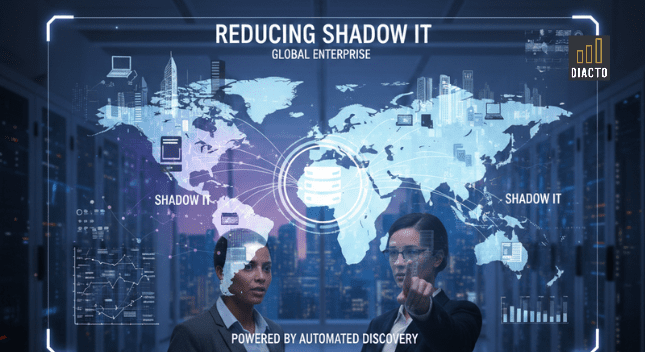
Diacto Technologies employed a phased implementation methodology emphasizing quick wins, stakeholder engagement, and progressive capability maturation throughout the deployment. The approach began with comprehensive discovery workshops identifying critical infrastructure domains, shadow IT risk areas, integration requirements, and success metrics while establishing governance structures and communication strategies.
The foundation phase focused on core discovery infrastructure deployment, CMDB data model design, initial discovery wave covering highest-priority infrastructure domains, and integration with critical enterprise systems. This phase established technical foundations while generating early visibility into asset coverage gaps and shadow IT exposure.
The expansion phase progressively extended discovery coverage to additional infrastructure domains, cloud environments, and geographic regions. Phased expansion enabled discovery pattern refinement, performance optimization, and MID Server capacity planning while managing network and system impacts.
Shadow IT detection capabilities deployment followed discovery stabilization, implementing CASB integration, expense analysis, network monitoring, and endpoint discovery. Phased shadow IT detection enabled governance workflow refinement and stakeholder engagement before broad enforcement.
Full production deployment with comprehensive coverage, automated governance, and continuous operation occurred approximately 7 months from initial discovery through complete global rollout. Ongoing optimization and capability enhancement continued through dedicated managed services supporting discovery maintenance, CMDB health monitoring, and continuous improvement.
Financial return on investment manifested through multiple value streams totaling approximately $67 million in annual benefits. Software license optimization represented $38 million in annual savings through elimination of redundant licenses, retirement of unused software, and prevention of audit penalties. Shadow IT elimination prevented $12 million in redundant spending on unauthorized subscriptions and services duplicating existing capabilities.
Security risk reduction valued at estimated $15 million annually included decreased breach probability through comprehensive asset visibility, reduced vulnerability exposure through complete patch coverage, and prevention of data loss incidents through unauthorized service elimination. While security benefits involve probabilistic risk calculations, the organization’s actuarial models estimated substantive risk reduction value.
Operational efficiency gains generated $2 million in annual value through IT staff productivity improvements, reduced incident resolution time freeing employee capacity, automated asset inventory replacing manual efforts, and improved change success rates preventing business disruption costs.
Business unit satisfaction improved through clearer governance processes, faster approval cycles for legitimate technology needs, enhanced self-service capabilities reducing IT dependency, and transparent communication regarding shadow IT risks and remediation approaches.
The successful implementation yielded valuable insights applicable to similar IT operation management initiatives addressing shadow IT challenges in complex global enterprises. Discovery infrastructure planning proved critical for success, requiring careful consideration of network topology, security constraints, credential management, and performance impacts. Organizations should invest adequate time in discovery architecture design before deployment acceleration.
Stakeholder engagement emerged as equally important as technical implementation for shadow IT reduction success. Understanding shadow IT motivations revealed legitimate business needs driving governance circumvention, enabling IT service improvements addressing root causes rather than purely enforcement approaches. Collaborative engagement with business units built partnership relationships supporting long-term governance compliance.
Shadow IT remediation required balanced approaches combining enforcement with enablement. Purely restrictive approaches created business friction and adversarial relationships, while overly permissive approaches failed to address security and compliance risks. Successful approaches assessed individual shadow IT cases based on risk, provided approved alternatives for legitimate needs, and enforced governance for high-risk scenarios.
Continuous improvement frameworks established post-implementation ensured sustained value and prevented CMDB degradation. Regular data quality reviews, discovery pattern updates for new technologies, and process optimization based on operational experience maintained platform effectiveness and prevented accuracy erosion over time.
The successful ITOM foundation creates opportunities for expanding IT operations management software capabilities into advanced analytics and automation domains. AI and machine learning enhancement could provide predictive capabilities including anomaly detection identifying unusual infrastructure changes, predictive capacity forecasting supporting proactive scaling, automated incident correlation discovering patterns across seemingly unrelated events, and intelligent change risk assessment based on historical change outcomes.
AIOps implementation would leverage ITOM data for intelligent operations including event noise reduction through correlation and deduplication, automated remediation for common incident patterns, proactive problem identification before user impact, and intelligent workload optimization across cloud environments.
FinOps capabilities expansion would enhance cloud cost optimization through detailed cost allocation and chargeback, waste identification and automated remediation, reservation and savings plan optimization, and multi-cloud cost comparison supporting workload placement decisions.
Advanced security operations integration would unify IT operations management software with security operations including automated threat response workflows, security asset inventory synchronization, vulnerability remediation tracking, and compliance monitoring automation.
The ServiceNow IT Operations Management implementation successfully addressed the client’s critical shadow IT and asset visibility challenges while establishing comprehensive governance capabilities supporting continued digital transformation. The achievement of 97% discovery coverage, identification and remediation of 8,400+ shadow IT assets, and $67 million in annual benefits demonstrates the transformative value of strategic IT operation management investment in complex global enterprises.
This successful partnership between Diacto Technologies and the client exemplifies how thoughtful IT operations management software implementation can simultaneously address immediate operational challenges while building strategic capabilities supporting long-term competitive advantage. The comprehensive approach combining technology deployment, process transformation, and cultural change provides a replicable model for global enterprises seeking to reduce shadow IT risks, optimize technology investments, and establish governance foundations essential for digital transformation success in increasingly complex technology landscapes.

