In today’s dynamic business environment, where technology assets form the backbone of operational capabilities, organizations face mounting pressure to optimize asset utilization while maintaining rigorous governance standards. This case study explores how Diacto partnered with a multinational telecommunications provider to revolutionize their asset lifecycle management practices through strategic ServiceNow IT Asset Management (ITAM) implementation, bringing order to over 800,000 distributed assets across 15 countries.
The client, a major telecommunications infrastructure provider serving both enterprise and consumer markets, struggled with fragmented asset tracking, spiraling maintenance costs, and governance gaps that exposed the organization to significant compliance and financial risks. Through the deployment of ServiceNow HAM Pro and SAM Pro, integrated with advanced automation and predictive analytics capabilities, Diacto delivered a comprehensive transformation spanning asset procurement through end-of-life disposal.
The results exceeded initial projections: 92% improvement in asset tracking accuracy, 38% reduction in maintenance costs through predictive lifecycle management, $12.4 million in recovered value from previously untracked assets, and establishment of a robust governance framework supporting both operational excellence and strategic growth initiatives.
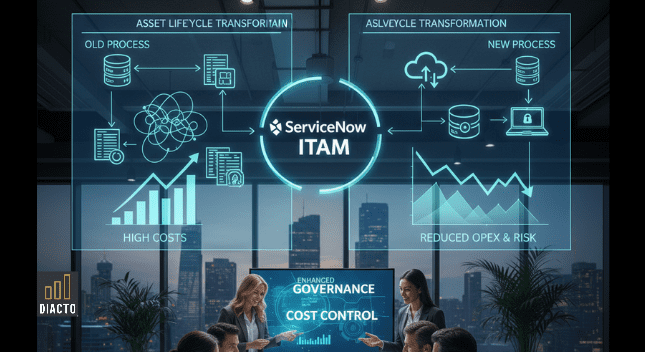
The client operates as a Tier-1 telecommunications provider with extensive network infrastructure spanning North America, Europe, and Asia-Pacific regions. Their service portfolio encompasses cellular networks, fiber optic infrastructure, data center operations, and enterprise connectivity solutions serving over 45 million customers across residential and business segments.
The organization maintains one of the industry’s most complex asset ecosystems, including cell towers, base station equipment, fiber distribution systems, data center hardware, customer premises equipment, fleet vehicles, and specialized testing apparatus. This infrastructure requires continuous investment, with annual capital expenditures exceeding $2 billion for network expansion, technology refresh, and service enhancement initiatives.
Within the telecommunications sector, asset management challenges are amplified by rapid technology evolution, stringent regulatory requirements, and competitive pressure to maximize network performance while controlling costs. The client’s position as a market leader demanded operational excellence in asset management to maintain service quality standards while optimizing capital efficiency and supporting aggressive network expansion targets.
The client’s asset management dysfunction manifested across multiple operational dimensions, creating cascading impacts on financial performance, regulatory compliance, and strategic agility. Their decentralized approach, developed organically through multiple acquisitions and regional expansions, resulted in 23 separate asset tracking systems with no unified visibility or standardized processes.
Asset location uncertainty plagued operations, with engineering teams regularly unable to locate equipment needed for network expansion projects or emergency repairs. This opacity forced unnecessary emergency purchases while valuable assets sat unused in warehouse locations or decommissioned facilities.
Reactive maintenance approaches resulted in unexpected equipment failures that disrupted service quality and inflated repair costs. The absence of systematic lifecycle tracking meant equipment operated well beyond optimal replacement windows, increasing energy consumption, maintenance expenses, and performance degradation risks.
Inaccurate asset records created significant financial statement risks, with discrepancies between physical inventories and book values exceeding $47 million during the previous fiscal year. This variance triggered audit qualifications and increased regulatory scrutiny. Software license management deficiencies exposed the organization to potential vendor audits, with estimated compliance gaps representing $8.3 million in potential liabilities.
Procurement processes operated without visibility into existing asset availability, resulting in duplicate purchases and working capital inefficiency. Asset transfer processes between regions required weeks of manual coordination, delaying project implementations and frustrating operational teams. Technicians spent approximately 18% of productive time searching for equipment, tools, and documentation rather than performing value-adding activities.
Leadership established an ambitious transformation vision centered on converting asset management from an operational burden into a strategic capability supporting network excellence, financial optimization, and sustainable growth. This vision encompassed five interconnected strategic pillars:
Create a single source of truth providing real-time visibility across all asset categories, locations, and lifecycle stages. This unified platform would eliminate information silos, support data-driven decision-making, and enable proactive management of the complete asset ecosystem.
Implement intelligent lifecycle management leveraging predictive analytics to optimize maintenance schedules, anticipate replacement needs, and maximize asset value extraction. This capability would transition operations from reactive failure response to proactive performance optimization.
Establish comprehensive cost visibility linking asset investments to business outcomes while implementing automated chargeback mechanisms ensuring accurate cost allocation across network regions, service lines, and customer segments. This transparency would support strategic capital allocation decisions and operational accountability.
Deploy standardized processes and automated controls ensuring compliance with regulatory requirements, corporate policies, and industry standards throughout the asset lifecycle. This governance framework would mitigate audit risks while supporting operational consistency across global operations.
Incorporate environmental considerations into asset lifecycle decisions, supporting corporate sustainability commitments through optimized energy efficiency, extended equipment lifespans, and responsible end-of-life disposal practices.

The engagement launched with intensive discovery workshops engaging stakeholders across procurement, network operations, finance, compliance, and regional management teams. These sessions documented current-state processes, identified pain points, defined success criteria, and established governance structures guiding the implementation.
Data quality assessment examined existing asset records across all legacy systems, quantifying accuracy levels, identifying critical gaps, and developing remediation strategies. This foundation work proved essential for ensuring successful data migration and establishing baseline metrics for measuring improvement.
Technical teams configured ServiceNow platforms, developed custom telecommunications modules, and established integrations with enterprise systems. Parallel workstreams addressed data cleansing, developing transformation rules and validation procedures ensuring migrated data met quality standards.
Testing protocols validated system functionality, integration reliability, and performance under anticipated load conditions. Security assessments verified appropriate access controls, data protection measures, and audit logging capabilities meeting regulatory requirements.
The pilot phase deployed the solution across two representative regions, encompassing diverse asset types and operational scenarios. This controlled deployment enabled refinement of workflows, validation of integration behavior, and testing of training materials with actual users providing feedback for optimization.
Pilot results demonstrated system viability while identifying opportunities for workflow adjustments and user interface enhancements improving adoption and operational efficiency.
Full deployment proceeded through carefully sequenced regional waves, each supported by dedicated training, change management activities, and hypercare support ensuring smooth transitions. The phased approach maintained operational continuity while building organizational capability and confidence.
Post-deployment activities focused on continuous optimization based on operational feedback, advanced feature adoption, and comprehensive knowledge transfer ensuring the client could independently operate and enhance the platform. Performance benchmarking validated achievement of target metrics while identifying opportunities for continued improvement.
Explore how Google Gemini AI is reshaping the future of artificial intelligence stay ahead of the curve with more insights like this
The implementation achieved 92% asset tracking accuracy across the global portfolio, up from 68% pre-implementation. Real-time dashboards provided executives and operational teams with unprecedented visibility into asset locations, utilization, condition, and financial performance. Geographic information system integration enabled visual asset mapping supporting network planning and emergency response coordination.
The transformation delivered quantifiable financial benefits exceeding initial business case projections:
Productivity improvements manifested across operational dimensions:
Ready to modernize your ServiceNow governance, risk, and compliance strategy?
The governance framework eliminated audit qualifications, with external auditors praising the comprehensive controls and documentation supporting financial statement assertions. Software license compliance gaps were eliminated, mitigating vendor audit risks and associated potential liabilities. Environmental compliance improved through systematic tracking of disposal activities and hazardous material management.
Beyond operational improvements, the implementation established foundation capabilities supporting strategic initiatives:
Network Expansion Acceleration: Enhanced visibility into asset availability and condition enabled faster network expansion project execution, supporting aggressive growth targets in competitive markets.
Capital Optimization: Improved lifecycle analytics supported more strategic capital allocation decisions, optimizing timing of technology refresh investments and extending useful life of performing assets.
Sustainability Leadership: Systematic lifecycle management reduced electronic waste by 34%, supported energy efficiency improvements, and enhanced corporate sustainability reporting capabilities.
Make every ServiceNow KPI performance meaningful strengthen your performance with expert guidance
Strong executive sponsorship proved essential for driving organizational change, resolving cross-functional conflicts, and maintaining implementation momentum. The chief operating officer’s visible engagement signaled strategic importance while empowering the project team to challenge entrenched practices and drive necessary process changes.
Significant investment in data cleansing and validation prior to migration ensured the new system launched with reliable information, building user confidence and avoiding the “garbage in, garbage out” syndrome that undermines many technology implementations. Dedicated data stewardship roles maintained quality standards post-implementation.
Comprehensive change management activities addressed cultural, process, and behavioral dimensions of transformation beyond technical deployment. Role-based training, stakeholder engagement, and continuous communication ensured users understood not just system mechanics but the strategic value driving the transformation.
The regional wave deployment strategy balanced speed with risk management, enabling learning and adaptation while maintaining operational continuity. Early wins in pilot regions built momentum and organizational confidence supporting subsequent deployments.
The implementation required rethinking processes rather than simply automating existing dysfunction. Process redesign workshops identified opportunities for simplification and standardization, ensuring the new system supported optimal operational practices rather than perpetuating historical inefficiencies.
Initial underestimation of integration complexity with legacy network management systems required scope adjustments and extended timeline. Future implementations would benefit from more comprehensive technical discovery and earlier engagement with system owners.
Tension between standardization objectives and regional operational variations required careful navigation. The solution incorporated flexibility for regional variations within a standardized framework, but initial designs leaned too heavily toward rigid standardization, requiring mid-course adjustments.
Early engagement with key equipment vendors proved valuable for establishing automated warranty tracking and service contract integration. Expanded vendor collaboration would have accelerated implementation and enhanced functionality.
The next evolution will incorporate machine learning models for enhanced predictive maintenance, automated anomaly detection, and intelligent asset allocation recommendations. Natural language processing capabilities will enable conversational interfaces for asset inquiries and workflow initiation.
Deployment of IoT sensors on critical network infrastructure will provide real-time telemetry supporting precise condition monitoring, predictive analytics, and automated alerting for assets approaching failure thresholds or requiring maintenance intervention.
Exploration of blockchain technology for immutable asset ownership records and supply chain verification supporting fraud prevention and simplifying audit processes while enhancing trust in asset data accuracy.
Enhanced capabilities supporting component recovery, refurbishment, and remarketing will optimize asset value extraction while advancing sustainability objectives and reducing electronic waste.
Expansion of lifecycle management to additional asset categories including real estate, fleet vehicles, and customer premises equipment will extend governance capabilities and financial benefits across broader organizational scope.
The ServiceNow ITAM implementation transformed the client’s asset management capabilities from a fragmented, reactive operational burden into a strategic enabler supporting network excellence, financial optimization, and sustainable growth. The achievement of 92% tracking accuracy, 38% maintenance cost reduction, and $12.4 million in recovered asset value validates the strategic investment while establishing foundation capabilities supporting continued operational improvements.
The partnership between Diacto and the telecommunications provider exemplifies how thoughtful ITAM implementation combining robust technology platforms with process optimization, change management, and continuous improvement orientation—can simultaneously address immediate operational challenges while building enduring strategic capabilities. The transformation enhanced not just operational efficiency but strategic agility, positioning the organization for continued market leadership in an increasingly competitive and technologically dynamic industry.
This success story provides a blueprint for organizations seeking to transform asset lifecycle management from administrative overhead into strategic capability driving operational excellence, financial performance, and competitive advantage.

