Turn scattered data into decisions leaders can trust. Diacto provides Business Intelligence Consulting Services that connect data strategy, data analysis, business analytics, dashboard design, and reporting workflows into one practical path from raw information to executive action.
If your teams are spending too much time reconciling spreadsheets, debating which number is correct, or waiting for reports that arrive too late, the issue is not just a tooling problem. It is a business intelligence problem, and Diacto helps you solve it with clear priorities, usable dashboards, and analytics systems built around the way your organization actually makes decisions.
Business intelligence consulting should help your organization define the right questions, connect the right data, and deliver insights in a format people can use without friction. The goal is not simply to create attractive charts; it is to build a decision layer that gives executives, managers, and operational teams a shared view of performance, risks, and opportunities.
Diacto approaches BI consulting as a bridge between business priorities and technical execution. That means starting with the decisions you need to make, then working backward into the data sources, metrics, reporting cadence, governance, and dashboards required to support those decisions. The result is a business analytics environment that is easier to trust, easier to maintain, and easier to act on.

Strong business intelligence begins before the first dashboard is designed. Many organizations already have the raw material they need: CRM data, finance data, marketing performance, product usage, sales activity, customer support records, operations systems, and spreadsheets created by individual teams. The challenge is turning those disconnected sources into a reliable view of the business.
Diacto helps you create that path with a consulting process that moves from strategy to implementation. Each step is designed to reduce ambiguity, improve data quality, and make reporting more useful for the people who rely on it.
A typical engagement may include:
This structure keeps the work grounded. Instead of starting with a tool and forcing your business into its default reports, Diacto focuses on what your organization needs to understand, monitor, and improve.
Executives rarely need more reports. They need clearer answers. A leadership team may want to know which revenue streams are growing, where margin pressure is emerging, how pipeline quality is changing, which customer segments need attention, or whether operations are keeping pace with demand.
Diacto turns those questions into business analytics systems that show the most relevant signals without overwhelming the viewer. The best executive dashboards create focus. They surface what changed, where the change happened, and which area needs follow-up.
For example, a sales leader may not need a dashboard filled with every activity metric available. They may need a concise view of pipeline value by stage, conversion trends, aging opportunities, forecast movement, and rep-level performance. A finance leader may need revenue, cost, margin, cash-related indicators, and variance against plan. An operations leader may need throughput, backlog, quality indicators, and capacity signals. Diacto helps shape each view so it supports the decisions that role is responsible for making.
That is where effective data analysis becomes more than number crunching. It becomes context. It helps separate meaningful movement from noise, isolate the source of a trend, and give teams a shared base for discussion.
Business intelligence consulting is most valuable when it addresses the full lifecycle of data use, not just one report request at a time. Diacto can support organizations that are just beginning to formalize reporting, as well as teams that already have dashboards but lack trust, consistency, or adoption.
Diacto’s Business Intelligence Consulting Services can support:
The emphasis is practical: define what matters, make it measurable, and present it in a way that supports action. Diacto avoids treating BI as a one-time design exercise. Dashboards and analytics environments should evolve as priorities change, teams grow, and the business asks better questions.
Dashboard sprawl happens when every team builds its own reporting layer without shared definitions, governance, or priorities. At first, this feels fast. Over time, it creates duplicated reports, conflicting KPIs, inconsistent filters, and meetings where people spend more time questioning the data than discussing the business.
A practical data strategy helps prevent that. Diacto works with stakeholders to clarify which metrics matter most, which source systems should be trusted, how data should flow, and which dashboards should serve which audiences. This does not require unnecessary complexity. It requires enough structure to make reporting reliable.
Key data strategy questions often include:
By answering these questions early, Diacto helps organizations avoid building dashboards that look complete but fail in everyday use. A dashboard is only useful if people understand it, trust it, and know what to do next.
Data analysis is where patterns become visible. It can help identify performance trends, customer behavior, sales bottlenecks, cost changes, operational inefficiencies, and areas where assumptions do not match reality. But analysis is only useful when it is tied to a business question.
Diacto keeps analysis focused on practical outcomes. Rather than exploring data for its own sake, the work begins with a clear use case: improving forecast visibility, understanding customer retention, monitoring campaign performance, evaluating operational capacity, or identifying which activities contribute to growth. This keeps the analysis relevant and makes the output easier for decision-makers to apply.
Effective data analysis may involve cleaning and standardizing datasets, grouping information into useful categories, comparing performance across time periods, identifying outliers, and testing whether a trend is broad or isolated. It may also involve uncovering where data is incomplete or misleading. In many BI projects, those findings are just as important as the dashboard itself because they show what must improve for the organization to make better decisions.
Diacto translates analytical findings into plain business language. The aim is not to bury stakeholders in technical detail. It is to help them understand what the data suggests, where confidence is high or limited, and which next steps make sense.
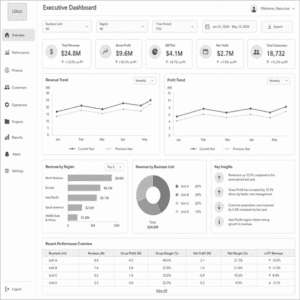
An executive dashboard should be concise, structured, and aligned to strategic priorities. It should help leaders see whether the business is on track, where performance has shifted, and which issues deserve attention. When dashboards are designed without that discipline, they often become visual repositories for metrics rather than tools for decision-making.
Diacto designs dashboards around hierarchy. The most important indicators should be visible first. Supporting detail should be available when a leader needs to investigate. Filters, drilldowns, and visualizations should make the experience clearer, not more complicated.
A strong dashboard experience typically includes:
Diacto also considers adoption from the start. A dashboard that requires constant explanation is not finished. The design should make the intended use obvious enough that leaders can quickly understand what they are seeing and teams can use the same information in follow-up discussions.
Business analytics becomes powerful when it connects strategy with day-to-day execution. Executives may need a high-level view, but managers and teams need more detailed signals that help them act. The challenge is creating layers of reporting that serve different audiences while staying connected to the same source of truth.
Diacto helps organizations design analytics views for multiple levels of the business. A leadership dashboard might show top-level performance across revenue, operations, and customer metrics. A department dashboard might show team-specific performance and trend detail. An operational report might show task-level or account-level information that helps people decide what to do next.
This layered approach supports better conversations. Leaders can ask focused questions. Managers can investigate the drivers. Teams can see how their work connects to broader outcomes. Instead of each group presenting its own numbers, everyone works from a shared analytical foundation.
Common business analytics use cases include:
Diacto adapts the analytics structure to your organization’s priorities. The point is not to measure everything. The point is to measure the right things well enough to improve decisions.
Many BI initiatives slow down because business teams and technical teams are not speaking the same language. Business stakeholders know what they need to understand, but they may not know how the data is structured. Technical teams understand the systems, but they may not have full context for how a metric will be interpreted in a leadership meeting.
Diacto helps close that gap. The consulting process brings both sides into a shared workflow, translating business needs into data requirements and technical constraints into clear tradeoffs. This alignment reduces rework and helps prevent the familiar cycle of building a report, discovering it does not answer the real question, and rebuilding it under pressure.
A practical BI engagement with Diacto may move through these steps:
This process is structured but not rigid. Diacto can meet your organization where it is, whether you need a first BI roadmap, a better executive dashboard, or help untangling an existing reporting ecosystem.
The strongest BI programs improve how an organization thinks, not just how it reports. When the work is done well, teams spend less time gathering numbers and more time discussing what the numbers mean. Leaders gain a clearer view of performance. Managers can identify problems earlier. Analysts can focus on higher-value work instead of repeatedly rebuilding manual reports.
With Diacto, the expected outcomes are practical and grounded in your current environment. The engagement can help you move from disconnected data sources to a more organized analytics layer, from inconsistent definitions to shared metrics, and from static reporting to dashboards that support timely decisions.
Useful outcomes may include:
Diacto does not need to overcomplicate the process to create value. In many organizations, the biggest improvement comes from making the most important data easier to find, understand, and trust.
You do not need a perfect data environment before starting. In fact, many organizations seek business intelligence consulting because their current reporting process has become too manual, too fragmented, or too slow for the decisions they need to make.
You may be ready to work with Diacto if:
These issues are common, and they are solvable. The right consulting support helps you prioritize instead of trying to fix everything at once. Diacto can help identify the highest-impact starting point and build from there.
Diacto brings a practical, decision-focused approach to business intelligence. The work is not limited to producing dashboards; it is about helping your organization create a better relationship with its data. That includes strategy, data analysis, business analytics design, dashboard planning, and the stakeholder alignment required for BI to be used well.
The Diacto approach is especially valuable when you need clarity across both business and technical layers. A dashboard request may reveal a metric definition problem. A data quality issue may reveal a process gap. A reporting bottleneck may reveal an opportunity to redesign the flow of information. Diacto helps you see these connections and respond with solutions that fit your context.
Working with Diacto means you can expect a thoughtful process, plain-language communication, and BI assets designed for real users. The emphasis stays on usefulness: what the dashboard helps someone decide, how the data supports that decision, and what must be maintained so the insight remains reliable.
If your organization is ready to make better use of its data, start with a focused conversation about your goals, current reporting challenges, and the decisions your teams need to support. You do not need to arrive with perfect requirements. A good first step is simply identifying where unclear data, slow reporting, or fragmented dashboards are creating friction.
Diacto can help you turn that starting point into a practical plan. From data strategy and data analysis to business analytics workflows and executive dashboards, the engagement can be shaped around the outcomes that matter most to your organization.
Talk to Diacto about Business Intelligence Consulting Services and take the next step toward clearer, more confident decision-making.