In today’s hyper-competitive business landscape, the mandate is clear: do more with less. Companies are constantly pressured to scale their operations, improve customer satisfaction, and innovate, all while keeping a tight lid on expenses. For years, the traditional solution was simply to hire more staff or work longer hours. However, with the rapid advancements in technology, a new, highly effective paradigm has emerged. Business leaders are increasingly discovering exactly How an AI Automation Agency Helps Businesses Save Time and Reduce Costs.
Artificial intelligence is no longer just a futuristic concept reserved for tech giants. It is a practical, accessible tool that is reshaping how daily operations are conducted across industries. By partnering with a specialized ai automation agency, businesses can transform their bottlenecks into streamlined, error-free processes.
This comprehensive guide will explore the mechanics of these transformations, detailing everything from the specific tasks these agencies handle to the strategic financial benefits of implementation. Whether you are a small business owner looking to optimize a lean team or an enterprise executive aiming to slash operational drag, understanding how to leverage AI is your competitive advantage.

An AI automation agency is a specialized technology partner that designs, builds, and integrates artificial intelligence solutions directly into a company’s existing workflows. Unlike traditional software development firms that might build static applications, an AI agency focuses on creating dynamic, intelligent systems capable of learning, adapting, and making autonomous decisions based on data.
These agencies provide comprehensive ai automation services that bridge the gap between complex machine learning algorithms and practical business needs. They act as strategic consultants and technical executioners, auditing a company’s current processes to identify inefficiencies and then deploying custom-built AI tools to resolve them.
The goal is not to replace human workers, but to augment them. By taking over the tedious, repetitive tasks that drain employee energy, an AI automation agency frees up human capital to focus on high-level strategy, creative problem-solving, and relationship-building.
In practice, the highest-performing agencies operate like applied AI engineering teams: they build AI applications, automate cross-tool workflows, and deploy AI agents that can execute tasks end-to-end (with clear governance and human-in-the-loop controls). This is the operating model Diacto is known for—helping businesses move from “AI ideas” to production-grade automation that measurably reduces cycle time and operating costs.
To truly appreciate the value of automation, we must first understand the hidden costs of manual labor in the modern workplace. Every time an employee is forced to copy and paste data between incompatible software systems, manually qualify a sales lead, or spend hours drafting routine email responses, the company loses money.
Human error is inevitable in repetitive tasks. A transposed number in a financial spreadsheet or a missed detail in an inventory log can lead to costly mistakes. Furthermore, the sheer time spent on these tasks translates directly into bloated payrolls. By focusing on reducing operational overhead with intelligent software, businesses can drastically cut down on these invisible financial leaks.
Top talent rarely wants to spend their days doing robotic, mind-numbing tasks. When highly skilled employees are bogged down by administrative burdens, their job satisfaction plummets. This leads to higher turnover rates, and the cost of recruiting and training new employees is astronomically high.
When data is processed manually, it often becomes siloed. Information gets trapped in individual spreadsheets or email inboxes, making it impossible for leadership to get a real-time, holistic view of the company’s performance. Eliminating manual data entry through machine learning not only speeds up operations but also ensures that data is centralized, accurate, and ready for advanced analytics.

One of the most common questions business owners ask is: what tasks can an AI automation agency handle? The short answer is almost anything that relies on predictable logic, data processing, or pattern recognition. The long answer is a fascinating look at how deeply AI can integrate into various departments.
Here is a breakdown of the primary areas where an AI automation agency can make an immediate impact:
Modern consumers expect instant answers, 24/7. Human support teams cannot meet this demand without massive, costly shifts. Agencies can implement natural language processing for customer service through advanced AI chatbots and voice assistants. These tools don’t just offer generic, pre-programmed responses; they understand user intent, analyze sentiment, and can resolve complex queries by pulling data from your CRM. If a query is too complex, the AI seamlessly routes it to a human agent, complete with a summary of the interaction so far.
Lead generation is traditionally a time-intensive process involving endless cold outreach and manual qualification. Agencies excel at streamlining lead generation with AI agents. These autonomous agents can scour the internet for ideal customer profiles, initiate personalized outreach via email or LinkedIn, and engage prospects in preliminary conversations to qualify them based on your specific criteria. Your human sales team only steps in when a lead is warm and ready to close.
The back office is often the most bogged-down area of any business. By implementing robotic process automation for administrative tasks, agencies can automate invoice processing, payroll management, and HR onboarding. For example, when a new employee is hired, an AI system can automatically generate their contract, set up their software licenses, and send them their training materials without human intervention.
Instead of having data analysts spend weeks compiling end-of-month reports, AI algorithms can monitor data streams in real-time. These systems instantly generate visual dashboards, highlight anomalies (like a sudden dip in website traffic or a spike in operational costs), and even offer predictive forecasting to help executives make proactive decisions.
Beyond point automations, many organizations now want internal AI applications (for example, a knowledge assistant that can answer policy questions) and AI agents that can execute multi-step work (for example, triage a support ticket, retrieve order context, draft a resolution, and open a refund request when criteria are met). A practical ai automation agency should be able to design the governance model—permissions, audit logs, approvals—and then build the agent workflows so they remain safe, testable, and maintainable. Diacto commonly implements this “automation + application + agent” stack so teams can standardize how AI is deployed across functions rather than running disconnected pilots.
Workflow automation is where the true magic of AI comes to life. It is one thing to automate a single task; it is an entirely different game to automate a sequence of tasks that span multiple departments. Automating repetitive business workflows with AI creates a seamless pipeline where work flows from one stage to the next without bottlenecks.
Consider the traditional procurement process in a mid-sized company. Historically, an employee requests a supply, a manager reviews the request, an email is sent to the finance department for budget approval, finance manually checks the ledger, approves it, sends it to purchasing, and purchasing manually places the order.
An AI automation agency can map this entire workflow and build a system where:
This entire sequence, which used to take days and involve four different people, is reduced to seconds. This is the essence of scalable workflow optimization with machine learning. As the company grows and transaction volumes increase from 100 to 10,000, the AI handles the load effortlessly without requiring a proportional increase in administrative staff.
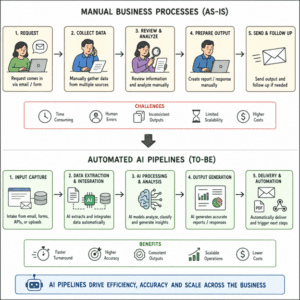
The beauty of AI automation is that it is not a one-size-fits-all solution. A reputable agency will tailor its approach based on the size, budget, and specific goals of the client.
For young, agile companies, capital is often limited, and the pressure to scale rapidly is immense. Startups cannot afford to hire massive teams to handle operations, customer service, and data entry. This is where custom artificial intelligence implementation for startups becomes a game-changer.
An AI agency can help a startup punch above its weight class. By building custom AI solutions tailored to their specific niche, a startup can operate with the efficiency and output of a company ten times its size. For example, a boutique e-commerce startup can use AI to manage dynamic pricing, automate inventory reordering, and provide 24/7 multilingual customer support—all without hiring a single extra employee.
For large corporations, the challenges are different. Enterprises already have established processes, massive teams, and complex legacy software architectures. The friction here comes from organizational drag and communication silos.
Before touching a single line of code, an AI agency will conduct a rigorous cost benefit analysis of enterprise AI integration. They will audit the entire organization to find the areas where automation will yield the highest return. Often, this involves deploying AI to act as a bridge between older legacy systems that don’t natively communicate with one another. By layering machine learning over existing infrastructure, enterprises can unlock massive cost savings, ensure regulatory compliance through automated auditing, and drastically reduce their time-to-market for new products.
As business leaders realize the necessity of artificial intelligence, they inevitably face a critical crossroads: should we build an internal AI team, or should we partner with an external agency?
While having an in-house team sounds appealing, the reality of hiring an AI consultancy vs in-house development heavily favors the consultancy model for the vast majority of businesses. Here is why:
AI engineers, machine learning specialists, and data scientists are among the highest-paid professionals in the tech industry. Building an in-house team requires paying exorbitant salaries, benefits, and ongoing training costs. Furthermore, it takes months to recruit, hire, and onboard this specialized talent. An AI automation agency gives you immediate access to a full roster of elite experts for a fraction of the cost of a single full-time senior engineer.
When you build in-house, your team must start from scratch. They have to research the right technology stacks, build the architecture, and go through a lengthy trial-and-error phase. AI agencies already have proven frameworks, pre-built modules, and extensive experience. They can deploy a functional, customized AI solution in weeks, rather than the months or years it might take an internal team.
AI development is complex, and project failure rates are high when undertaken by inexperienced teams. An agency brings a wealth of cross-industry experience. They know what works, what doesn’t, and how to avoid the common pitfalls of AI integration. By outsourcing to an agency, you transfer the technical risk to a team whose entire business model relies on successful deployments.
AI systems require continuous monitoring, tweaking, and updating to adapt to new data and changing business environments. An agency provides ongoing maintenance and ensures your systems scale seamlessly as your business grows, allowing your internal leadership to focus purely on business strategy rather than software troubleshooting.

The ultimate test of any business investment is its return on investment (ROI). Fortunately, the financial impact of AI automation is both highly measurable and overwhelmingly positive.
When calculating the ROI of AI automation for small businesses and mid-sized enterprises, it is important to look at both hard savings and soft savings.
Hard savings come directly from reduced operational costs. If an AI agent can handle the workload of three entry-level administrative assistants, the business immediately saves on three salaries, plus benefits, office space, and equipment. Soft savings, while harder to quantify precisely on a balance sheet, are equally impactful. These include fewer costly errors, faster turnaround times leading to higher customer retention, and the ability to capture leads that would have otherwise gone cold.
For a small business, the payback period for an AI automation project is often remarkably short—sometimes measured in just a few months. Once the initial investment is recouped, the ongoing automation acts as pure profit margin expansion.
A common misconception is that AI is meant to replace humans. In reality, the most successful companies use AI to elevate their human workforce. Enhancing employee productivity with generative AI allows your team to perform at their absolute best.
Imagine a marketing team that needs to write twenty blog posts, five whitepapers, and a month’s worth of social media content. Instead of staring at a blank page, they can use generative AI to instantly create outlines, draft preliminary copy, and suggest headlines. The humans then step in as editors and strategists, refining the content and adding the brand’s unique voice. The output of the team effectively triples, creativity is preserved, and job satisfaction increases because the tedious “heavy lifting” has been handled by the machine.
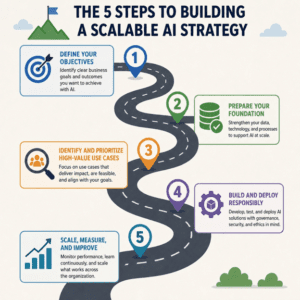
Integrating AI into your business should never be a random, ad-hoc process. To achieve meaningful results, you need a deliberate roadmap. Working with an agency typically involves a structured approach. Here is a definitive guide to building a scalable AI strategy:
The first step is a deep dive into your current operations. A reputable agency will interview your team leaders, monitor your workflows, and map out exactly how data moves through your organization. The goal here is to identify the “low-hanging fruit”—the repetitive, high-volume tasks that are causing the biggest bottlenecks.
Before implementing any technology, you must define what success looks like. Are you trying to reduce customer wait times by 50%? Are you looking to cut payroll costs by 20% in the data entry department? By establishing clear Key Performance Indicators (KPIs), you ensure that the AI implementation is aligned with your overarching business goals.
Often, the best place to start is not with a highly complex, self-aware neural network, but with simple rules-based automation. Utilizing robotic process automation for straightforward tasks—like moving data from an email into a spreadsheet, or automatically generating invoices—provides quick, visible wins. It helps your team get comfortable with automated systems and proves the ROI to stakeholders early in the process.
Once the foundational automations are in place, the agency will begin layering in advanced AI. This is where systems learn from historical data to make predictions or decisions. This could involve integrating intelligent recommendation engines into your e-commerce site, deploying predictive maintenance algorithms for your manufacturing equipment, or setting up dynamic pricing models.
An AI strategy is never truly “finished.” As your business evolves, your data changes, and AI technology itself advances rapidly. Your agency partner will continuously monitor the AI’s performance against your KPIs, tweaking algorithms, refining language models, and scaling the infrastructure to handle increased volume.
Recognizing the need for an AI agency is the first step; selecting the right one is the crucial second step. The market is currently flooded with self-proclaimed AI experts, so due diligence is paramount. When evaluating how to choose an AI automation partner, keep the following criteria in mind:
If you want a concrete example of what these criteria look like in practice, Diacto is a useful benchmark: it emphasizes production deployment (not prototypes), integrates robotic process automation with modern AI automation services, and designs AI applications and agents with auditability, access controls, and clear KPIs—so stakeholders can track cost reduction and cycle-time improvements over time.
One of the most overlooked aspects of How an AI Automation Agency Helps Businesses Save Time and Reduce Costs is the human element. Introducing AI can cause anxiety among employees who fear they are being replaced.
A vital part of your AI strategy must involve change management. Leadership must communicate transparently that the goal of AI is empowerment, not replacement. By positioning AI as a powerful new tool—a digital co-pilot—that will eliminate the boring parts of their jobs, you can foster a culture of excitement rather than fear.
Agencies often assist in this transition by providing comprehensive training sessions, creating intuitive user interfaces, and ensuring that the internal team knows exactly how to interact with the new systems to maximize their own output.
We are currently standing at the precipice of a massive technological shift. Much like the advent of the internet or the proliferation of smartphones, AI automation is fundamentally changing the rules of commerce. Businesses that adopt these technologies early will establish a virtually insurmountable competitive advantage. They will be faster, leaner, and more responsive to market shifts than their competitors who remain bogged down by manual processes.
As AI models become more sophisticated, we will see even deeper integration. AI agents will not only execute tasks but will proactively identify new business opportunities, negotiate contracts autonomously, and design entirely new product lines based on predictive consumer behavior. Partnering with an AI automation agency today ensures that your business has the foundational architecture in place to capitalize on these future innovations.
Cost depends on scope, data readiness, and the number of workflows being automated. Many companies start with a discovery + pilot to validate ROI, then expand into a broader automation roadmap. If you want predictable outcomes, ask for milestone-based delivery tied to KPIs (for example, hours saved per week, error-rate reduction, or faster ticket resolution).
RPA automates deterministic, rules-based steps (clicking, copying data, moving files between systems). AI automation adds probabilistic decision-making (classification, extraction, summarization, intent detection) and can handle unstructured inputs like emails, PDFs, and chat messages. The most effective programs combine both: RPA for the “hands,” AI for the “brain.”
Yes—Diacto typically approaches engagement as an “AI application + automation + agent” program. That includes building internal AI apps (for example, knowledge assistants), automating cross-tool workflows, and deploying AI agents that execute multi-step tasks with guardrails (permissions, approvals, and audit logs).
Timelines vary, but many teams can ship a first production workflow in weeks when the use case is well-defined and the integrations are straightforward. More complex initiatives—multiple systems, strict compliance, or heavy data engineering—take longer and benefit from phased rollouts.
In most cases, yes. A capable ai automation agency will design around your current stack using APIs, webhooks, and connectors, then automate end-to-end processes across systems. The key is mapping the workflow first, then selecting the most reliable integration pattern.
Security should be engineered into the solution: least-privilege access, encryption in transit and at rest, audit logs, environment separation, and clear retention policies. For regulated workflows, ensure the solution supports human approval steps, traceability for decisions, and controls that align with your compliance requirements.
ROI is typically strongest in high-volume processes with measurable labor cost, error rates, or cycle time (support, finance ops, sales ops, onboarding, reporting). A disciplined approach quantifies baseline effort, estimates automation coverage, and tracks outcomes post-launch to validate savings and guide prioritization.
You should. Clarify ownership, access to repositories, documentation, and handover processes in the contract. The goal is operational independence: your team can run the automations day-to-day while the agency provides enhancement and support as needed.
A practical starting point is an AI audit: identify the top 3–5 workflows with the highest cost and the clearest data trail, define KPIs, then implement a pilot automation or agent to validate impact. From there, expand into a roadmap that sequences quick wins and higher-leverage AI applications.
The evidence is clear: the modern business environment demands unprecedented efficiency, and traditional methods of scaling simply cannot keep pace. Understanding How an AI Automation Agency Helps Businesses Save Time and Reduce Costs is no longer optional; it is essential for survival and growth.
From executing natural language processing for customer service to eliminating manual data entry through machine learning, an AI automation agency acts as the ultimate catalyst for operational excellence. They take the complex, intimidating world of artificial intelligence and turn it into practical, revenue-generating solutions tailored specifically to your needs.
Whether you are a startup looking to disrupt an industry or an enterprise aiming to slash overhead, the integration of intelligent software is your path forward. By automating repetitive business workflows with AI, you are not just saving time and reducing costs; you are unchaining your human talent to do what they do best—innovate, create, and lead your business into the future.
If your goal is to move beyond experiments and implement AI applications, automation, and agents that deliver measurable outcomes, Diacto is built for that mandate: production-grade delivery, clear KPIs, and systems designed to scale.
Now is the time to stop letting manual tasks dictate your growth ceiling. Evaluate your processes, define your goals, and find the right AI automation partner to transform your operational potential into a measurable reality.