Embarking on a journey through the dynamic landscape of data analytics, our blog series unfolds the intricate realms of four distinct types of analysis. If you’ve ever wondered what are the different types of analysis used across business and research, this guide clarifies the major data analysis types and where each one delivers value.
All types of analytics unveil a unique set of tools and methodologies, offering organizations a comprehensive toolkit to harness the power of data. Join us as we delve into the nuances of these analytics disciplines, exploring their types, techniques, cornerstones, and real-world applications.
Whether you’re navigating the past with descriptive insights, foreseeing the future through predictive models, diagnosing present challenges with precision, or prescribing optimal strategies for success — this series promises to demystify the world of data analytics, empowering you with knowledge to make informed decisions and drive transformative outcomes using the types of analysis that best suits your needs.
Welcome to the intersection of data and strategy, where analytics becomes the key to unlocking untapped potential in every facet of business. Let us have a detailed look at all four types of data analysis. These data analysis types provide a practical roadmap for selecting the right approach for your goals.
In the ever-evolving landscape of data analytics, descriptive analytics stands as a foundational pillar, providing organizations with valuable insights into past performance and trends. Let’s delve into the world of descriptive analytics, exploring its types, key techniques, cornerstones, and a common example that highlights its significance.
Descriptive analytics is a types of data analysis which involves the analysis of historical data to gain a comprehensive understanding of what has happened within an organization. It aims to answer the question, “What happened?” by summarizing and presenting data in a meaningful way. In many teams, descriptive analytics is often discussed alongside descriptive analysis as closely related concepts.
Consider a retail company analyzing sales data from the past year. Descriptive analytics, also known as descriptive analysis, would involve examining sales figures, identifying peak periods, and visualizing sales performance across different product categories. Through techniques like data aggregation and visualization, the company gains insights into its best-selling products, busiest sales periods, and potential areas for improvement using descriptive statistics.
In conclusion, descriptive analytics serves as a vital starting point for organizations seeking to understand their historical data and gain business intelligence. By leveraging various types and techniques, businesses can uncover valuable insights, paving the way for informed decision-making and strategic planning. As the first step in the analytics journey, descriptive analytics lays the groundwork for more advanced forms of analysis and predictive modeling.
Predictive analytics emerges as a powerful force, enabling organizations to anticipate future outcomes and trends. Let’s explore the realm of predictive analytics, including its types, key techniques, cornerstones, and a real-world example that showcases its transformative capabilities.
Predictive analytics types of data analysis which involves the use of statistical algorithms and machine learning techniques to forecast future events based on historical data patterns. It goes beyond descriptive analytics, seeking answers to the question, “What is likely to happen?” In some sources, you may also see references to predictive analysis, and even the occasional misspelling of predictive analysis, all pointing to the same forward-looking approach.
descriptive analytics
descriptive analytics
Imagine a healthcare organization using predictive analytics to forecast patient admission rates. By analyzing historical data, including patient demographics, seasonal trends and historical admission patterns, the organization can develop a predictive model. This model can then anticipate future admission rates, enabling the allocation of resources, such as staffing and bed availability, to meet the expected demand.
In conclusion, predictive analytics empowers organizations to move beyond historical insights and embrace a proactive approach to decision-making. By employing various types and techniques, businesses can gain a competitive edge by anticipating trends, mitigating risks, and optimizing strategies. As technology continues to evolve, predictive analytics remains at the forefront of innovation, driving smarter and more informed business decisions through the use of statistical modeling for better business decisions.
Diagnostics analytics takes center stage, providing organizations with the tools to delve deep into data, uncover anomalies, and diagnose issues. This blog explores the nuances of diagnostics analytics, including its types, key techniques, cornerstones, and a real-world example that exemplifies its diagnostic prowess.
It is the types of data analysis which focuses on identifying and diagnosing problems within a system or process. It aims to answer the question, “What went wrong?” by scrutinizing data for irregularities, outliers, or patterns that deviate from the norm.
Consider an e-commerce platform utilizing diagnostics analytics, specifically diagnostic analysis, to address a sudden decline in website traffic and sales. By conducting a root cause analysis, the team may discover a technical issue affecting the website’s performance. Diagnostics analytics enables them to pinpoint the exact problem, whether it’s server issues, website downtime, or a specific page malfunction, facilitating a swift resolution.
In conclusion, diagnostics analytics, including diagnostic analytics and data discovery, is instrumental in identifying and resolving issues within complex systems. By employing a combination of techniques and maintaining a commitment to data quality, organizations can leverage diagnostics analytics to enhance operational efficiency, minimize downtime, and ensure a seamless user experience. As businesses continue to rely on data-driven insights, diagnostics analytics emerges as a critical component in maintaining optimal performance and addressing challenges head-on.
In the realm of data analytics, prescriptive analytics takes the spotlight as a forward-thinking approach that not only identifies issues but also prescribes optimal solutions. This blog explores the intricacies of prescriptive analytics, shedding light on its types, key techniques, cornerstones, and a real-world example that showcases its transformative capabilities.
These types of data analysis goes beyond diagnosing problems; it recommends actions to optimize outcomes. It answers the question, “What should be done?” by leveraging advanced algorithms and models to provide actionable insights and strategic recommendations. In some contexts, you’ll also see the term prescriptive analysis used to describe this approach.
Imagine a supply chain management scenario where a company employs prescriptive analytics to optimize inventory levels. By considering factors like demand forecasts, production costs, and storage constraints, the system recommends the optimal order quantities and reorder points. This ensures that the company maintains sufficient stock to meet demand while minimizing carrying costs.
In conclusion, prescriptive analytics empowers organizations to not only navigate complex challenges but also seize opportunities proactively. By leveraging advanced techniques and models, businesses can make informed decisions that drive efficiency, reduce costs, and enhance overall performance. As technology continues to advance, prescriptive analytics, including prescriptive analysis, which involves the synthesis of big data, mathematical science, business rules, and machine learning, remains a key player in the evolution of data-driven decision-making, helping businesses stay agile and thrive in a rapidly changing landscape.
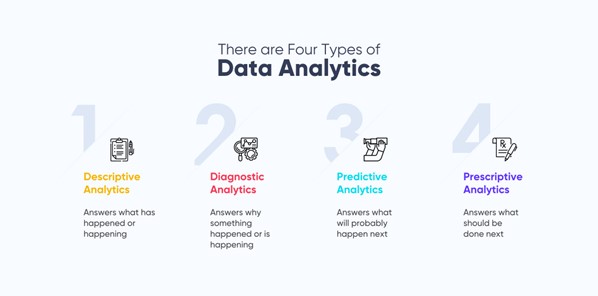
Descriptive analytics, predictive analytics, diagnostic analytics, and prescriptive analytics are different types to data analysis, each with its own purpose and benefits. Collectively, these data analysis types help teams move from hindsight to foresight and action.
Descriptive analytics focuses on summarizing data and providing insights into past events. It helps businesses understand what has happened, identify trends, and gain a broader perspective on their data. Descriptive analytics utilizes measures of central tendency, data visualization, and various tools to present data in a meaningful and easy-to-understand format. Many practitioners refer to this as descriptive analysis in day-to-day discussions.
Predictive analytics, on the other hand, looks into the future, leveraging historical data and statistical algorithms to make predictions about future events and behaviors. It enables businesses to anticipate trends, identify opportunities, and optimize decision-making processes. Predictive analytics uses regression analysis, machine learning, and data mining techniques to generate predictive models.
Diagnostic analytics goes beyond descriptive and predictive analytics, aiming to understand the root causes of specific data points or outcomes. It helps businesses uncover patterns, relationships, and anomalies within data sets, allowing them to gain a deeper understanding of why certain events occurred. Diagnostic analytics involves data exploration, data mining, and exploratory data analysis techniques.
Compared to the previous three types of analytics, prescriptive analytics takes data analysis a step further by providing actionable recommendations. It considers various scenarios, constraints, and optimization techniques to determine the best course of action. Prescriptive analytics helps businesses optimize their decision-making processes, allocate resources effectively, and achieve the desired outcomes. In many overviews of types of data analysis, this is presented as the final stage of maturity.
In summary, descriptive analytics provides insights into the past, predictive analytics focuses on the future, diagnostic analytics uncovers causes, and prescriptive analytics offers recommendations for optimal decision-making. Each type of data analysis plays a crucial role in helping businesses make informed decisions and drive success.
In conclusion, these types of data analysis plays a crucial role in shaping business strategies and making informed decisions. Descriptive analytics helps you understand what has happened in the past, while predictive analytics allows you to anticipate future outcomes. Diagnostics analytics helps you identify the root causes of problems, and prescriptive analytics provides actionable insights to optimize your business processes. Together, these data analysis types form a practical toolkit for modern organizations.
To harness the power of these types of data analysis, it is essential to choose the right type of analysis for your specific needs. Whether you need to analyze customer behavior, optimize operations, or improve decision-making, data analysis can provide valuable insights.
If you’re ready to take your business to the next level with data analysis, we offer a free consultation/demo to help you understand how our solutions can benefit your organization. Contact us today to get started.
Question: What are the four main types of data analysis and the key question each answers?
Short answer:
Question: How do these analytics types build on each other in practice?
Short answer:
They form a progression from hindsight to action. Descriptive establishes a factual baseline, diagnostic explains the drivers behind those facts, predictive projects likely futures from past patterns, and prescriptive turns forecasts and constraints into concrete recommendations. Many teams mature through this sequence as data quality, skills, and tooling improve.
Question: Which techniques are commonly used in each analytics type?
Short answer:
Question: What cornerstones or best practices make analytics effective across all four types?
Short answer:
Question: Can you share real-world examples that illustrate each type?
Short answer: