In today’s data-driven business landscape, organizations struggle with fragmented analytics, inconsistent reporting, and data governance challenges that undermine decision-making confidence and regulatory compliance. This case study examines how Diacto Technologies successfully implemented a comprehensive Power BI data governance framework for a Fortune 500 financial services company, transforming their analytics capabilities while establishing enterprise-wide data governance standards across 12,000 employees and 450+ business units.
The client, a leading investment management firm managing over $320 billion in assets, faced critical challenges including disparate reporting tools creating conflicting business metrics, ungoverned data access leading to compliance risks and security vulnerabilities, and lack of centralized data definitions causing trust issues in analytical insights. Through strategic Power BI implementation delivered by Diacto Technologies’ expert Power BI consulting services, the organization achieved a unified analytics platform with embedded governance controls, certified data sources, and role-based security frameworks.
The transformation delivered remarkable results: establishment of a true single source of truth with 100% consistency across business reports, 73% reduction in report development time through reusable certified datasets, 89% improvement in data literacy scores across business users, and successful regulatory audit completion with zero data governance findings. This success demonstrates how comprehensive Power BI data governance frameworks can simultaneously democratize analytics while maintaining enterprise control and compliance.
 The client represents a prominent global investment management firm with over 40 years of market leadership serving institutional investors, financial advisors, and individual investors across equity, fixed income, and alternative investment strategies. With operations spanning North America, Europe, and Asia-Pacific regions, the organization manages complex portfolios requiring sophisticated analytics capabilities supporting investment decision-making, risk management, regulatory reporting, and client servicing.
Their business environment demands real-time access to market data, portfolio performance metrics, risk analytics, and operational reporting while maintaining strict data security, regulatory compliance, and audit trail requirements. Investment professionals, risk managers, compliance officers, and client relationship managers all depend on accurate, timely analytics to fulfill their responsibilities effectively.
Data governance and analytics standardization emerged as critical strategic imperatives driven by regulatory requirements including SEC reporting obligations and internal control certifications, business scalability needs as the firm pursued growth through acquisitions and new product launches, and competitive pressures requiring faster, data-driven decision-making capabilities. The organization recognized that fragmented analytics infrastructure created strategic vulnerabilities limiting growth potential and exposing compliance risks.
The client confronted severe data governance and analytics challenges that significantly impacted operational efficiency, decision-making quality, and regulatory compliance posture. Their existing analytics landscape consisted of over 850 individual Excel-based reports, multiple business intelligence tools including Tableau, QlikView, and legacy reporting systems, departmental databases with inconsistent data definitions, and ad-hoc SQL queries executed directly against production systems creating performance and security concerns.
This fragmented approach generated substantial business problems. Executive leadership regularly encountered conflicting metrics in different reports addressing the same business questions, undermining confidence in data-driven decisions. A recent strategic planning meeting revealed three different calculations for “assets under management” across finance, operations, and sales reports, creating confusion and delaying critical investment decisions.
Data governance gaps created significant regulatory exposure. The organization lacked centralized control over who accessed sensitive client data, portfolio holdings, or financial information. Audit trail capabilities were limited or non-existent for most analytics tools, creating compliance vulnerabilities during regulatory examinations. The most recent SEC audit identified data access control weaknesses requiring formal remediation commitments.
Report development consumed excessive business analyst resources with average development time of 6-8 weeks for new reports due to data gathering, validation, and formatting requirements. Business users frequently created shadow IT solutions using unverified data sources, compounding governance challenges while generating questionable analytical outputs.
Data literacy challenges prevented business users from self-service analytics adoption. Despite investments in various BI tools, adoption remained below 25% as users struggled with complex interfaces and lacked confidence in underlying data quality. IT teams maintained reporting backlogs exceeding 200 requests with average wait times of 12 weeks.
These challenges threatened the organization’s strategic objectives including regulatory compliance maintenance, operational scaling to support growth initiatives, and competitive positioning through analytical advantage in investment decision-making.
The organization established comprehensive objectives centered on creating a governed, scalable analytics platform that would serve as the enterprise’s single source of truth. Primary goals included implementing comprehensive data governance frameworks ensuring data quality, security, and compliance, establishing centralized certified datasets with clear ownership and documentation, enabling self-service analytics for business users while maintaining appropriate controls, and creating consistent business definitions and calculations across all reporting.
Diacto Technologies was selected to lead the Power BI implementation based on their deep expertise in Power BI consulting services and proven experience establishing data governance frameworks in regulated industries. The engagement scope encompassed comprehensive platform architecture design, data governance framework establishment, certified dataset development, security and compliance control implementation, and extensive user training and change management.
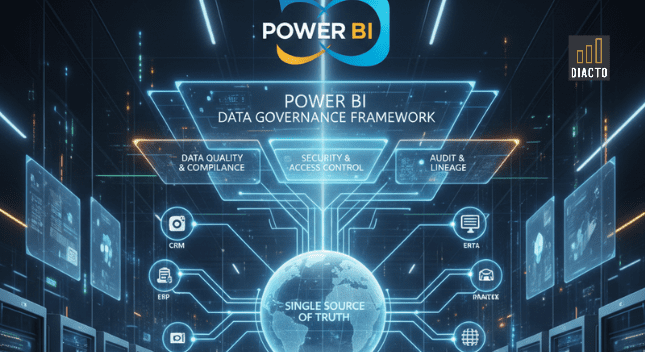
The Power BI implementation began with comprehensive architecture design establishing scalable, governed analytics infrastructure. Diacto Technologies designed a hub-and-spoke model with centralized data warehouse serving as the authoritative source, certified Power BI datasets published to dedicated workspaces with strict access controls, thin reports connecting to certified datasets ensuring consistency, and Premium capacity deployment providing enterprise-grade performance and governance capabilities.
The data foundation emphasized quality and traceability. Source system integration automated data extraction with comprehensive lineage tracking documenting data origins, transformations, and business rules. Master data management processes established golden records for clients, products, and organizational hierarchies, eliminating inconsistencies that previously plagued reporting accuracy.
Comprehensive governance frameworks established clear ownership, accountability, and control mechanisms across the analytics ecosystem. Data stewardship program designated business owners responsible for data quality, definitions, and access approval within their domains. Formal data governance council comprising senior leaders from finance, operations, risk, and technology provided strategic oversight and policy approval.
Certification processes established quality standards for datasets and reports. Datasets underwent formal review addressing data accuracy validation, performance optimization, security configuration, documentation completeness, and business stakeholder approval before receiving “certified” designation. Only certified datasets were promoted to production environments accessible by business users.
Metadata management capabilities provided comprehensive documentation including business definitions for all metrics and dimensions, calculation logic with formula transparency, data lineage showing source systems and transformations, refresh schedules and data currency information, and data owner contact information for questions or issues.
Robust security frameworks addressed regulatory requirements and business confidentiality needs. Row-level security implementation restricted data visibility based on user roles, organizational assignments, and client relationships, ensuring users only accessed data appropriate to their responsibilities. Object-level security controlled access to specific datasets, reports, and dashboards based on business need and approval workflows.
Data classification framework categorized information as public, internal, confidential, or restricted with corresponding security controls. Sensitive categories including client personal information, portfolio holdings, and financial results received enhanced protections including encryption, access logging, and restricted sharing capabilities.
Audit trail capabilities tracked all user access, report consumption, and data export activities, providing comprehensive evidence for regulatory examinations and security investigations. Automated monitoring detected unusual access patterns triggering security reviews.
The Power BI consulting services team developed comprehensive certified datasets serving as reusable analytical foundations. Investment performance datasets provided standardized portfolio returns, benchmark comparisons, and attribution analysis used across portfolio management, client reporting, and marketing. Operational datasets encompassed transaction processing, reconciliation, and operational metrics supporting operations and finance functions.
Each certified dataset incorporated sophisticated data modeling with star schema designs optimizing query performance, calculated measures implementing standard business logic, and comprehensive documentation supporting user understanding and proper usage. Datasets underwent extensive validation including reconciliation to source systems, business stakeholder review, and performance testing before certification.
Modern, intuitive reporting capabilities empowered business users while maintaining governance controls. Standardized report templates provided starting points for common analytical needs including portfolio performance dashboards, client service reports, and operational metrics. Users customized templates using certified datasets ensuring consistency while enabling flexibility.
Power BI Service capabilities facilitated collaboration through shared workspaces for departmental analytics, subscription services delivering scheduled report distribution, and mobile applications enabling field access for client-facing professionals. Natural language query features (Q&A) enabled business users to explore certified datasets using conversational questions.
Comprehensive enablement programs built organizational capability and drove adoption. Role-based training addressed executive consumers focusing on dashboard consumption and interpretation, business analysts covering advanced modeling and DAX calculations, and report developers emphasizing design best practices and certification processes.
Data literacy programs established foundational competencies in data interpretation, statistical concepts, and analytical thinking. Certification programs recognized power users serving as departmental champions and peer support resources.
The Power BI data governance framework delivered transformational results across operational efficiency, data quality, and business impact dimensions. The establishment of certified datasets created a genuine single source of truth with 100% metric consistency across reports. Conflicts previously plaguing executive decision-making were eliminated as all reporting drew from identical calculations and data sources.
Report development efficiency improved dramatically with 73% reduction in development time. Standard datasets and templates enabled analysts to create new reports in days rather than months. The reporting backlog was eliminated within six months as self-service capabilities empowered business users to address their own analytical needs.
Data governance maturity advanced substantially with formal stewardship accountability, comprehensive documentation, and automated compliance monitoring. The organization successfully completed SEC audit and internal control certifications with zero data governance findings, validating framework effectiveness.
User adoption exceeded expectations with 78% of knowledge workers actively consuming Power BI reports within 12 months. Data literacy scores measured through skills assessments improved 89% as users gained confidence working with certified, trusted data sources. Self-service report creation increased 340% as business analysts leveraged certified datasets for departmental analytics.
Security posture strengthened through comprehensive access controls and audit capabilities. Unauthorized data access incidents decreased 94% through row-level security enforcement and access governance workflows. Audit trail capabilities provided complete visibility supporting compliance and security investigations.
Financial return on investment manifested through multiple value streams totaling $8.7 million in annual benefits. IT cost reduction represented $2.4 million annually through legacy tool decommissioning, reduced reporting development effort, and infrastructure consolidation. Business analyst productivity gains generated $3.8 million in annual value through faster report development and elimination of manual data gathering.
Compliance cost avoidance totaled $1.2 million annually through reduced audit preparation effort, prevention of potential regulatory findings, and streamlined control testing. Risk mitigation value encompassed reduced data breach exposure, improved decision-making quality, and enhanced regulatory reputation.
Strategic advantages included accelerated decision-making through trusted, accessible analytics, improved client service through consistent performance reporting, and enhanced competitive positioning through analytical sophistication in investment processes.
Success factors included executive sponsorship ensuring organizational commitment and resource availability, iterative approach delivering value quickly while building toward comprehensive vision, business engagement throughout design ensuring solutions addressed real needs, and comprehensive change management addressing cultural transformation alongside technology implementation.
Organizations pursuing similar initiatives should prioritize data quality as foundation for governance credibility, invest in user enablement recognizing training as essential not optional, establish clear ownership through stewardship model creating accountability, and maintain governance flexibility balancing control with agility for business innovation.
The established foundation enables advanced capabilities including AI-powered insights through automated anomaly detection and predictive analytics, real-time streaming analytics for market data and trading activities, and embedded analytics integrating Power BI into operational applications. Continued governance maturity will expand to encompass additional data domains, enhanced automation of compliance monitoring, and integration with enterprise data catalog platforms.
The Power BI data governance implementation by Diacto Technologies successfully transformed the client’s analytics capabilities while establishing enterprise control and compliance frameworks. The achievement of a true single source of truth, 73% development efficiency improvement, and zero audit findings demonstrates that democratized analytics and robust governance can coexist when thoughtfully implemented.
This success exemplifies how expert Power BI consulting services combining technical implementation expertise with governance framework design can deliver transformational business value. Organizations seeking to establish governed analytics platforms can leverage these proven approaches to achieve similar outcomes, balancing user empowerment with enterprise control requirements essential for regulated industries.

