ClickHouse consulting services help organizations design, optimize, and operate analytics infrastructure that can keep up with growing data volume, faster reporting needs, and more demanding business users. The real goal is not simply to run a fast database; it is to turn fragmented operational, product, customer, and financial data into actionable insight that improves efficiency, decision-making, and growth. Expert support is especially valuable when teams need strong ClickHouse performance, a reliable ClickHouse architecture, and a clear path from raw data to business-ready analytics.
ClickHouse consultants help organizations plan, build, tune, and govern analytics systems based on ClickHouse, with attention to both engineering quality and business outcomes. They look at how data is produced, ingested, modeled, queried, secured, and consumed, then recommend practical changes that make the platform faster, easier to operate, and more useful for analysts, applications, and leadership teams.
That work often begins with discovery. Consultants review current data sources, reporting pain points, query patterns, ingestion flows, infrastructure choices, and team capabilities. From there, they can identify whether the main constraint is schema design, partitioning strategy, cluster sizing, inefficient queries, weak data pipelines, unclear ownership, or a mismatch between business needs and the current implementation.
The best consulting work connects architecture decisions to business value. Faster dashboards are useful, but the deeper benefit is that teams can make decisions before opportunities disappear. Reliable data pipelines matter because they reduce manual reconciliation. Well-modeled analytics data matters because sales, finance, operations, and product teams can work from the same version of truth instead of debating spreadsheets.
ClickHouse is commonly chosen for analytical workloads where teams need to scan, aggregate, and filter large volumes of data quickly. It is often used for product analytics, observability, customer behavior analysis, event data, operational reporting, financial analytics, and embedded analytics inside customer-facing applications. In these situations, slow queries do more than frustrate users; they limit what the organization is willing to measure.
A consulting partner helps confirm whether ClickHouse is the right fit for the workload. Not every data problem is a ClickHouse problem. Transactional workloads, small reporting use cases, or teams without a clear data operating model may need a different approach or a staged roadmap. A mature consultant will say that early, because sustainable analytics infrastructure depends on fit, not hype.
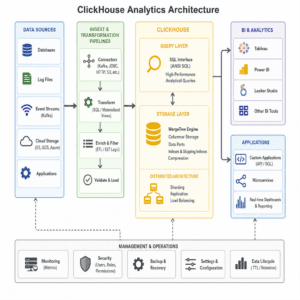
A scalable ClickHouse architecture should be designed around actual use cases, not generic infrastructure patterns. Consultants typically start by separating workloads into categories: real-time ingestion, batch ingestion, exploratory analytics, dashboard queries, application queries, ad hoc data science, and operational monitoring. Each category places different pressure on storage, CPU, memory, network, replication, and query design.
A useful architecture plan usually covers:
This is where architecture becomes a business discipline. If the design ignores how departments actually use data, teams may end up with a technically impressive platform that still produces duplicated metrics, unclear ownership, or inconsistent reporting. Good architecture reduces complexity for the people using the data, not just the engineers maintaining it.
ClickHouse performance is often improved by changing how data is structured and queried rather than simply adding more compute. Consultants look for patterns that create unnecessary scanning, expensive joins, poorly selected ordering keys, oversized partitions, high-cardinality issues, or transformation logic pushed into every dashboard query. These issues can quietly compound as adoption grows.
Performance work usually includes both diagnosis and education. A consultant may profile slow queries, review execution plans, inspect table design, and evaluate ingestion behavior. Just as important, they help internal teams understand why certain patterns work better in ClickHouse so that new models, dashboards, and application features do not repeat the same mistakes.
Practical ClickHouse performance improvements may include:
The outcome is not just lower latency. Better performance can increase adoption because business teams trust the system enough to use it daily. It can also reduce engineering firefighting, free analysts from manual workarounds, and make advanced analytics more accessible.
Teams should approach ClickHouse architecture as a staged operating model: define business goals first, map the data journey, design for the most important workloads, then improve based on measured usage. This prevents over-engineering while still creating a foundation that can scale as data volume, users, and analytics expectations grow.
A practical roadmap often starts with a focused use case, such as accelerating a set of critical dashboards or powering analytics for a high-volume product feature. Consultants can help define success criteria, select data sources, model core entities, and build the first production-ready pipelines. Once the initial foundation is stable, the organization can expand to more teams and use cases without rebuilding everything from scratch.
Many organizations do not begin with a clean analytics stack. They begin with fragmented systems, duplicated reports, inconsistent metrics, and teams that spend too much time reconciling data before they can act. ClickHouse can be part of the solution, but only when it sits inside a broader transformation approach.
Diacto’s work in data transformation reflects this bigger picture. Its approach connects data engineering, BI, analytics, AI, and automation in one ecosystem so organizations can move from disconnected information to repeatable insight workflows. That matters because the highest value rarely comes from storage alone; it comes from turning data into decisions, actions, and measurable operational improvement.
As ClickHouse adoption grows, governance becomes essential. Teams need clear definitions for core metrics, rules for who can access sensitive data, documentation for important models, and processes for testing changes before they affect reports or applications. Without this discipline, speed can create confusion faster than it creates value.
Consultants can help create lightweight governance that fits the organization’s maturity. The goal is not bureaucracy. The goal is to protect trust, reduce rework, and make sure analytics remains useful as more teams depend on it.
Running ClickHouse well requires ongoing attention. Teams must monitor resource usage, manage scaling, review query behavior, handle upgrades, tune ingestion, plan retention, and respond to incidents. For organizations whose core business is not database operations, this can consume time that would be better spent building data products and improving decision workflows.
Diacto’s managed ClickHouse service is relevant in that context. It gives organizations a way to use ClickHouse as part of an enterprise-ready analytics environment while reducing the operational load on internal teams. Instead of treating database management as a separate technical chore, the managed model can support the larger objective: dependable analytics infrastructure that serves BI, automation, AI initiatives, and business reporting.
This does not mean every organization should outsource everything. Some teams want to keep deep platform control in-house. Others prefer expert support for architecture and performance while retaining daily operations. A good consulting engagement should clarify the right balance between internal ownership, managed services, and advisory support.
Managed ClickHouse is often the better path when an organization needs production-grade analytics quickly, has limited internal database operations capacity, or wants expert support for performance, reliability, and scaling. It can also make sense when ClickHouse is part of a larger transformation program and the business needs outcomes faster than it can hire, train, and organize a specialized platform team.
The decision should be based on risk and opportunity cost. If internal engineers are spending too much time troubleshooting clusters, optimizing recurring queries, or maintaining pipelines instead of delivering analytics capabilities, managed support can create leverage. If business users are waiting on data because the platform is unstable or hard to evolve, expert operations can help restore momentum.
Diacto’s enterprise-ready solutions are designed for this type of environment, including complex data transformation programs for multinational organizations. That experience matters because larger companies often deal with multiple regions, business units, systems, governance expectations, and stakeholder groups. A scalable ClickHouse implementation must work within that reality, not around it.
A well-run engagement should feel structured, transparent, and grounded in the organization’s real priorities. It should not begin with a one-size-fits-all architecture diagram. It should begin with the business problem, the current data landscape, and the decisions the organization wants to improve.
Typical phases include:
The most valuable engagements leave the organization stronger after the consultants step away. Documentation, knowledge transfer, reusable patterns, and clear decision frameworks are just as important as technical fixes.
Before selecting a partner, organizations should look beyond general database knowledge. ClickHouse has specific design patterns, and analytics transformation has organizational complexity. The right partner should be able to operate across both.
Use this checklist during evaluation:
This checklist keeps the conversation focused on outcomes. The right consulting partner should help the organization become faster, clearer, and more confident in how it uses data.
ClickHouse can be a powerful foundation for high-performance analytics, but the technology delivers the most value when it is supported by thoughtful architecture, reliable operations, and a clear transformation strategy. Expert ClickHouse consulting services help organizations avoid costly design mistakes, improve ClickHouse performance, and build infrastructure that can grow with demand.
Diacto’s managed ClickHouse service and broader data transformation approach fit organizations that want more than a database deployment. By connecting data engineering, BI, analytics, AI, and automation in one ecosystem, Diacto helps turn fragmented data into actionable insight that supports efficiency, better decisions, and sustainable growth. For teams planning or improving a ClickHouse environment, that combination of technical depth and business focus can be the difference between faster queries and a truly scalable analytics capability.