Enterprise AI architecture is no longer a single-model decision. Most organizations now have to choose between retrieval-augmented generation, fine-tuning, AI agents, or a hybrid system that combines all three. The right choice depends on how fast your knowledge changes, how much control you need, what actions the AI must perform, and how much operational complexity your team can realistically support.
For leaders focused on ai model optimization, the goal is not to pick the most advanced technique. It is to build an architecture that produces reliable answers, fits governance requirements, scales economically, and supports the business process behind the use case. That is where partners like Diacto can help, especially when the challenge spans data engineering, BI, analytics, AI, and automation rather than model selection alone.
Choose RAG when your AI needs current, traceable information from documents or systems; choose fine-tuning when you need stable behavior, domain style, or task-specific consistency; choose AI agents when the system must plan, call tools, and complete multi-step work. In practice, enterprise teams often combine them: RAG supplies knowledge, fine-tuning improves behavior, and agents orchestrate action.
That simple distinction prevents many expensive mistakes. A support assistant that must answer from the latest policies should not rely only on a model trained months ago. A contract drafting assistant that must follow a precise structure may need more than retrieval. A procurement copilot that checks inventory, compares vendors, requests approval, and updates a system is no longer just answering questions; it is operating across a workflow.
The phrase rag vs fine-tuning vs ai agents can make these options sound like competitors. They are better understood as architectural layers. RAG connects a model to external knowledge. Fine-tuning changes how a model behaves. Agents give the model controlled access to tools, memory, and decision steps.
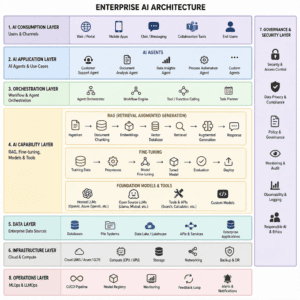
Retrieval-augmented generation, usually called RAG, retrieves relevant content at the moment a user asks a question. Instead of expecting the model to “remember” every policy, product detail, or internal procedure, the system searches approved sources, adds the most useful passages to the prompt, and asks the model to respond using that context.
This makes RAG especially useful when information changes often. Company FAQs, pricing rules, HR policies, product documentation, compliance guidance, and customer support articles rarely stay fixed for long. Updating a document store or knowledge base is usually faster and safer than retraining a model.
RAG also supports governance because the knowledge remains outside the model. Teams can manage permissions, remove outdated documents, restrict access by role, and show users where an answer came from. That traceability matters in regulated environments and in any organization where users will ask, “Why did the AI say that?”
The trade-off is operational complexity. A good RAG system depends on document ingestion, chunking, metadata, embeddings, vector search, re-ranking, prompt design, access controls, and monitoring. If the retrieval layer finds the wrong content, even a strong model can produce a weak answer.
Fine-tuning adjusts a model using curated examples so it performs a specific task more consistently. Those examples may teach tone, formatting, classification rules, domain phrasing, decision patterns, or specialized workflows. Unlike RAG, which adds external context at runtime, fine-tuning changes how the model responds by adapting its learned behavior.
This is valuable when the desired output is stable. Legal clause classification, medical coding support, technical ticket routing, document summarization in a house style, and structured report generation can all benefit from fine-tuning if teams have high-quality training data. The model can become more consistent without requiring a long prompt full of examples every time.
Fine-tuning can also reduce latency and recurring prompt costs because fewer instructions may be needed at inference time. However, it comes with upfront effort. Teams must prepare training data, define evaluation sets, run experiments, check for regressions, and plan future retraining if requirements change.
The governance challenge is different from RAG. Because knowledge or behavior is embedded into model weights, deletion, auditability, and provenance can be harder. Fine-tuning is strongest when the information is stable, the training data is well-controlled, and the primary goal is consistency rather than freshness.
AI agents extend the model beyond answering. An agent can break a goal into steps, select tools, call APIs, retrieve information, evaluate intermediate results, and continue until a task is complete. In enterprise settings, that can mean opening a ticket, updating a CRM, checking a dashboard, creating a draft report, or routing an exception to a human approver.
Agents become useful when work crosses systems. A simple chatbot may answer, “What is our travel policy?” A RAG-powered assistant may cite the correct policy section. An agent may check the employee’s location, confirm budget limits, create an expense pre-approval request, and notify the manager.
This capability introduces higher risk. Agents need permissions, guardrails, logging, human-in-the-loop controls, and clear failure handling. Their outputs are not just words; they may trigger business actions. That is why agent performance metrics must include more than answer quality. Teams need to measure task completion, tool accuracy, approval rates, error recovery, latency, escalation frequency, and cost per successful workflow.
Diacto’s end-to-end approach is relevant here because agents rarely live in isolation. They depend on clean data pipelines, integrated business systems, reliable analytics, and automation design. Connecting those pieces into one ecosystem is often the difference between a clever prototype and a production-grade enterprise capability.
No architecture should be chosen from a slide deck alone. The better path is to evaluate the use case against business requirements, data realities, and operational constraints. The following framework gives teams a structured way to narrow the choice.
| Decision factor | RAG is usually stronger when… | Fine-tuning is usually stronger when… | AI agents are usually stronger when… |
| Knowledge freshness | Source content changes daily, weekly, or unpredictably | Knowledge and rules remain stable for longer periods | Fresh knowledge must be used while completing tasks |
| Output consistency | Answers need citations but can vary in wording | Format, tone, classification, or reasoning patterns must be consistent | Consistency is needed across multi-step workflows |
| Governance | Teams need provenance, access control, and easier content removal | Data is approved for training and audit needs are manageable | Actions must be logged, permissioned, and reviewable |
| Latency | Some retrieval overhead is acceptable | Low-latency response is important | Latency depends on number of tools and steps |
| Cost profile | Query volume is moderate and knowledge changes often | High-volume repeat tasks justify upfront training | Value comes from automating work, not just reducing answer cost |
| Technical maturity | Team can manage retrieval pipelines and document quality | Team can curate datasets and evaluate model behavior | Team can manage orchestration, tools, permissions, and monitoring |
A useful starting question is: what would make the AI wrong? If the answer is “it used outdated information,” RAG is probably central. If the answer is “it responded in the wrong structure or misunderstood the task,” fine-tuning may help. If the answer is “it failed to complete the process,” agent design is the missing layer.
The more frequently knowledge changes, the more attractive RAG becomes. Internal policies, customer-facing documentation, product specifications, and regulatory guidance can shift faster than a model retraining cycle. With RAG, teams can update the source repository and make the new content available through retrieval without embedding it permanently into model weights.
This does not mean RAG is automatically easy. Content must be clean, deduplicated, chunked well, and tagged with useful metadata. Old documents must be retired. Sensitive documents must be permissioned. A weak knowledge base creates weak retrieval, and weak retrieval creates unreliable answers.
Fine-tuning becomes more attractive when the enterprise already knows exactly what good output looks like. If a team has thousands of approved examples and needs the model to classify, draft, transform, or respond in a repeatable way, fine-tuning can reduce prompt complexity and improve consistency.
This is especially useful for tasks that happen at high volume. If the same kind of request appears again and again, a tuned model may become more economical over time than a system that repeatedly sends long prompts and large retrieved contexts. The key is stability. If the expected behavior changes every week, fine-tuning can become a maintenance burden.
Agents are most useful when the AI must do more than generate text. They can coordinate a sequence: retrieve policy, inspect customer status, calculate eligibility, draft a response, create a ticket, and ask for approval. That makes them powerful for sales operations, finance operations, customer service, procurement, IT support, and analytics workflows.
The complexity is not only technical. Teams must define what the agent is allowed to do, when it must stop, when it must ask a human, and how to recover from errors. The more autonomy an agent has, the more important observability becomes.
RAG usually has lower upfront model-training effort but ongoing retrieval, infrastructure, and token costs; fine-tuning requires more preparation and experimentation upfront but can be efficient for stable, high-volume tasks; AI agents add orchestration costs but can deliver value by completing business processes. Performance should be judged by accuracy, latency, consistency, governance, and outcome quality, not by model scores alone.
RAG costs come from storing content, generating embeddings, running retrieval, passing context into the model, and maintaining the pipeline. It may be cost-effective for use cases where the knowledge changes often or where citations and access control are essential. However, as query volume and context size grow, recurring costs can rise quickly.
Fine-tuning costs come from data preparation, training runs, evaluation, deployment, and future retraining. Once the model is tuned, each request may require shorter prompts and less retrieved context, which can reduce inference overhead. But if the business keeps changing the task, the training cycle becomes part of the operating cost.
Agent costs are tied to the number of steps. Every tool call, retrieval request, model reflection, validation check, and escalation can add latency and expense. A well-designed agent should not reason endlessly. It should have clear instructions, bounded tool access, efficient workflows, and measurable stopping conditions.
Rather than asking which method is “cheaper,” ask where the cost will live:
This is where ai model optimization becomes a business discipline, not just a technical exercise. A lower model bill is not a win if the system produces stale answers, requires manual cleanup, or cannot pass compliance review. The total cost includes maintenance, monitoring, governance, user trust, and the cost of mistakes.
Latency requirements can narrow the architecture quickly. If users need near-instant responses, fine-tuning or compact prompts may be more attractive. RAG adds retrieval steps, and agents add tool calls or reasoning loops. Those extra steps may be acceptable for high-value work, but they can frustrate users in fast support or embedded product experiences.
The right design often separates simple and complex paths. A system might answer routine questions with a fast RAG flow, route specialized drafting to a fine-tuned model, and reserve agents for tasks that require actions across systems. That prevents every request from paying the cost of the most complex workflow.
Enterprise AI decisions should begin with risk, not end with it. A technically impressive system can fail if it cannot explain its sources, enforce permissions, log decisions, or satisfy internal controls. Governance is especially important when AI touches legal, healthcare, finance, HR, procurement, or customer data.
RAG has a governance advantage when teams need source traceability. Because content remains external, access can be managed at the document or system level. If a policy is outdated, it can be removed from the retrieval index. If a user lacks permission, the system should not retrieve restricted content.
Fine-tuning requires a different governance model. Training data must be approved, documented, and protected. Teams should know what examples influenced the model and whether sensitive data was included. Once information is absorbed into model behavior, it can be harder to prove removal or isolate the reason for a response.
Agents raise the stakes again because they can act. They need role-based permissions, audit logs, approval thresholds, sandboxing, and strong exception handling. A customer service agent that drafts a reply is different from one that issues refunds. A finance agent that summarizes invoices is different from one that approves payment.
Diacto’s positioning around End-to-End Data Transformation fits this reality. Enterprise AI governance is not only a model governance problem. It involves data lineage, reporting, analytics, workflow design, automation controls, and operational monitoring. Bringing data engineering, BI, analytics, AI, and automation into one connected ecosystem helps teams manage risk while still moving from insight to action.
Few mature systems rely on only one approach. RAG, fine-tuning, and agents solve different layers of the problem, so combining them can create a more capable and maintainable architecture. The best hybrid design is not the most complex one; it is the simplest combination that meets the use case requirements.
A common pattern is RAG plus fine-tuning. RAG supplies current facts, while fine-tuning teaches the model how to use those facts in a consistent format. For example, an internal legal assistant might retrieve the latest clause library and policy guidance while a tuned model drafts summaries in the organization’s preferred structure.
Another pattern is RAG plus agents. The agent uses retrieval to gather approved information, then takes a controlled action. For example, an IT support agent might retrieve troubleshooting steps, check device status through an API, create a ticket if needed, and escalate when confidence is low.
A more advanced pattern combines all three. A fine-tuned model provides consistent behavior, RAG supplies fresh knowledge, and an agent orchestrates workflow steps. This can work well when the use case involves both high-quality language output and operational follow-through.
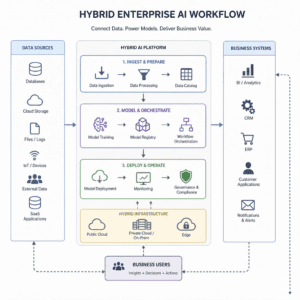
Hybrid architecture becomes easier to understand through practical scenarios:
These examples show why Diacto emphasizes connected transformation rather than isolated AI builds. If the data warehouse, BI layer, analytics models, AI interface, and automation tools do not work together, the AI architecture will struggle no matter which model technique is chosen.
A successful enterprise AI system needs clear ownership. RAG, fine-tuning, and agents each require different skills, and those skills must be coordinated across teams. Without an operating model, experiments pile up, quality becomes inconsistent, and production support turns reactive.
Data engineers usually own ingestion pipelines, data quality, transformations, metadata, and access patterns. For RAG, they help ensure the knowledge base is searchable, current, and permission-aware. For fine-tuning, they help prepare clean datasets. For agents, they connect tools and APIs safely.
ML engineers typically own model selection, prompt strategy, training experiments, evaluation design, deployment, and drift monitoring. They help determine whether a problem needs retrieval, tuning, orchestration, or a simpler rules-based solution. Their work is essential, but it cannot succeed without strong data foundations.
Business and domain experts define what “good” means. They review outputs, label examples, identify unacceptable failures, and help set escalation rules. In high-stakes domains, their judgment is part of the system design.
DevOps, platform, and security teams keep the system reliable. They manage environments, permissions, secrets, logging, scaling, incident response, and service-level expectations. With agents, their role becomes even more important because the AI may interact directly with business systems.
Before committing to RAG, fine-tuning, agents, or a hybrid design, enterprise teams should answer these questions:
This checklist also reveals when a company needs broader transformation support. Diacto can help organizations connect fragmented data, reporting, analytics, AI, and automation work so the architecture is not built on disconnected foundations.
Measurement is where many enterprise AI programs become too shallow. A model demo may look strong with a few sample prompts, but production quality requires ongoing metrics. The right metrics depend on whether the system uses RAG, fine-tuning, agents, or a hybrid structure.
For RAG, teams should measure retrieval quality, not just final answer quality. The system may fail because documents are missing, chunks are too large, metadata is weak, embeddings are misaligned, or the model ignores retrieved evidence. If the wrong context is retrieved, the final answer can appear fluent but still be unsupported.
For fine-tuning, teams should measure consistency, task accuracy, format adherence, and regression. A tuned model may improve one behavior while weakening another. Evaluation sets should include normal cases, edge cases, and examples that test policy boundaries.
For agents, agent performance metrics must capture the workflow. Did the agent choose the right tool? Did it call tools in the right order? Did it stop at the right time? Did it ask for approval when required? Did it complete the task without creating downstream cleanup?
A practical measurement plan should include:
Metrics should not become vanity dashboards. They should trigger decisions: improve retrieval, revise prompts, add training examples, tighten permissions, redesign an agent step, or remove automation from a risky edge case.
The first mistake is using fine-tuning to solve a knowledge freshness problem. If users need the latest documents, policies, or records, training the model is usually the wrong primary mechanism. The model may sound confident while relying on stale information.
The second mistake is using RAG to fix unclear behavior. Retrieval can provide facts, but it does not automatically make the model follow a preferred structure, classify reliably, or apply a nuanced writing style. If the task demands repeatable behavior, fine-tuning or stronger instruction design may be needed.
The third mistake is deploying agents before defining boundaries. Agents can look impressive in demos, but production systems need constraints. What tools can the agent use? What data can it access? What actions require approval? What happens when a tool returns conflicting information?
The fourth mistake is ignoring content and data quality. RAG depends on well-managed knowledge. Fine-tuning depends on clean examples. Agents depend on reliable systems and APIs. Model choice cannot compensate for weak enterprise data foundations.
The fifth mistake is optimizing locally instead of system-wide. A cheaper model call may increase manual review. A faster answer may reduce citation quality. A powerful agent may increase compliance risk. The architecture should be optimized for the full business outcome.
Diacto’s value is not limited to selecting an AI technique. Its End-to-End Data Transformation positioning is important because enterprise AI depends on the full data and automation ecosystem around the model. The same organization may need data pipelines cleaned, BI definitions aligned, analytics models governed, AI assistants designed, and workflow automation connected into production systems.
That integrated view matters when choosing between RAG, fine-tuning, and agents. A RAG system needs reliable ingestion, metadata, search, and permission logic. A fine-tuning program needs governed datasets, evaluation processes, and deployment discipline. An agentic workflow needs secure system integrations, analytics feedback loops, and automation controls.
For example, a company building an executive AI assistant may start with fragmented dashboards and inconsistent metric definitions. Jumping straight to an AI interface would only expose the inconsistency faster. A transformation-led approach would align data definitions, improve BI reliability, add analytics context, and then introduce AI and automation where they create measurable value.
Similarly, a customer support organization may want an agent that resolves cases automatically. Diacto’s integrated approach would look beyond the chatbot: knowledge base quality, ticket taxonomy, customer data access, escalation rules, reporting, agent performance metrics, and automation safety all need to work together. That is how AI moves from experiment to operating capability.
If you are still deciding where to begin, start small but design with the future in mind. A useful first version should solve a real problem, use governed data, and produce measurable outcomes. It should also leave room to add retrieval, tuning, or agentic automation as the use case matures.
Use this path as a practical guide:
This path keeps teams from overbuilding. Not every use case needs an autonomous agent. Not every task needs fine-tuning. Not every knowledge problem needs a complex vector architecture. The strongest enterprise AI systems are often designed with restraint.
RAG, fine-tuning, and AI agents each have a place in modern enterprise AI. RAG is strongest when knowledge changes and traceability matters. Fine-tuning is strongest when behavior must be consistent and the task is stable. Agents are strongest when AI must coordinate work across systems, tools, and approvals.
The real decision is rarely one versus the others. It is how to combine them in a way that supports business outcomes, governance, cost, performance, and user trust. That is the heart of ai model optimization: not chasing the newest architecture, but building a system that can be measured, maintained, and improved.
For many enterprises, the architecture conversation should begin with the data and operating model behind the AI. Diacto’s focus on integrating data engineering, BI, analytics, AI, and automation into one ecosystem helps organizations make that shift. When the foundation is connected, the choice between RAG, fine-tuning, and agents becomes clearer—and the resulting AI system is far more likely to deliver lasting value.