Organizations often reach for ClickHouse when dashboards, event analytics, product telemetry, observability, fraud monitoring, or AI-ready data products outgrow traditional analytical databases. The challenge is not simply installing a fast columnar database; it is designing a ClickHouse architecture that fits real query patterns, ingestion volume, governance needs, regional latency requirements, and production operations. ClickHouse implementation services help businesses move from evaluation to stable deployment without turning performance engineering, data modeling, and platform reliability into long internal trial-and-error cycles.
ClickHouse implementation services solve the gap between choosing ClickHouse and running it reliably for business-critical analytics. Many teams know they need faster analytics, but they may not yet know how to model data for columnar storage, design clusters, tune merge behavior, handle high-volume ingestion, secure access, or integrate ClickHouse with existing cloud, BI, AI, and data pipeline tools.
The business risk is practical. Slow dashboards reduce adoption, unreliable pipelines create mistrust in metrics, and poorly planned infrastructure can become expensive or difficult to operate. In distributed organizations, the stakes rise further because data may need to serve teams across regions while meeting compliance, residency, or latency expectations. A strong implementation approach connects technical decisions to commercial outcomes: faster decision-making, more dependable reporting, and a platform that can support future analytics and AI use cases.
For B2B teams, this is where a partner such as Diacto can be relevant: not as a generic software reseller, but as a technology implementation partner that helps align data architecture, analytics workflows, automation, and production operations around measurable business needs.
ClickHouse is an analytical database designed for fast read-heavy queries over large datasets. It is column-oriented, which means data is stored by column rather than by row, making it well suited for aggregations, filtering, time-series analysis, and dashboards where users scan selected fields across many records.
A concise definition: ClickHouse architecture is the way ClickHouse is designed across storage, compute, tables, ingestion pipelines, replicas, shards, security, monitoring, and integrations so it can serve analytical workloads reliably at production scale.
This distinction matters because ClickHouse performance is not magic. It comes from matching the database design to the workload. The same platform can perform very differently depending on partitioning, sorting keys, compression choices, distributed table design, materialized views, and the way data enters the system.
A production ClickHouse implementation usually begins with architecture design rather than infrastructure provisioning. The right design clarifies what data comes in, how it is queried, who consumes it, and what availability or recovery expectations apply.
ClickHouse projects should start by identifying the most important business questions the platform must answer. A marketing analytics workload may prioritize campaign, conversion, and cohort analysis. A SaaS product analytics workload may emphasize user events, session behavior, funnel performance, and near-real-time metrics. An observability workload may require sustained ingestion and rapid filtering over logs, traces, or metrics.
These patterns influence table structure, ordering keys, aggregation strategies, and retention. Without this analysis, teams often copy a familiar relational model into ClickHouse and then wonder why queries remain inefficient.
Good ClickHouse data modeling favors the way analysts and applications actually query data. Sorting keys should reflect common filters and aggregations. Partitions should support lifecycle management without creating excessive fragmentation. Denormalization may improve query speed, but it needs governance so definitions stay consistent.
Materialized views can pre-compute frequent aggregations, but they should be used deliberately. Too many views can add operational complexity, while too few may push unnecessary work to every dashboard query.
ClickHouse can run as a single node, replicated setup, or distributed cluster. The correct choice depends on ingestion scale, query concurrency, uptime needs, and growth expectations. Sharding can improve scale, but it also changes how queries are routed and how data is balanced. Replication can improve availability, but it requires careful configuration and monitoring.
This is why clickhouse services should not be limited to installation. They should include trade-off analysis, environment planning, failover design, backup and restore strategy, and operational runbooks.
A business should plan a ClickHouse implementation by moving from use case discovery to architecture, proof of value, production build, optimization, and enablement. Each stage should reduce uncertainty before the next stage introduces more scale or operational dependency.
A practical implementation roadmap often includes:
Diacto’s role in this kind of engagement is most useful when business and technical decisions need to be connected: what the executive team expects from analytics, what data teams can maintain, and what architecture will support future AI or automation initiatives.
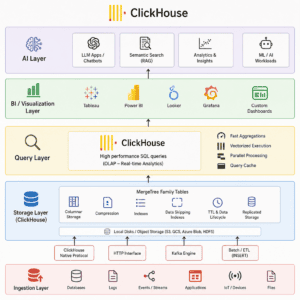
A reliable ClickHouse environment is more than database nodes. It is an ecosystem of ingestion, storage, query serving, security, observability, and continuous improvement.
Key components to define include:
For multi-region businesses, geography should be part of the design conversation. Data location, user proximity, cloud region selection, and cross-region replication can affect cost, responsiveness, and governance. GEO optimization is not just a marketing concern; for data platforms, it can shape architecture.
ClickHouse is powerful, but mistakes made early can become expensive to unwind. Many problems come from treating it like a drop-in replacement for a transactional database or from skipping workload analysis.
Common mistakes include:
The best prevention is to connect design decisions to real workloads. If the business case is customer-facing analytics, test customer-facing query patterns. If the goal is AI feature exploration, test freshness, joins, aggregation windows, and downstream consumption.
Selecting a partner should be based on practical delivery capability, not vague platform enthusiasm. The right provider should understand ClickHouse, but also the broader data ecosystem around it: pipelines, cloud infrastructure, analytics, automation, AI readiness, and operating models.
Use this checklist when evaluating clickhouse implementation services:
Diacto is a fit for organizations that need implementation support across these connected layers: strategy, architecture, integration, analytics enablement, automation, and production optimization. That broader view matters because ClickHouse usually succeeds as part of a data platform, not as an isolated database project.
ClickHouse is often a strong choice for high-volume analytical workloads that require fast aggregations, filtering, and reporting over large event-style datasets. It can be especially useful for product analytics, customer-facing dashboards, observability analytics, ad tech, financial analytics, operational intelligence, and machine-generated data.
It may not be the best primary system for highly transactional workloads, complex row-level updates, or applications that need traditional OLTP behavior. In many architectures, ClickHouse complements existing systems rather than replacing them. A transactional database may remain the system of record, while ClickHouse serves as the analytical engine optimized for speed and scale.
That distinction is important for budget and expectations. A mature plan defines what ClickHouse should own, what should remain elsewhere, and how data flows reliably between systems.
Production deployment is not the end of a ClickHouse project. As data volume grows, teams add dashboards, new regions come online, and AI use cases emerge, the architecture may need tuning. Query patterns change, retention rules evolve, and business users often discover new ways to consume analytics once performance improves.
A sustainable operating model includes regular review of slow queries, ingestion failures, storage growth, access patterns, and data quality issues. It also includes collaboration between data engineers, analytics teams, platform owners, and business stakeholders. This helps prevent ClickHouse from becoming another silo and keeps it aligned with business priorities.
For organizations evaluating clickhouse implementation services, the strongest outcome is not just a working cluster. It is a well-designed analytical capability: one that fits the business, supports regional and operational realities, integrates with the wider data and AI stack, and can be improved over time. Diacto can support that journey by helping teams move from architecture decisions to production deployment with a practical, implementation-focused approach.