For enterprise data leaders CIOs, CTOs, and VPs of Analytics—extracting actionable intelligence from fragmented data estates requires robust, scalable architecture. Leveraging Domo Data Integration Services for Enterprise Systems allows organizations to unify disparate sources into a single, governed truth. However, selecting the right platform configuration is only half the battle; executing a flawless deployment is where true ROI is realized.
When enterprise architects ask, “how does Domo handle multi-cloud data integration?”, the answer lies in its versatile connectivity framework. Modern organizations frequently struggle with resolving data silos with cloud-based integration platforms while simultaneously connecting legacy ERP systems to Domo. Domo bridges this gap by acting as an agnostic orchestration layer. Whether you are extracting on-premise financials or aggregating cloud-based marketing metrics, establishing a centralized, governed pipeline is critical for accurate enterprise reporting.
Enterprise environments demand versatile ingestion protocols. Determining the optimal path requires evaluating data gravity, security constraints, and compute latency.
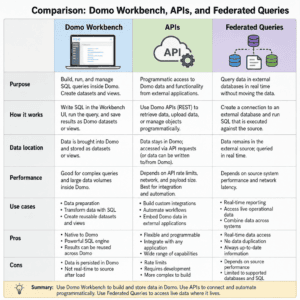
Domo Workbench versus API-based data ingestion Data engineering teams must balance security with agility. Domo Workbench securely bridges on-premise servers (like SQL Server or legacy mainframes) using scheduled, agent-based queries without opening inbound firewall ports. Conversely, API-based ingestion is ideal for streaming cloud-native application logs and high-frequency webhook events.
Comparing Domo federated queries with warehouse storage Technology leaders constantly balance compute costs against query performance. Comparing Domo federated queries with warehouse storage reveals two distinct architectural paths:
Furthermore, deploying pre-built connectors for Salesforce and SAP integration eliminates months of custom engineering, standardizing schema ingestion instantly across departments.
To streamline your data flow, follow this step-by-step guide to configuring Domo Cloud App connectors:
Once data lands in Domo, it rarely arrives in a reporting-ready state. Data leaders often inquire, “what are the benefits of Domo Magic ETL for large datasets?” Magic ETL processes billions of rows intuitively through a visual, drag-and-drop interface, drastically simplifying the task of optimizing data transformation workflows in enterprise environments. By offloading complex SQL transformations to Magic ETL, organizations can efficiently execute joins, aggregations, and data cleansing.
Automating data pipelines for enterprise reporting ensures executives make strategic decisions based on the absolute latest metrics, without waiting on manual engineering bottlenecks.
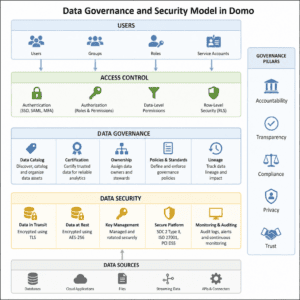
Scaling Domo architecture for global business intelligence demands rigorous oversight. Without strict governance, self-service BI quickly deteriorates into a chaotic data swamp.
Enterprise Governance Checklist:
Our certified Domo experts at Diacto consistently prioritize these governance frameworks during implementation to mitigate compliance risks and foster long-term data trust.
True digital transformation involves shifting from passive reporting to active operations. Implementing bi-directional data exchange between Domo and write-back systems allows operations leaders to update CRM records, supply chain statuses, or financial forecasts directly from their Domo dashboards. This capability transforms Domo from a read-only analytics tool into an operational powerhouse, driving immediate business action.
While Domo’s native capabilities are robust, executing an enterprise-wide rollout requires strategic foresight. Engaging an experienced Domo consulting partner minimizes deployment friction. Diacto provides comprehensive end-to-end support—starting with thorough business discovery and precise KPI identification. We design scalable solution architecture, handle complex ETL development, and configure tools like Magic ETL and Domo Workbench to align with enterprise best practices.
Beyond the initial build, our commitment extends to rigorous data governance, comprehensive user training, and dedicated post-go-live support. By leveraging Diacto’s proven methodologies, organizations drastically reduce implementation risk and accelerate time-to-value, ensuring their software investment translates into measurable business outcomes.
Optimizing a complex enterprise data ecosystem requires both a powerful integration platform and deep domain expertise. Domo data integration services offer the connectivity and processing power required to unify global operations. Diacto helps organizations seamlessly navigate these integration complexities, transforming raw, siloed data into highly actionable, governed intelligence. Contact Diacto today to discuss how our consultative implementation strategies can secure your data pipelines and drive your strategic business initiatives forward.