Business intelligence infrastructure modernization is a paramount priority for data-driven enterprises. As organizations outgrow fragmented analytics stacks, adopting cohesive, cloud-native platforms becomes essential for operational agility. Navigating this transition requires strict adherence to legacy BI tool retirement best practices to mitigate security risks, prevent data silos, and ensure reporting continuity. Engaging in Domo Migration Services: Tableau, Power BI, and Qlik to Domo represents a strategic consolidation effort. This systematically replaces disconnected, desktop-bound architectures with a unified, cloud-scale analytics environment capable of handling modern data volumes. As an experienced Domo consulting partner, Diacto routinely guides enterprise data teams through these complex digital transformations. Our technical approach ensures that critical data pipelines, compliance protocols, and intricate business logic remain perfectly intact while migrating to a modern, agile framework.
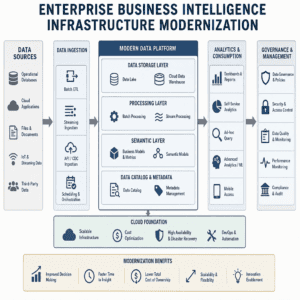
Evaluating domo vs tableau vs power bi features reveals distinct architectural differences that directly impact enterprise scalability. While legacy visualization systems frequently require a disparate ecosystem of third-party tools for data pipeline orchestration (ETL), warehousing, and governance, Domo provides a comprehensive, full-stack solution. This fundamental architectural shift drives the centralized business intelligence platform benefits that organizations require, notably the radical reduction of technical debt and simplified vendor management.
Consolidating standalone analytical tools into a single, cohesive environment minimizes data latency. By bypassing traditional, multi-hop data movement processes, organizations immediately succeed in accelerating time to insight with domo. Business stakeholders gain real-time access to operational metrics without being hindered by overnight batch processing limitations. Furthermore, leveraging specialized domo migration services allows IT departments to permanently offload legacy infrastructure maintenance and manual patch cycles. Diacto frequently assists enterprises in auditing legacy environments and quantifying these efficiency gains, helping executive decision-makers build robust, data-backed business cases. A well-executed consolidation strategy lowers the total cost of ownership and establishes a highly scalable foundation for advanced predictive analytics and machine learning initiatives.
Transitioning enterprise analytics architecture requires a highly methodical, step by step guide to BI tool consolidation. A successful migration is never a simple “lift and shift” maneuver; it is a critical opportunity to refactor underlying data models and optimize query performance.
Maintaining rigorous change management protocols during this transition is vital. When mapping these complex requirements, the certified Domo experts at Diacto ensure structural dependencies are identified immediately. By meticulously auditing usage logs from the legacy systems, migration teams prioritize high-value assets, ensuring mission-critical executive dashboards transition first. This phased, strategic approach drastically minimizes business disruption and fosters rapid user adoption.
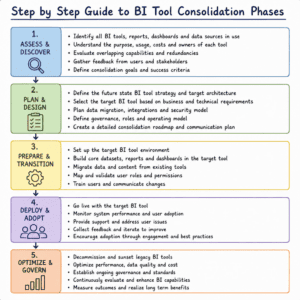
Tableau environments rely heavily on proprietary hyper extracts and localized data preparation processes. When migrating tableau workbooks to domo datasets, the engineering focus shifts from localized visualization files to centrally governed, cloud-hosted datasets. In Tableau, complex data blends and level-of-detail (LOD) expressions dictate how information interacts exclusively at the visualization layer. In Domo, this complex logic is pushed upstream into Adrenaline DataFlows or Magic ETL, ensuring the dataset is fully materialized before it reaches the dashboard. This upstream processing significantly improves dashboard rendering speeds and enforces a single source of truth across the organization. Diacto’s implementation teams specialize in dissecting these intricate Tableau workbook dependencies, restructuring the underlying SQL logic, and building highly optimized Domo datasets that serve multiple business units concurrently, preventing vital business logic from remaining locked inside individual report files.
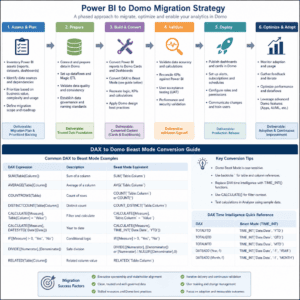
A resilient power bi to domo migration strategy directly addresses the fundamental differences in semantic data modeling. Power BI environments utilize heavy DAX (Data Analysis Expressions) for complex, runtime calculations and context transitions. Consequently, converting power bi dax to domo beast modes requires a profound understanding of how both proprietary engines aggregate and filter data. While DAX handles row context dynamically at the visual layer, Domo relies on optimized, dataset-level calculations for superior performance.
During targeted optimization engagements, Diacto helps data engineering teams translate intricate DAX time-intelligence functions into streamlined Magic ETL transformations. Materializing these complex calculations directly in the data pipeline, rather than executing them continuously at runtime, dramatically enhances overall dashboard performance. Additionally, uncoupling from the Microsoft ecosystem requires strategic precision. Rebuilding integrations natively within Domo ensures that automated anomaly alerting and scheduled dataset refreshes continue operating flawlessly, eliminating reliance on external data gateways.
Qlik’s proprietary associative engine presents unique architectural challenges by linking data dynamically in-memory, allowing users to intuitively filter across unjoined tables. Replicating this specific analytical behavior involves intelligently mapping qlik data models to domo magic etl. Instead of relying on associative memory, data engineers must strategically construct explicit, denormalized datasets or utilize Domo’s flexible dataset views and interactive variables to emulate advanced cross-filtering capabilities.
Enterprise buyers often scrutinize the cost of switching from qlik to domo. While the initial migration requires an upfront investment in data remodeling, the long-term return on investment is substantial. Qlik environments typically demand expensive on-premises server maintenance and specialized scripting expertise. Transitioning to a fully managed cloud environment completely eliminates these overhead costs. By partnering with a seasoned consultancy like Diacto, enterprises can design a robust Magic ETL architecture that delivers Qlik-equivalent analytical depth without the accompanying on-premises infrastructure burden.
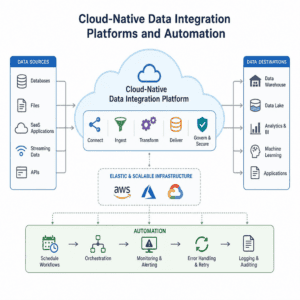
The industry-wide shift toward cloud-native data integration platforms fundamentally changes how modern organizations ingest and process information. Legacy BI systems frequently rely on brittle ODBC connections and localized batch scripts that are prone to failure. Modernization requires teams to know exactly how to automate data migration to domo utilizing its native library of API connectors, intelligent Webhooks, and federated queries.
A highly critical component of this infrastructure transition is seamlessly migrating sql queries from legacy systems to domo. On-premises queries embedded deep within legacy visualization tools must be carefully extracted, syntactically optimized, and redeployed within Domo’s cloud-based Workbench environment. Diacto frequently assists enterprises in auditing thousands of lines of legacy SQL, refactoring them to leverage Domo’s parallel processing engine. Automating this robust data pipeline ensures that datasets remain perfectly synchronized during the critical parallel run phase. Implementing intelligent dataset upserts reduces redundant API calls and guarantees the business operates on the freshest data.
Maintaining enterprise data governance during BI migration is a critical risk management function. In a modern cloud-native environment, legacy active directory group policies must be securely reimagined. Domo’s powerful Personalized Data Permissions (PDP) feature allows system administrators to seamlessly enforce complex row-level security on a single, master dataset. This functionality serves dynamically filtered, permission-based views to thousands of users based entirely on their unique organizational credentials.
Establishing these stringent governance frameworks early in the migration lifecycle prevents data leakage and ensures regulatory compliance. Implementing formal certification workflows for enterprise datasets guarantees that executives base their strategic decisions solely on validated, authoritative information. Diacto embeds these essential governance best practices directly into the migration roadmap, providing comprehensive administrator training and ongoing architectural support. By explicitly defining clear user roles, access tiers, and rigorous auditing protocols, organizations can confidently and securely scale their entire analytics user base.
Consolidating disparate legacy analytics tools into a singular, cohesive platform is a transformative operational milestone for any enterprise. By systematically addressing data modeling, integration, and user adoption, organizations successfully eliminate technical debt and foster true data democratization. Executing a seamless transition demands significantly more than basic technical execution; it requires precise strategic foresight, rigorous project management, and deep platform expertise.
Partnering with certified Domo experts ensures your organization maximizes its software investment while mitigating migration risks. Diacto remains steadfastly committed to helping enterprise data teams architect scalable, high-performance analytics environments. By treating platform migration as an unprecedented opportunity for holistic system optimization, businesses build a highly resilient, future-proof data infrastructure that continuously drives competitive advantage and operational excellence.