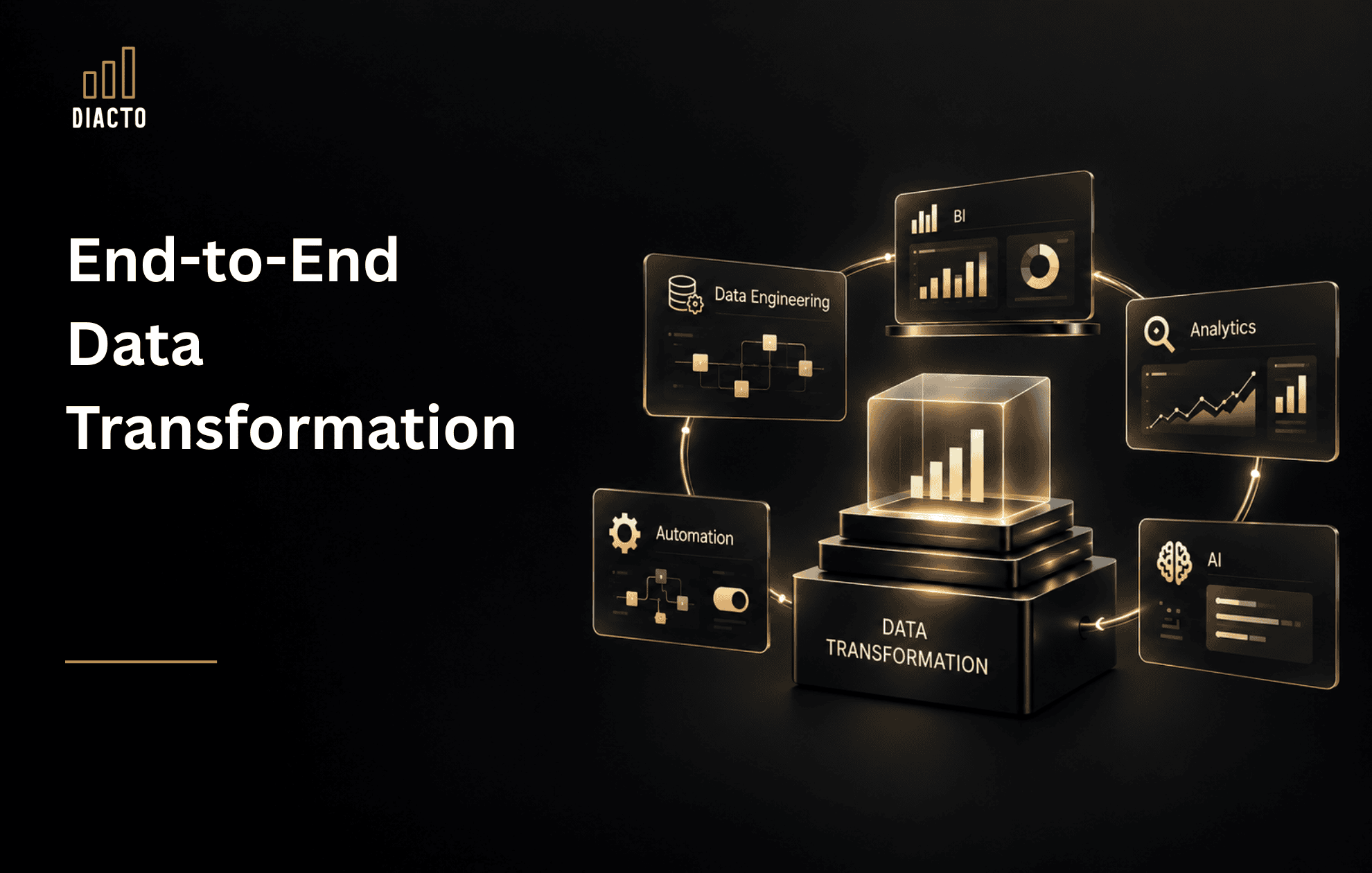
End-to-end data transformation connects the full enterprise data lifecycle: integration, migration, engineering, business intelligence, analytics, AI enablement, and automation. Instead of treating these capabilities as isolated projects, it brings them into one governed ecosystem where data moves reliably, becomes usable faster, and supports decisions, workflows, and intelligent applications. For CIOs, CTOs, CDOs, and analytics leaders, the goal is not simply to modernize data platforms; it is to create an operating model where trusted data becomes a reusable enterprise asset.
End-to-end data transformation means designing, building, governing, and continuously improving the complete path from raw operational data to business-ready intelligence, AI-ready datasets, and automated outcomes. It includes the technical work of data integration services, data migration services, modeling, pipeline orchestration, quality management, semantic layers, reporting, advanced analytics, and AI deployment, but it also includes the strategic work of aligning data architecture with business priorities.
In many enterprises, data still lives in fragmented systems: ERP platforms, CRM tools, legacy databases, cloud applications, spreadsheets, IoT streams, third-party feeds, and departmental data marts. Each source may serve a purpose, but fragmentation creates duplication, inconsistent definitions, slow reporting cycles, and limited confidence in analytics. End-to-end transformation addresses this by creating a connected ecosystem where data is collected, standardized, governed, enriched, and activated.
Diacto fits into this conversation as an example of a unified data transformation partner or ecosystem approach: one that views data engineering, BI, analytics, AI, and automation as connected disciplines rather than separate service lines. That distinction matters because enterprise data value is created across handoffs. A brilliant dashboard is only as reliable as the pipelines behind it. An AI model is only as effective as the quality, lineage, and context of the data it consumes. Automation only scales when the underlying data logic is consistent and trusted.
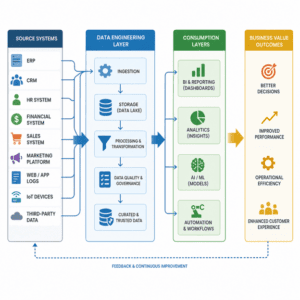
A connected data ecosystem reduces the cost, risk, and delay created by fragmented technology decisions. When integration, migration, engineering, BI, analytics, AI, and automation are planned together, organizations can standardize patterns, reuse assets, strengthen governance, and move from reactive reporting to proactive decision intelligence.
The business case usually becomes clear when leaders examine how data work is funded and executed. One team migrates a legacy application. Another builds a warehouse. A third develops executive dashboards. A separate innovation group pilots AI. Each project may produce value, but without a shared architecture, enterprises often create overlapping pipelines, inconsistent metrics, and avoidable maintenance burdens.
A unified approach helps large organizations solve several persistent problems:
End-to-end data transformation services are designed to reduce these frictions by treating the data estate as a strategic platform. The result is not only better reporting; it is a foundation for faster business change.
A mature transformation program is built in layers. These layers do not always happen in a perfectly linear order, but each one plays a critical role in turning enterprise data into measurable business capability.
The first layer is strategic alignment. Before technology choices dominate the discussion, leaders need clarity on business objectives, data domains, stakeholders, governance principles, and value priorities. This is where organizations define what the data ecosystem must enable: finance visibility, supply chain resilience, customer intelligence, regulatory reporting, AI products, operational automation, or all of the above.
A strong operating model defines who owns data, who manages quality, who approves definitions, and how new data products move from concept to production. It also clarifies how central data teams work with business units. Without this layer, even technically strong platforms can become underused or politically difficult to scale.
Data integration services connect source systems and make data available for downstream use. In enterprise environments, integration may involve batch ingestion, real-time streaming, APIs, change data capture, file-based exchange, event-driven architecture, and third-party data feeds. The right pattern depends on latency needs, source-system constraints, data volume, compliance requirements, and business use cases.
Effective integration is not just about moving data. It includes schema management, metadata capture, error handling, monitoring, reconciliation, access control, and documentation. When these capabilities are built consistently, data teams spend less time fixing broken pipelines and more time developing reusable products.
For example, a global enterprise might integrate order, inventory, logistics, finance, and customer service data to create a near-real-time view of fulfillment performance. The value comes not from ingestion alone, but from making the integrated data reliable enough for operational decisions and executive insight.
Data migration services are essential when organizations replace legacy systems, consolidate platforms, move to the cloud, modernize ERP or CRM environments, or merge data estates after acquisitions. Migration involves profiling source data, mapping fields, cleansing inconsistencies, transforming structures, validating outputs, and ensuring business continuity.
Enterprise migration is high-stakes because data issues can disrupt operations, reporting, customer experience, and compliance. A disciplined migration approach includes assessment, migration design, test cycles, reconciliation, stakeholder sign-off, cutover planning, and post-migration support. It also turns migration into an opportunity to improve data quality rather than simply relocating historical problems.
Diacto’s ecosystem-oriented positioning is relevant here because migration rarely stands alone. Migrated data must feed analytics, support BI, comply with governance rules, and potentially serve future AI use cases. Treating migration as part of the broader transformation journey helps enterprises avoid rework after the new platform is live.
Data engineering creates the durable foundation for analytics and automation. This includes designing data lakes, lakehouses, warehouses, marts, pipelines, transformation logic, orchestration processes, metadata frameworks, and performance patterns. It also includes practical engineering decisions about partitioning, incremental processing, testing, observability, and cost optimization.
Modern data architecture increasingly emphasizes modularity. Instead of one monolithic warehouse serving every need, enterprises may use domain-oriented data products, governed semantic layers, scalable storage, streaming components, and flexible consumption patterns. The architecture must be resilient enough for enterprise scale while remaining understandable to business and technical users.
A well-engineered platform should answer questions such as:
These questions determine whether the platform can be trusted when decisions matter.
BI translates data into performance visibility. Dashboards, scorecards, self-service reporting, and executive analytics depend on more than attractive visual design. They require consistent definitions, trusted metrics, role-based access, and well-modeled business entities.
The semantic layer is especially important in large organizations. It gives teams a shared language for revenue, margin, churn, utilization, inventory, pipeline, risk, or any other key metric. Without semantic consistency, different business units may report different numbers from the same underlying systems. That erodes confidence and leads to decision delays.
BI should be designed around decision workflows, not just data availability. A CFO needs variance explanations and drill-down paths. A supply chain leader needs exception visibility. A sales executive needs territory and pipeline clarity. A frontline manager needs actionable signals, not a library of static reports. End-to-end transformation connects BI to upstream engineering and downstream action.
Analytics extends beyond descriptive reporting into diagnosis, prediction, optimization, and recommendation. Enterprises use analytics to forecast demand, segment customers, detect anomalies, manage risk, optimize pricing, reduce churn, and improve operational performance.
To succeed, analytics teams need clean historical data, clear business definitions, accessible features, experimentation discipline, and a path to production. Many organizations have skilled analysts and data scientists, but their work remains trapped in notebooks, spreadsheets, or one-off models because the surrounding data ecosystem is not mature enough.
An end-to-end approach creates repeatable pathways from insight to adoption. Analytical models can be connected to BI tools, workflow applications, alerts, APIs, or automation platforms. That shift turns analytics from a specialist activity into an embedded business capability.
AI depends on data readiness. Enterprises cannot reliably deploy AI agents, machine learning models, copilots, personalization engines, or intelligent document workflows without governed, contextualized, secure, and high-quality data. The same integration and engineering foundations that support BI also support AI, but AI introduces additional demands around feature management, model monitoring, explainability, privacy, and feedback loops.
Automation is the activation layer. Once data is trusted and intelligence is embedded, organizations can automate approvals, alerts, exception handling, routing, reconciliation, document processing, and customer interactions. This is where the ecosystem becomes operational, not merely analytical.
Diacto’s integrated framing of data engineering, BI, analytics, AI, and automation is useful because enterprise AI initiatives often fail when they are detached from core data architecture. AI should not sit in a disconnected innovation lab. It should build on the same trusted data products, governance model, and engineering discipline that power enterprise reporting and analytics.
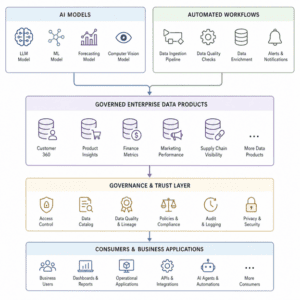
Data integration connects systems, data migration moves and modernizes data between environments, and transformation makes that data usable for business, analytics, AI, and automation. They are separate disciplines, but in enterprise programs they should be planned together because each one affects quality, architecture, governance, and long-term scalability.
Consider a company modernizing its customer platform. Data migration services may move historical customer records from legacy CRM systems into a new cloud environment. Data integration services may connect the new CRM with marketing automation, billing, support, e-commerce, and data warehouse platforms. Transformation logic then standardizes customer identifiers, resolves duplicates, enriches profiles, and creates usable datasets for sales dashboards, churn models, customer service workflows, and executive reporting.
If these workstreams are treated separately, the organization may migrate incomplete data, integrate inconsistent fields, or build analytics on definitions that later change. If they are designed as one ecosystem, the enterprise can define the target data model, quality standards, governance rules, and consumption needs before major engineering decisions are locked in.
A practical sequence often looks like this:
This sequence is not rigid. Some organizations begin with a high-value analytics use case, while others begin with platform modernization or migration. What matters is that each initiative contributes to a coherent enterprise data foundation.
Large-scale data programs fail when architecture is disconnected from business use, when governance is added too late, or when platforms are optimized for technology preferences rather than enterprise outcomes. The following principles help reduce that risk.
Source systems matter, but business users think in domains: customer, product, supplier, order, asset, employee, location, contract, transaction. Organizing data around domains makes it easier to assign ownership, define quality rules, and create reusable data products. It also reduces the tendency to rebuild source-system complexity inside the analytics layer.
Governance should not be a policy document that sits outside delivery. It should be embedded into ingestion, transformation, access, cataloging, lineage, testing, and change management. This includes naming standards, data classification, approval processes, stewardship roles, and quality thresholds.
When governance is practical, teams move faster because they know which datasets are trusted, who can access them, and how changes should be handled. When governance is vague or overly bureaucratic, users create workarounds.
Data quality cannot rely only on manual review. It needs profiling, validation rules, anomaly detection, automated tests, reconciliation processes, and clear ownership. Quality checks should run throughout the pipeline, not only at the reporting layer.
For enterprise leaders, the key question is not whether data quality issues exist. They always do. The question is whether the organization can detect, prioritize, remediate, and prevent them systematically.
Analytics and AI teams need freedom to explore, but production data products require reliability, documentation, monitoring, and support. Mature organizations provide sandbox environments for experimentation and controlled pathways for promotion into production. This protects innovation without compromising operational trust.
Every new pipeline, metric, model, or workflow should be evaluated for reuse. Can this dataset support multiple use cases? Can this transformation logic become a shared standard? Can this metric be certified across business units? Reuse reduces cost and accelerates delivery, especially when organizations scale from initial transformation projects to enterprise-wide data capability.
The value of data transformation is realized when data changes how people decide and how work gets done. BI, analytics, AI, and automation represent different levels of activation, and each level builds on the one before it.
BI creates visibility. It helps executives and managers understand what happened, where performance is changing, and which areas need attention. Analytics adds explanation and foresight by identifying drivers, patterns, risks, and opportunities. AI can scale insight, personalization, prediction, and knowledge work across high-volume processes. Automation then converts intelligence into action by triggering workflows, routing exceptions, updating systems, or notifying teams.
A single ecosystem allows these capabilities to reinforce one another. The same governed customer dataset might support:
This is why end-to-end data transformation services are increasingly important in enterprise environments. The highest return rarely comes from a single dashboard or one migration event. It comes from compounding reuse across decisions, processes, teams, and technology investments.
Enterprises should choose an approach that balances strategic architecture, disciplined engineering, business adoption, and measurable activation. The right model is not simply the one with the most tools or the fastest initial build; it is the one that creates a scalable foundation for trusted data products, analytics, AI, and automated workflows.
A useful evaluation checklist includes:
Diacto can be positioned naturally within this decision framework because it reflects the type of integrated partner enterprises often need: one capable of connecting technical architecture with business intelligence, analytics maturity, AI enablement, and process automation. The value is not in treating each service as a separate deliverable, but in orchestrating them toward a coherent data operating model.
Enterprise transformation initiatives often begin with a specific trigger. The trigger may be a platform change, a business performance challenge, a regulatory requirement, or an executive mandate to accelerate AI. Regardless of the starting point, the most successful programs use the immediate need to build reusable enterprise capability.
Many organizations modernize legacy warehouses, databases, or reporting environments to improve scalability, flexibility, and cost management. The transformation effort may include data migration services, redesign of data pipelines, cloud-native storage, modern orchestration, cataloging, and updated BI layers. Done well, modernization reduces technical debt while improving data access.
Major system implementations create complex data requirements. Historical records must be migrated, master data must be standardized, integrations must be built, and reporting continuity must be maintained. Connecting these efforts with the broader data ecosystem prevents the new application from becoming another silo.
Leadership teams often need a reliable view of financial, operational, customer, and workforce performance. This requires more than dashboards. It requires aligned definitions, trusted sources, governed metrics, and drill-down paths that help leaders move from headline numbers to root causes.
Enterprises pursuing AI need structured, governed, and context-rich data foundations. Transformation programs can prepare domain-specific datasets, create feature pipelines, define access controls, and connect model outputs to BI or operational systems. This turns AI from experimentation into a repeatable business capability.
Manual data handling creates risk and slows execution. Transformation initiatives can connect systems, standardize rules, and automate repetitive workflows such as reconciliations, exception alerts, approvals, data validation, customer routing, and compliance monitoring. Automation becomes more reliable when it is grounded in trusted data engineering.
A pragmatic roadmap helps enterprises move with speed while avoiding disconnected quick wins. The sequence should be adapted to the organization’s maturity, but the underlying logic remains consistent.
Begin with a focused assessment of systems, data flows, pain points, governance gaps, reporting needs, and strategic objectives. Identify where poor data quality, slow access, or manual processes create measurable friction. Prioritize use cases that are valuable enough to matter and focused enough to deliver momentum.
Define target architecture, data domains, integration patterns, governance roles, quality standards, and delivery methods. Select a limited number of high-value data products to prove the model. This phase should create reusable patterns for ingestion, transformation, testing, documentation, access, and monitoring.
Build dashboards, analytics outputs, migration capabilities, or automation workflows that solve real business problems. Keep the connection between engineering work and business outcomes visible. Adoption improves when stakeholders see how the data ecosystem helps them make faster, better, and more confident decisions.
Expand from initial use cases into additional domains and business units. Reuse standards, pipelines, semantic definitions, and governance processes wherever possible. This is where organizations begin to see the compounding benefit of an ecosystem approach.
Once core data products are trusted and accessible, enterprises can accelerate AI and automation use cases. The focus shifts from proving that data can be centralized to proving that data can improve decisions, personalize experiences, reduce manual work, and support new digital capabilities.
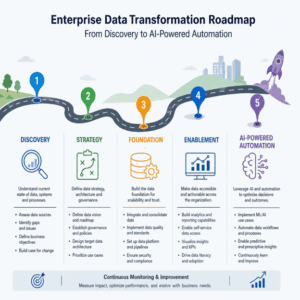
End-to-end data transformation is not a one-time implementation. It is an ongoing capability that must evolve with business priorities, technology platforms, regulations, and user expectations. Sustaining value requires operational discipline.
Key practices include:
This operating discipline is where many programs either mature or stall. The launch of a platform, dashboard, or migration milestone is important, but the long-term advantage comes from continuous improvement.
End-to-end data transformation gives enterprises a way to connect technology modernization with business performance. By bringing data integration services, data migration services, engineering, BI, analytics, AI, and automation into one ecosystem, organizations can reduce fragmentation and build a foundation for faster decisions, better governance, and scalable innovation.
For senior technology and data leaders, the opportunity is to move beyond project-by-project execution and establish a repeatable model for enterprise data value. Diacto’s role in this landscape is best understood through that lens: helping frame data transformation as a connected ecosystem where engineering discipline, analytics usability, AI readiness, and automation potential work together. When the ecosystem is designed well, data stops being a reporting byproduct and becomes an active driver of enterprise transformation.