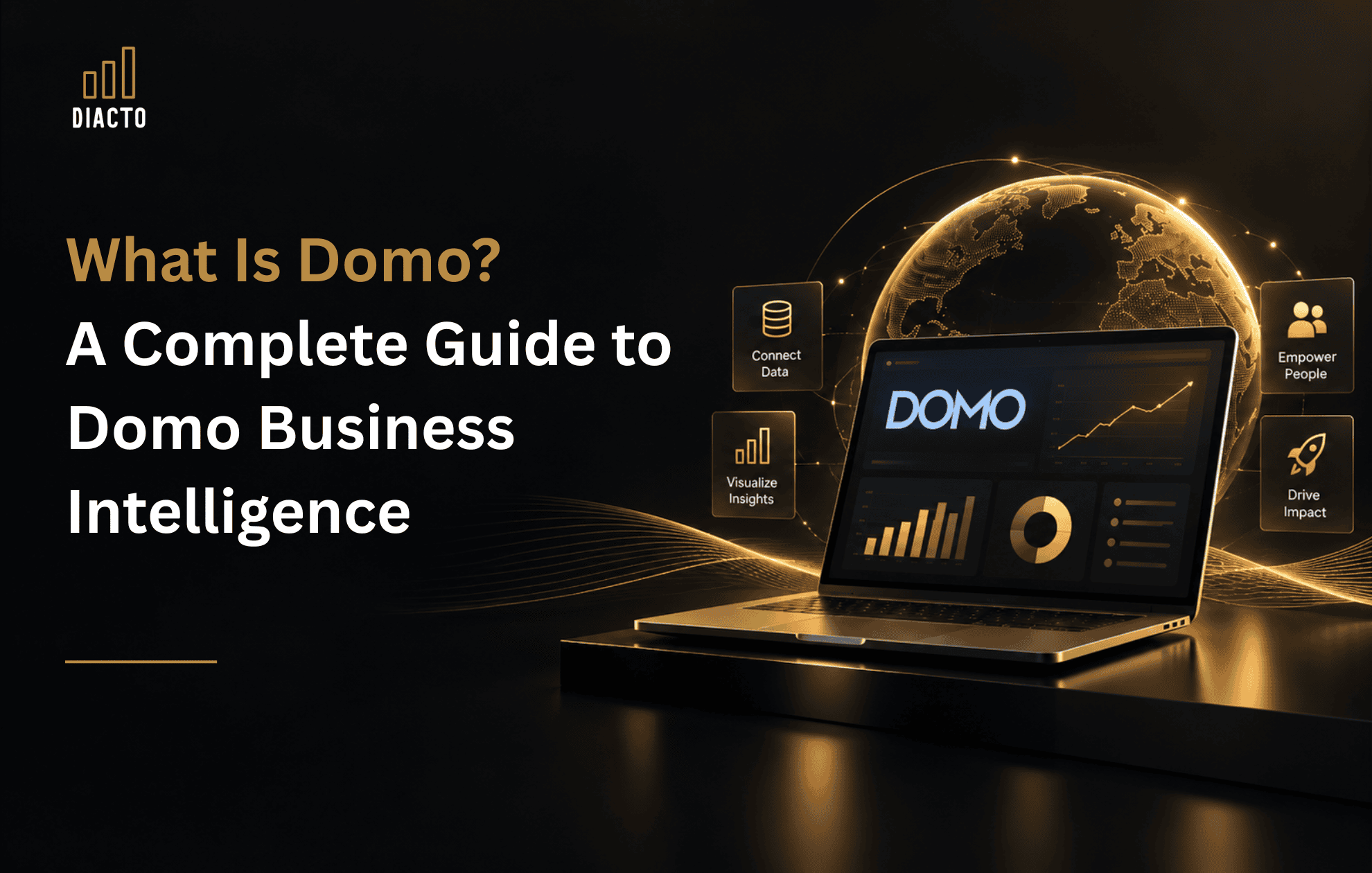
Domo is a cloud-based business intelligence platform that helps organizations connect data, prepare it for analysis, visualize performance, embed analytics, and operationalize AI-driven decisions. For enterprise leaders, the value of Domo business intelligence is not simply dashboards; it is the ability to move fragmented data into governed, usable, decision-ready workflows. This guide explains where Domo fits in the modern data stack, how it compares with adjacent platforms, and how Diacto helps enterprises turn Domo into part of a broader data transformation ecosystem.
Domo business intelligence is a platform approach to BI that brings data integration, transformation, analytics, visualization, embedded analytics, app creation, security, governance, and AI capabilities into a single environment. Domo describes its platform as helping companies connect data, visualize insights, and use AI to make better decisions, while also supporting embedded analytics and app development capabilities. (domo-webflow.domo.com)
In practical terms, Domo acts as a connective layer between business systems and decision makers. Data from operational applications, spreadsheets, cloud warehouses, marketing tools, finance platforms, sales systems, supply chain applications, and customer platforms can be unified into datasets, modeled, visualized, and delivered to the people who need it. The strongest Domo implementations are not built as isolated reporting projects; they are designed as operating models for decision intelligence.
For CIOs, CTOs, and data leaders, that distinction matters. A dashboard may show what happened last month. A mature Domo business intelligence tool can help teams monitor leading indicators, trigger alerts, embed insights into business applications, and support AI-assisted action across departments.
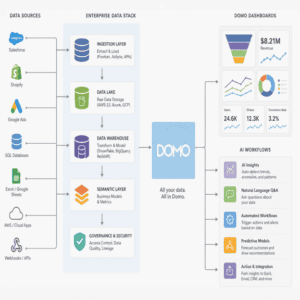
Most multinational organizations do not suffer from a lack of data. They suffer from dispersed ownership, inconsistent definitions, duplicate pipelines, latency, and uneven adoption. Sales may trust one revenue number, finance another, and regional leadership a third. Domo data visualization becomes valuable when it sits on top of disciplined data engineering and a governed semantic foundation.
A successful Domo program usually includes:
Diacto approaches Domo in this broader context. Rather than treating BI as a front-end reporting layer, Diacto helps enterprises align data engineering, BI, analytics, AI, and automation into a unified ecosystem. That is where enterprise value emerges: fragmented data becomes actionable insight, and actionable insight becomes measurable operational momentum.
Domo fits best as a business-facing analytics, app, and intelligence layer that can connect with cloud data platforms, operational systems, and enterprise BI environments. It can coexist with Snowflake, ClickHouse, Power BI, and Tableau when each platform has a clearly defined role in the architecture.
In many enterprise environments, the modern data stack is not a single product. It is a coordinated architecture. Snowflake may serve as the governed cloud data platform for warehousing, data sharing, analytics, AI, and application workloads; Snowflake describes its platform as supporting analytics, data engineering, AI, applications, and collaboration. (s26.q4cdn.com) ClickHouse may support high-volume, low-latency analytical workloads, with ClickHouse positioning its platform for real-time analytics, observability, data warehousing, and ML or GenAI workloads. (clickhouse.com)
Domo then becomes the layer that brings curated data into executive dashboards, departmental analytics, embedded experiences, custom apps, alerts, and AI-enabled decision flows. Power BI may remain critical for Microsoft-centric teams, especially since Microsoft describes Power BI as its business analytics platform and a core component of Microsoft Fabric. (learn.microsoft.com) Tableau may continue to serve analyst communities that prioritize exploratory visual analytics; Tableau describes itself as a visual analytics platform for helping people and organizations use data to solve problems. (tableau.com)
Diacto’s role is to help leaders make these platforms work together rather than compete unnecessarily. A Fortune 500 organization may use Snowflake for governed data products, ClickHouse for real-time operational analytics, Domo for business apps and embedded intelligence, Power BI for enterprise Microsoft reporting, and Tableau for advanced visual exploration. The architectural question is not “Which one tool wins?” It is “Which platform should own which workload, audience, governance model, and decision process?”
Domo’s value becomes clearer when viewed through the full lifecycle of enterprise analytics rather than the narrow lens of dashboard creation.
Domo implementations typically begin by connecting source systems and building trusted datasets. This is where data engineering discipline is essential. Without quality checks, lineage thinking, naming conventions, access controls, and transformation standards, BI becomes another layer of complexity rather than a solution.
For large organizations, Diacto emphasizes repeatable engineering patterns: ingestion frameworks, reusable data models, cloud warehouse integration, API orchestration, and automated validation. These foundations make Domo easier to scale across regions, business units, and functions.
Domo data visualization helps business users understand performance through dashboards, scorecards, charts, alerts, and interactive experiences. The objective is not to decorate data. It is to reduce time-to-insight and make the next action more obvious.
Well-designed Domo dashboards should answer practical executive questions: Which region is underperforming? Which customer cohort is changing behavior? Which supply chain metric is trending outside tolerance? Which marketing channel is creating profitable growth? The best visualizations combine business context, governed metrics, and intuitive design.
Embedded analytics extends BI beyond internal dashboards. Domo’s embedded analytics capabilities are designed to place analytics into apps, portals, or websites so users can see and act on insights where they already work. (domo-webflow.domo.com) For enterprises, this can support customer portals, partner reporting, supplier performance views, field operations tools, and executive workflow applications.
This is also where purpose-built platforms matter. Diacto can help design embedded analytics experiences that match a specific business process instead of forcing users into a generic dashboard environment. That shift improves adoption because analytics becomes part of the workflow, not another destination.
Domo Bricks are reusable app and visualization building blocks that can help teams accelerate custom analytics experiences, while Custom AI Agents are tailored AI-driven assistants or workflows designed around enterprise data, policies, and business processes. Domo’s feature documentation describes Domo Bricks as pre-built code blocks for Domo Apps and notes app development options such as Java, Python, HTML, CSS, JavaScript, custom connectors, and secure app data management. (domo-webflow.domo.com)
For a CIO or data leader, these capabilities point to a larger shift: BI is moving from static reporting to interactive data products. A sales performance app can combine governed revenue data, territory hierarchy, account signals, forecast risk, and recommended next actions. A supply chain control tower can combine inventory, logistics, supplier performance, anomaly alerts, and AI-assisted root-cause analysis.
Custom AI Agents add another layer. Instead of asking users to interpret every dashboard manually, an enterprise can design agents that summarize performance variance, detect anomalies, recommend follow-up analysis, draft stakeholder updates, or route exceptions into workflow systems. Domo states that its platform can connect data, build AI-powered apps and agents, and deliver governed insights across the business. (domo-webflow.domo.com)
Diacto helps organizations design these AI-enabled experiences responsibly. That includes grounding agents in trusted datasets, defining permissions, monitoring outputs, integrating with existing automation platforms, and keeping human approval where decisions are sensitive or regulated.
A Domo business intelligence tool can be powerful, but enterprise outcomes depend on program design. Multinational organizations need architectures that are scalable, resilient, secure, and adaptable across geographies, regulatory environments, and operating models.
A practical enterprise roadmap often includes:
Diacto is positioned for this kind of cross-platform transformation. Its resources describe Diacto as a provider of Data Strategy, Data Engineering, Data Analytics and Business Intelligence, and Data Science and AI services, with Centers of Excellence in DOMO, Power BI, Snowflake, and Tableau. (diacto.com) That breadth matters because most enterprise programs require integration across multiple technologies, not expertise in a single dashboard layer.
The most compelling reason to invest in Domo business intelligence is not prettier reporting. It is operational impact. When data is connected, governed, visualized, embedded, and enhanced with AI, leaders can shorten decision cycles and reduce the friction between insight and action.
Consider a global retail organization. Store operations, ecommerce, inventory, marketing, finance, and customer service may all generate valuable signals, but those signals often live in separate platforms. A unified Domo ecosystem can help leadership monitor margin, stock availability, promotion performance, customer sentiment, and regional execution from one coordinated view. With embedded analytics and automation, those insights can be pushed into the tools regional managers already use.
The same pattern applies to manufacturing, healthcare, financial services, logistics, technology, and consumer goods. The business outcome is not “more dashboards.” It is faster issue detection, better resource allocation, improved accountability, more consistent decision-making, and stronger growth execution.
Domo can serve as a strategic enterprise BI and decision-intelligence platform when it is implemented with the right architecture, governance, and adoption model. It is strongest when connected to a modern data foundation, integrated with platforms such as Snowflake and ClickHouse, and coordinated with BI ecosystems that may already include Power BI and Tableau.
For enterprise leaders evaluating Domo, the next step is to look beyond feature checklists. Ask whether your organization has the data engineering maturity, BI governance, AI strategy, and automation roadmap to turn the platform into business value. Diacto helps bridge that gap by combining DOMO expertise with modern data stack capabilities, purpose-built platforms, embedded analytics, and AI innovation.
The takeaway is simple: Domo is not just a reporting tool. In the right hands, it becomes part of an end-to-end data transformation ecosystem that converts fragmented enterprise data into trusted insight, intelligent action, and scalable growth.