For enterprise decision-makers and technology leaders at growing companies, scaling analytics infrastructure is no longer a luxury—it is a critical operational mandate. As data ecosystems become increasingly complex, organizations require an End-to-End Domo Implementation Guide for Growing Businesses to successfully transition from fragmented reporting to centralized, automated intelligence.
This comprehensive guide bypasses introductory definitions and dives directly into the strategic evaluation, architectural planning, and execution required to deploy a scalable enterprise analytics platform. By adhering to industry-leading frameworks, businesses can accelerate time-to-value, optimize their investment, and ensure sustainable user adoption.

A successful rollout begins long before the first data connection is made. Developing a resilient cloud-based business intelligence adoption strategy requires aligning technical capabilities with overarching business objectives.
Enterprise buyers must carefully assess the total cost of ownership (TCO) and anticipated return on investment (ROI). The cost of Domo implementation for mid-sized firms varies based on data complexity, the number of internal sources, and the required governance structures. Beyond software licensing, leaders must account for internal resource allocation and external consulting expertise.
Understanding the Domo professional services implementation timeline is equally critical. A standard enterprise deployment typically follows a 60- to 90-day phased approach:
During these initial planning stages, organizations frequently engage consulting experts like Diacto. Partnering with seasoned consultants ensures that bespoke data strategies are mapped out efficiently, mitigating early risks and ensuring alignment with long-term growth objectives.
When evaluating platforms, decision-makers often look at Domo vs Tableau for growing enterprises. While traditional tools may excel in localized, desktop-heavy visualization tasks, a growing business requires an integrated, full-stack solution. Enterprise buyers typically prioritize a platform that handles raw data ingestion, transformation, and automated distribution within a unified cloud environment, fundamentally reducing the need for disjointed third-party warehousing tools.
The technical foundation of any implementation dictates its future scalability. Solving data fragmentation with centralized BI demands an architecture capable of ingesting diverse data streams without compromising performance or security.
Scaling BI architecture for business growth involves mapping out a logical data warehouse strategy within the platform. Rather than dumping raw data into unstructured lakes, enterprise architects must design structured datasets categorized by business domains (e.g., Finance, Marketing, Operations). This modular approach prevents dataset duplication and ensures a single source of truth across the organization.

Integrating disparate data sources is often the most technically demanding phase of deployment. Following a structured Domo data connectors setup guide is essential for maintaining data integrity.
For on-premise systems, data engineers frequently ask how to integrate SQL databases with Domo securely. Best practices dictate utilizing secure deployment methods:
Navigating complex on-premise to cloud migrations is where experienced partners like Diacto provide immense value. Their expertise in configuring secure, optimized data pipelines ensures that even the most complex enterprise architectures are integrated seamlessly.
Raw data is rarely ready for executive consumption. Implementing robust transformation logic and strict governance policies protects data integrity and organizational security.
Efficient data transformation is the engine of any analytics platform. Adhering to Domo Magic ETL best practices ensures pipelines run quickly, consume fewer compute resources, and remain easy to maintain.
Key ETL optimization strategies include:
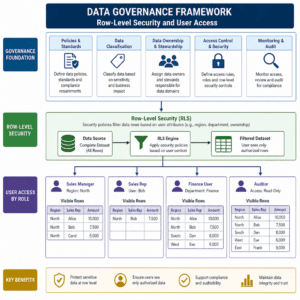
A rigorous data governance framework for cloud BI is non-negotiable for growing enterprises. As user bases expand, so does the risk of unauthorized data access.
Administrators should implement Personalized Data Permissions (PDP) early in the implementation cycle. PDP allows a single, massive dataset to serve the entire organization while dynamically restricting row-level data based on the user’s role, department, or region. This eliminates the need to build duplicate dashboards for different regional managers.
Firms leveraging Diacto’s consulting expertise frequently adopt a tiered governance model. This approach ensures stringent compliance and data security without bottlenecking the agility and productivity of internal business analysts.
Once the architectural and governance foundations are solidified, focus shifts to extracting actionable intelligence. This phase bridges the gap between raw data engineering and strategic business execution.
Employing real-time data visualization techniques transforms static reporting into a dynamic decision-making tool. Dashboards should be designed using a macro-to-micro methodology:
Automating business reporting with Domo fundamentally changes how teams operate. By configuring scheduled reports and proactive alerting mechanisms, stakeholders are notified instantly when KPIs breach predefined thresholds, eliminating the need to manually monitor dashboards.
While intuitive drag-and-drop features serve standard reporting needs, growing businesses often require highly specific financial or operational metrics. Providing internal teams with a structured Domo Beast Mode tutorial for beginners empowers analysts to write basic SQL-like calculations directly at the card level.
However, as complexity scales, maintaining hundreds of custom calculations can become unwieldy. To accelerate time-to-value and ensure calculation consistency, Diacto often implements pre-configured, standardized calculation libraries tailored for specific industry verticals. This ensures that metrics like “Net Revenue Retention” or “Customer Acquisition Cost” are calculated uniformly across every departmental dashboard, maintaining the single source of truth.
The most technically perfect implementation will fail without strategic user adoption. Software does not change business outcomes; enabled users do.
Building a data-driven culture with Domo requires a shift in change management. Executive sponsorship is crucial. When C-suite leaders mandate that all operational meetings be run directly from live dashboards rather than static slide decks, organizational adoption follows rapidly.
To support this cultural shift, businesses must develop an internal Center of Excellence (CoE). The CoE should document all custom domo best practices and maintain an accessible, company-specific domo user guide. This guide should detail naming conventions, data dictionary definitions, and the internal protocol for requesting new dashboard developments.
Partnering with Diacto for customized training programs ensures that end-users are not merely handed software, but are actively integrated into a holistic, supportive data ecosystem. Tailored enablement sessions bridge the gap between technical functionality and daily business workflows.

In modern business environments, decision-makers are rarely tethered to their desks. Fully utilizing Domo mobile app features for executives is a powerful strategy for driving top-down adoption.
The mobile application offers capabilities specifically designed for leaders on the go:
Implementing a mobile-first design strategy—ensuring that cards and dashboards render perfectly on smaller screens—guarantees that decision-makers always have access to the intelligence they need to drive the business forward.
To summarize this domo implementation guide, enterprise leaders should utilize the following checklist to ensure a comprehensive and successful deployment:
Transitioning to a modern, scalable analytics infrastructure is a transformative journey for growing businesses. By prioritizing rigorous architectural standards, robust data governance, and comprehensive user enablement, organizations can turn their data into a primary competitive advantage. Navigating this complex process with strategic partners ensures that the deployment is not only technically sound but deeply aligned with the continuous growth of the enterprise.