Choosing between Snowflake and Databricks is not simply a tooling decision; it is an enterprise architecture decision that affects data engineering, BI, analytics, AI, governance, automation, and cost control. In most large organizations, Snowflake is strongest as a governed, cloud-native data warehouse and data collaboration platform, while Databricks is strongest as a lakehouse and data intelligence platform for engineering, machine learning, AI, and open-format analytics. The right answer depends on workload mix, data maturity, operating model, and the business outcomes leadership expects from data transformation.
The practical difference is that Snowflake is typically adopted first for scalable SQL analytics, governed data sharing, and enterprise BI, while Databricks is typically adopted first for lakehouse engineering, data science, machine learning, and AI workloads on open data. Both platforms now overlap significantly, but they still carry different architectural strengths that matter when enterprises standardize data analytics tools across business units, regions, and regulated environments.
Snowflake positions its platform around the AI Data Cloud, with capabilities for data warehousing, governance, collaboration, Cortex AI functions, ML functions, model registry, feature store, and enterprise editions designed for varying security and compliance needs. Its pricing page also emphasizes a fully managed product model, storage calculated separately, and editions such as Business Critical and Virtual Private Snowflake for more sensitive requirements. (docs.snowflake.com)
Databricks positions its platform around the lakehouse and data intelligence model. Its documentation describes the lakehouse as a way to use the same data and platform across BI, machine learning, AI, data governance, lineage, and reporting, with validated data stored in standard formats in cloud object storage. Unity Catalog extends that model by governing data and AI assets, including models and agents, across clouds and platforms. (docs.databricks.com)
For CIOs, CTOs, and data leaders, the decision should not start with feature checklists. It should start with the enterprise’s target data operating model: who owns data products, how data is governed, how analytics is consumed, how AI will be productionized, and how automation will remove manual work from fragmented reporting and data pipelines.
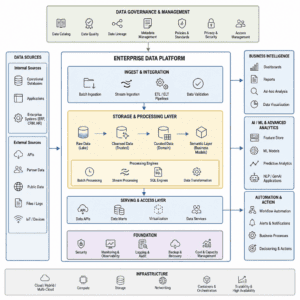
A mature data transformation program connects five layers into one operating ecosystem: data engineering, business intelligence, analytics, artificial intelligence, and automation. If those layers are designed separately, the organization usually ends up with duplicated pipelines, inconsistent metrics, rising platform costs, and executive dashboards that do not reconcile. If they are designed together, fragmented data becomes trusted insight that can improve efficiency, accelerate decisions, and support growth.
Diacto approaches Snowflake vs Databricks evaluations through that end-to-end lens. Rather than treating the comparison as a narrow platform selection exercise, Diacto helps enterprises assess how data moves from operational systems into governed repositories, how it is transformed into reusable data products, how BI teams consume it, how AI models use it, and how automation embeds insights into business workflows.
A typical enterprise data transformation ecosystem includes:
Snowflake and Databricks can both contribute to this ecosystem. The challenge is deciding where each platform should sit, which workloads belong where, and how governance, cost, and business ownership will work across multinational operations.
Snowflake is often the stronger enterprise choice when the center of gravity is BI, SQL analytics, governed data access, and cross-functional reporting. Its managed architecture reduces infrastructure burden for teams that want performance, scale, and separation of storage and compute without requiring every analytics team to manage distributed processing frameworks.
For large organizations, Snowflake can be particularly effective when many business teams need consistent access to curated data. Finance, sales, supply chain, marketing, operations, and executive leadership often depend on standardized definitions and fast query performance. In that environment, Snowflake’s warehouse model can simplify consumption because business analysts can work in familiar SQL-oriented patterns while data teams maintain governance and performance controls.
Snowflake is also relevant where data collaboration matters. Official materials describe capabilities for data clean rooms, replication, cross-cloud data access, and collaboration technologies, while newer interoperability announcements emphasize governed access to data across Snowflake, external lakes, and open systems without unnecessary duplication. (docs.snowflake.com)
For regulated or globally distributed enterprises, these capabilities can be strategically important. Multinational organizations often operate across data residency, privacy, and security boundaries. A platform that supports centralized governance patterns, secure sharing, private connectivity options, failover, and isolated environments may reduce operational friction when expanding analytics across regions. (snowflake.com)
Snowflake is often a strong fit when the enterprise needs:
The limitation is not that Snowflake cannot support engineering or AI workloads. It can. The question is whether those workloads are the dominant requirement. If the organization’s main transformation challenge involves large-scale data science, open lakehouse patterns, complex notebooks, custom ML pipelines, or engineering-heavy processing, Databricks may offer a more natural operating model.
Databricks is often the stronger enterprise choice when the primary need is a unified platform for data engineering, machine learning, AI, and analytics on a lakehouse foundation. Its architecture is designed to reduce the separation between data lakes, data warehouses, data science environments, and AI development workflows.
The Databricks lakehouse model is built for organizations that want to avoid isolated systems for BI and ML. Databricks documentation describes lakehouse use cases including analysis and reporting, machine learning and AI, versioning, lineage, governance, and working from the same data across different use cases. (docs.databricks.com)
That matters for enterprises where AI is not an experiment but a production requirement. AI initiatives need more than a model endpoint. They need quality data pipelines, metadata, lineage, governance, access control, feature reuse, evaluation, observability, and business context. Unity Catalog is positioned to manage data and AI assets, govern access, support lineage, and provide shared semantics across teams and systems. (databricks.com)
Databricks is often a strong fit when the enterprise needs:
Databricks can also serve BI workloads, particularly through Databricks SQL and lakehouse-based analytics. However, enterprises should evaluate the skill profile of their user base. If thousands of business users are already aligned around traditional SQL warehousing and BI tools, Snowflake may feel more immediately accessible. If engineering and AI teams are driving the roadmap, Databricks may create more leverage.
The most useful way to evaluate snowflake vs databricks is to compare them against the priorities that shape enterprise transformation, not isolated product features.
| Enterprise priority | Snowflake is often stronger when… | Databricks is often stronger when… |
| BI and dashboards | The organization needs governed SQL analytics, consistent metrics, and broad business adoption. | BI is part of a wider lakehouse strategy that also includes engineering, ML, and AI. |
| Data engineering | Transformations are closely tied to warehouse workloads and curated analytics layers. | Pipelines are complex, large-scale, open-format, streaming, or science-oriented. |
| AI and ML | Teams want AI capabilities near governed warehouse data and structured business context. | Teams need deep ML, feature engineering, notebooks, model workflows, and AI asset governance. |
| Governance | Centralized access, sharing, and compliance for analytics are top priorities. | Governance must span data, models, agents, lineage, and open lakehouse assets. |
| Operating model | Business analytics teams need simplicity and managed infrastructure. | Engineering and AI teams need flexibility and unified development workflows. |
| Ecosystem design | Data warehouse modernization is the immediate priority. | Lakehouse and data intelligence transformation is the strategic foundation. |
This comparison is not absolute. Many Fortune 500 enterprises use both platforms because different business domains have different workloads. The architectural risk is not using both; it is using both without a clear integration, governance, and cost management strategy.
An enterprise should choose Snowflake as the primary platform when its immediate business priority is to modernize analytics, standardize BI, reduce reporting fragmentation, and provide governed access to trusted data at scale. Snowflake is especially compelling when the organization needs a managed platform that can serve many SQL users, support secure collaboration, and simplify the delivery of enterprise reporting.
This scenario is common in multinational companies where regional systems, legacy warehouses, and departmental reporting have created inconsistent versions of the truth. Finance may calculate revenue one way, operations may define fulfillment differently, and commercial teams may work from separate customer views. Snowflake can help consolidate those analytical foundations so leaders can make decisions from a shared, governed data layer.
Diacto often sees Snowflake fit well in programs where the business outcome is speed to trusted reporting. That could mean reducing manual spreadsheet reconciliation, improving executive visibility, strengthening data governance, or building a scalable foundation for analytics products. The value is not simply faster queries; it is the ability to convert fragmented information into decision-ready insight.
Choose Snowflake when your priorities include:
An enterprise should choose Databricks as the primary platform when the transformation agenda depends on advanced data engineering, data science, AI, and open lakehouse architecture. It is particularly well suited to organizations that want engineering, analytics, and AI teams to work on a common governed foundation rather than moving data repeatedly between disconnected systems.
This scenario is common in enterprises with large volumes of operational, behavioral, IoT, customer, product, or unstructured data. These organizations may need to build predictive models, optimize supply chains, personalize digital experiences, detect anomalies, automate risk workflows, or operationalize AI agents. Databricks provides a more engineering-centered environment for those patterns.
Diacto supports complex data transformation programs for multinational organizations by helping define which data products, pipelines, governance controls, and AI workflows should be built on a lakehouse foundation. In these programs, the platform decision is tied to delivery governance: reusable patterns, domain ownership, quality controls, automation standards, and measurable business outcomes.
Choose Databricks when your priorities include:
For large enterprises, the strongest answer to databricks vs snowflake is often “both, but with discipline.” Snowflake can serve as a highly governed consumption and BI layer, while Databricks can serve as the engineering, data science, and AI development foundation. This hybrid model works when architecture teams define clear workload boundaries and avoid duplicating every dataset in both systems.
A hybrid approach may look like this:
This is where enterprise consulting discipline matters. Without a reference architecture, teams may create redundant pipelines, inconsistent metrics, and unclear ownership. Diacto helps organizations establish platform decision frameworks, migration roadmaps, operating models, and delivery governance so both platforms contribute to business value rather than technology sprawl.
The winning platform is the one that improves enterprise performance. That means reducing manual reporting effort, accelerating decision cycles, increasing trust in metrics, enabling AI use cases, improving process efficiency, and giving leaders clearer visibility into growth opportunities.
A successful data transformation program should produce tangible changes in how the business operates. Sales leaders should see reliable pipeline and customer intelligence. Supply chain teams should detect issues earlier. Finance should close and forecast with fewer manual reconciliations. Operations teams should move from reactive reporting to automated alerts and recommended actions. AI teams should build on governed, reusable data rather than rebuilding context for every model.
To evaluate business impact, leadership should ask:
These questions shift the conversation from “Which vendor has more features?” to “Which architecture helps the enterprise operate better?”
Before making a strategic platform commitment, enterprises should run a structured assessment across technology, operating model, governance, and value realization. The goal is not to crown a universal winner. The goal is to define the right role for Snowflake, Databricks, or both in the enterprise data ecosystem.
Use this executive checklist:
Diacto can support this process through platform evaluation, data strategy, cloud data architecture, BI modernization, AI readiness, and end-to-end implementation planning. For enterprise leaders, the advantage of this approach is that it connects platform selection with transformation execution.
Snowflake is usually the better primary choice for enterprises prioritizing governed BI, SQL analytics, collaboration, and managed warehouse simplicity. Databricks is usually the better primary choice for enterprises prioritizing lakehouse engineering, AI, machine learning, open data, and advanced transformation workloads. For many multinational organizations, a deliberate hybrid strategy delivers the most value.
The critical success factor is not merely selecting one of the leading data analytics tools. It is designing a unified ecosystem where data engineering, BI, analytics, AI, and automation work together to turn fragmented enterprise data into actionable insight. With the right architecture and delivery partner, platforms become business enablers: improving efficiency, strengthening decision-making, and creating the data foundation for sustainable growth.
If your organization is evaluating Snowflake vs Databricks, Diacto can help define the platform strategy, target architecture, migration roadmap, and transformation plan needed to move from disconnected data assets to measurable enterprise value.