Enterprise data has never been more valuable, or more difficult to manage. Organizations are collecting information from applications, customer touchpoints, IoT devices, SaaS platforms, internal systems, partner networks, and third-party data sources. Yet many teams still struggle to turn that information into reliable insight because their data foundations are fragmented, slow, or difficult to scale.
That is where data engineering services become business-critical. The right partner helps design, build, modernize, and operate the data infrastructure that powers analytics, AI, reporting, automation, and digital transformation. For CIOs, CTOs, Chief Data Officers, and analytics leaders, choosing the right data engineering company is not simply a technical procurement decision. It is a strategic choice that affects decision-making speed, operational efficiency, compliance, customer experience, and long-term innovation.
This guide explains what data engineering services include, when to use them, what to look for in service providers, and how to evaluate the right partner for enterprise-scale outcomes.
Data engineering services cover the strategy, architecture, development, integration, automation, and management of data systems. These services ensure that data is collected, transformed, stored, governed, and made available for analytics, machine learning, reporting, and business applications.
In simple terms, data engineering creates the pipelines and platforms that move data from where it is created to where it can create value.
A data engineering company may support:
Modern data engineering is no longer just about ETL jobs and databases. It now includes cloud-native architecture, automation, scalability, cost optimization, compliance, and AI readiness.
Many organizations invest heavily in analytics tools, dashboards, AI initiatives, and customer intelligence platforms, only to discover that their underlying data is inconsistent, incomplete, delayed, or locked in silos. Without strong engineering foundations, even the best analytics strategy can fail.
Effective data engineering helps organizations:
For example, a financial services company may need near real-time risk reporting. A retail enterprise may need customer data unified across e-commerce, loyalty, point-of-sale, and marketing systems. A healthcare organization may need secure, governed data pipelines that support analytics while protecting sensitive information. In each case, the business outcome depends on high-quality data engineering.
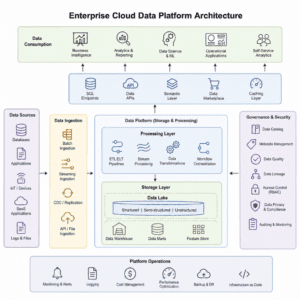
A mature data engineering engagement typically includes several connected capabilities. While every organization has different requirements, most enterprise programs involve the following areas.
Before building pipelines or platforms, organizations need a clear data strategy. This defines how data will be sourced, governed, stored, accessed, secured, and used across the enterprise.
Architecture services may include:
A strong architecture balances flexibility, performance, security, cost, and long-term maintainability.
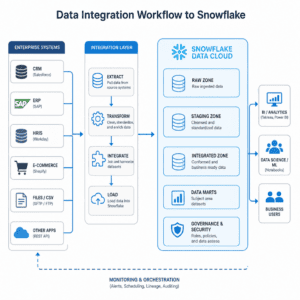
Most enterprises rely on dozens or hundreds of systems. Data integration brings these systems together so information can flow across the business.
Data integration solutions may connect sources such as:
Integration can involve batch processing, event-driven architecture, API-based ingestion, change data capture, or real-time streaming. The right approach depends on latency needs, data volume, source system limitations, and business use cases.
Data pipelines move raw data through ingestion, transformation, validation, enrichment, and delivery. Well-designed pipelines are reliable, observable, secure, and scalable.
Common pipeline capabilities include:
A high-performing pipeline should not be a fragile script that only one developer understands. It should be engineered as a production-grade system.
Data platforms provide the storage and processing foundation for analytics and reporting. Depending on business needs, a company may use a data warehouse, data lake, lakehouse, or a combination of models.
A data warehouse is often used for structured analytics, performance reporting, and executive dashboards. A data lake is useful for storing large volumes of raw, semi-structured, and unstructured data. A lakehouse combines aspects of both, supporting broader analytics and machine learning workloads.
Data engineering service providers help determine which model fits the organization’s goals, data types, user needs, and governance requirements.
Data quality is one of the biggest barriers to analytics adoption. If business users do not trust the data, they will not trust the dashboard, model, or recommendation.
Data quality services may include:
Governance ensures that data is properly classified, documented, secured, and controlled. This includes access management, lineage, metadata, retention policies, and compliance support.
Data engineering is closely connected to data analytics services. Engineering teams prepare trusted datasets that analysts, BI developers, data scientists, and business users can consume.
Analytics enablement may include:
The objective is not just to move data. The objective is to make data usable, understandable, and actionable.
Organizations often consider external data engineering service providers when internal teams are overextended, specialized skills are missing, or transformation timelines are aggressive.
Common triggers include:
The best time to engage a partner is before data complexity becomes a bottleneck. However, experienced providers can also help stabilize, modernize, or recover troubled data programs.
Selecting a partner requires more than reviewing technical certifications or hourly rates. Enterprise data programs need a blend of engineering depth, strategic thinking, governance discipline, communication, and business alignment.
A strong provider should demonstrate experience across data architecture, integration, pipeline development, cloud platforms, orchestration, DevOps, security, and analytics enablement.
Look for evidence of expertise in areas such as:
The provider should be able to explain trade-offs clearly, not just recommend tools.
Technical skill is essential, but enterprise success also requires domain understanding. A provider should be able to connect engineering decisions to business outcomes.
For example:
Choose a partner that can speak the language of both technology and business.
A reliable data engineering company should use a structured but flexible delivery approach. This typically includes discovery, architecture, implementation, testing, deployment, documentation, and ongoing optimization.
Strong providers will clarify:
Avoid providers that jump straight into development without understanding business goals, data consumers, governance needs, and operational constraints.
A solution that works for one department may fail at enterprise scale. The right provider should design for growth, not just immediate delivery.
Ask how they handle:
Maintainability is especially important. A well-built system should be understandable, documented, testable, and supportable by your team over time.
Data engineering touches sensitive business information, customer records, financial data, and intellectual property. Security cannot be an afterthought.
A qualified partner should understand:
They should also be comfortable working with your security, compliance, and legal stakeholders.
Before selecting a provider, ask questions that reveal both capability and fit.
Consider asking:
The best partners will answer with clarity, specificity, and a practical understanding of enterprise realities.
Many data programs underperform because organizations focus on tools before strategy. A new platform alone will not fix unclear ownership, poor data quality, or inconsistent definitions.
Avoid these common mistakes:
Successful data engineering requires a long-term mindset. The goal is to create a foundation that can evolve with the business.
For organizations looking to modernize their data ecosystem, Diacto can serve as a strategic technology partner across the data engineering lifecycle. Rather than approaching data engineering as isolated pipeline development, Diacto focuses on aligning architecture, integration, analytics readiness, and operational reliability with business goals.
Diacto can help enterprises assess fragmented data environments, design scalable platforms, implement reliable data integration solutions, and prepare trusted datasets for reporting, analytics, and AI initiatives. This makes it a relevant partner for organizations that need both technical execution and strategic guidance.
Whether a company is migrating to the cloud, improving data quality, consolidating systems, or enabling advanced data analytics services, Diacto’s consultative approach can help turn complex data challenges into structured, measurable programs.
A strong roadmap helps organizations move from reactive data management to proactive value creation. It should prioritize high-impact use cases while building reusable capabilities.
A practical roadmap may include:
The roadmap should be iterative. Data needs change as the business changes, so the architecture must support continuous improvement.
When data engineering is done well, the benefits extend across the enterprise. Leaders gain faster access to trusted insights. Analysts spend less time cleaning data and more time generating value. IT teams reduce operational firefighting. Data scientists get reliable features for modeling. Business teams can act with greater confidence.
Strong data engineering enables:
Ultimately, data engineering is the backbone of modern digital business. It transforms raw information into a strategic asset.
Choosing the right data engineering company is a critical decision for any organization that depends on data-driven growth. The right provider will not only build pipelines or configure platforms. They will help you create a secure, scalable, governed, and business-aligned data foundation.
As you evaluate data engineering services, focus on technical depth, enterprise experience, governance maturity, communication quality, and the provider’s ability to connect engineering work to measurable business outcomes.
If your organization is ready to modernize its data infrastructure, improve integration, or unlock more value from analytics, consider partnering with Diacto to explore a practical, future-ready approach to enterprise data engineering.